

South Korean documentary film “Sandstorm” reminds me that there are still many things I don’t know much about. Looking around several female athletes quite passionate about their respective professional athletic careers, the documentary attempts to illuminate its rather obscure main subject for more enlightenment for the audiences, and it works to some degree even though it is occasionally hampered by its rather scattershot narrative flow.
At the beginning, the documentary provides some background information. Traditional Korean wrestling, which is called “Ssireum”, was only for male players for many centuries, but female players were eventually allowed into the national league around 1999, and there have actually been a number of notable local competitions for female players in South Korea during last 25 years.
During the first half of the documentary, we are introduced to three young female players one by one: Choi Hee-hwa, Kim Da-hye, and Yang Yoon-seo. Although they respectively belong to different categories (There are four separate categories in their league, by the way), they all want to be the best one in their respective categories, and they all look up to Im Soo-jeong, who has been quite legendary for being an almost invincible national league champion for more than 10 years.
Needless to say, all of these three young female players want to surpass their idol and then become a champion just like many other female players out there. As a matter of fact, they all trained along with Im in the same group, and we get the glimpses of the genuine camaraderie among them and Im, who is certainly proud of having juniors to follow her footsteps even though also being quite determined to hold her champion title as long as she can.

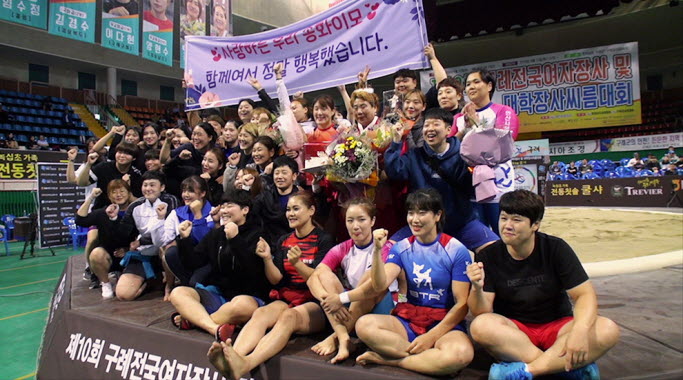
The documentary surely serves us a series of archival footage clips showing the annual local competitions attended by many female players. Although I must point out that these competitions look less popular and crowded compared to the male counterparts, those female players all look quite enthusiastic nonetheless, and they are certainly ready to do their best whenever they come upon the ring for their latest game.
The most interesting part of the documentary comes from the other seasoned female professional player besides Im. Her name is Song Song-hwa, and she gladly talks about how she got interested in Ssireum. She was just a plain housewife at first, but then she became quite passionate about Ssireum even though she was already a bit too old compared to many other female players, and, what do you know, she eventually became one of the most prominent players in the league.
Of course, there inevitably comes a point where Song did not feel strong enough to play against many of her juniors. After having another painful moment of defeat, she came to have a little bittersweet ceremony for her official retirement, and she subsequently moved onto the second chapter of her athletic career. Besides becoming a mentor to her many juniors, she often works as a referee, and she has also been a board member of the national league during last several years.
In case of Im, she thinks she can still go on even after failing to defend her champion title, and the documentary pays more attention to her as she faces a number of serious setbacks. While she surely tries to feel young at heart as playing against many of her juniors, her physical condition is sometimes less ideal than she wishes, and that is quite evident when she has an interview with her doctor at one point later in the documentary.
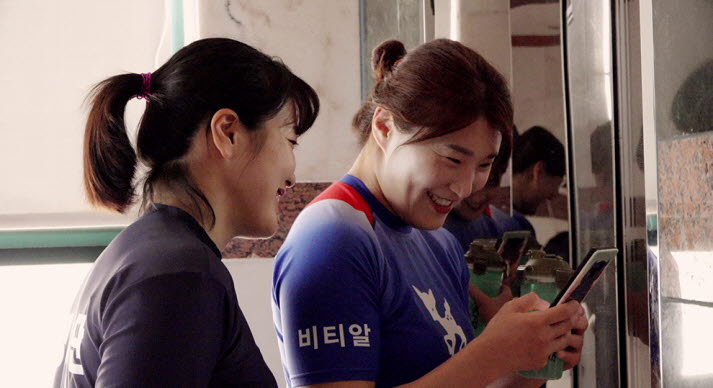
Needless to say, Im becomes concerned about what will be next for her career and life, and she is also often worried about what she and many other female players have struggled to maintain for so many years. Mainly because their competitions usually do not get much public attention compared to their male counterparts, there have not been enough financial supports for them, and their considerable achievement can be faded into the past someday if that troubling trend is not rectified in one way or another.
I wish the documentary would delve more into this serious issue, but it is unfortunately too busy with juggling its several main figures within its rather short running time (79 minutes). I certainly understand that it wants to present all of them as equally as possible, but it only ends up scratching the surface instead of simply letting us get to know any of these interesting ladies more. Furthermore, I also think it could go into more detail on their games, and that could lead to more understanding and appreciation on their efforts and skills.
Director Park Jae-min did a fairly competent job on the whole with care and respect, but “Sandstorm” could be improved more for being a better presentation of its intriguing main subject. Although it is not satisfying enough for recommendation, you may get interested in watching it if you do not know anything about its main subject, and you will probably also want more information in addition to being reminded again that, as many people often say these days, girls can indeed do anything.


 Seongyong's Private Place