

Animation feature film “Flow”, which was selected as the official submission of Latvia for Best International Film Oscar in this year, is a simple but enchanting fantasy tale which alternatively baffles and dazzles us. Without any dialogue at all, the film just presents a series of gorgeous visual moments as following the little adventure of one small cat and its several animals which happen to accompany that cat, and it is surely another excellent case of how original an animation film can be via ideas and images.
In the beginning, the film succinctly establishes its fantasy background. After we are introduced to a little black cat, we get the first action scene in the film as the cat is running away from a bunch of dogs after taking away a fish they have just caught, and then there comes a stunning scene featuring a herd of deer running away from a sudden big wave of water coming into the forest.
The cat manages to save itself, and then it comes across an abandoned big house filled with numerous stuffs left by whoever once lived there a long time ago. It seems that the world has been devoid of human beings for years, and we often see a number of small and big animal sculptures in and around the house. The cat surely shows some curiosity just like any cat would, and then it comes to make the attic of the house as its little comfortable shelter.

However, the water keeps rising (Is this an allegorical reflection of the global climate disruption in our world?), and the cat has no choice but to leave the house as looking for a higher spot. In the end, it comes across a boat with a capybara on board, and these two animals also come to rescue a lemur and then one of those dogs chasing after the cat at the beginning of the film. Needless to say, these four animals do not get along well with each other on the boat, and we accordingly get several little humorous moments from that.
The film simply observes how its animal characters come to make a sort of communication among them mainly via their sounds and physical movements, and it trusts us enough to let us gather the developing relationship drama among them. As a matter of fact, director/co-producer/co-writer/co-producer Glints Zilbalodis and his crew members actually recorded and then used the sounds of several real animals, and that certainly brings some authenticity to the animal characters in the film (A small trivia: they could not get the right sounds in case of the capybara, so they instead recorded the sounds from a baby camel).
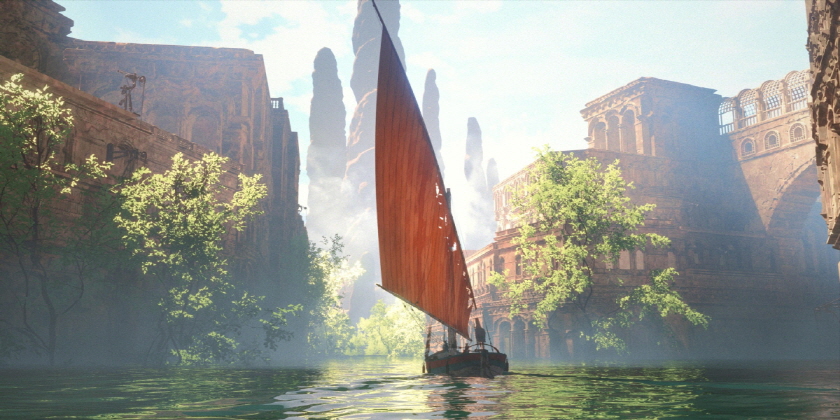
The story gets a little more interesting when the cat and its animal companions later encounter a bunch of big secretary bird. After one of these big birds happens to join the cat and its animal companions, they eventually reach to a huge but empty city partially immersed in water, and the film naturally gives us several moments of awe and wonder as its animal characters regard here and there in the city. Wondering what they exactly feel and think about the city as their boat keeps sailing as before, I was again reminded of what W.G. Sebald once said: “Men and animals regard each other across a gulf of mutual incomprehension.”
And the movie continues to enchant and baffle us more as its animal characters’ journey on the water is taking them to somewhere on the horizon. Although it is often evident that the production budget of the film is rather small, Zilbalodis and his crew did a splendid job of filling the screen with enough style and details to cherish, and the overall result is impressive enough to hold our attention even though we are often confounded about what the film is actually about. While Zilbalodis and his crew entirely depended on an open-source software named Blender, nothing looks cheap or shabby in their simple but striking animation, and the cat and several other animals in the film are presented as vivid characters to remember despite their rather broad appearance.

In my humble opinion, the film is a plain but haunting fable of friendship and solidarity which touchingly reminds us that we cannot live totally alone by ourselves. Sure, our feline character prefers to be alone as much as possible, but then it only ends up getting more associated with its accidental animal companions along the story, and there is some genuine poignancy around the end of its adventure story (You should stay during the following end credits for a brief but crucial post-credit scene, by the way).
The film is surely a big leap from Zilbalodis’ previous animation feature film “Away” (2019), where he did almost everything in its production and post-production stage. That animation film is extremely simple in terms of story and characters while having no dialogue at all just like “Flow”, but it is also fairly engaging mainly thanks to Zilbalodis’s competent handling of mood, style, and detail, and it will show you that he already developed his own animation touches even at that point.
In conclusion, “Flow” is one of the best animation films of this year, and it confirms to us that Zilbalodis is a talented animation film director to watch. While it surely requires some patience at the beginning, it is quite a rich visual experience to behold and admire, and it is definitely more rewarding than, say, “Moana 2” (2024). Believe me, “Flow” will provide a more satisfying sailing adventure in terms of story and character, and that will be appreciated by both young and adult audiences.


 Seongyong's Private Place
Pingback: 10 movies of 2024– and more: Part 2 | Seongyong's Private Place
Pingback: My Prediction on the 97th Academy Awards | Seongyong's Private Place