
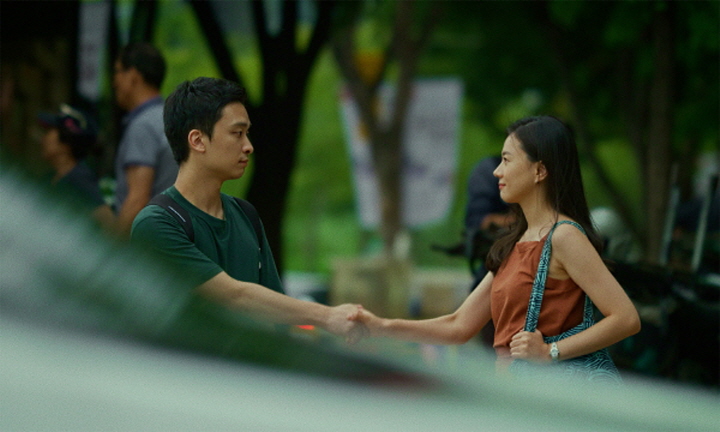
South Korean independent film “Mimang” presents the three different meanings of its title via the three acts loosely connected together. Although I am not sure about whether it works as well as intended by its filmmaker, it is engaging to some degree whenever it subtly illustrates the emotional undercurrents between its main characters, and I wish the movie went further with that for bringing more dept and substance to the story and characters.
The first act, which explains the first meaning of the title (迷妄: “Being unable to make sense from ignorance”), begins with the accidental encounter between two unnamed figures in a neighborhood area located in the middle of Seoul. When “Man” (Ha Seong-guk) is searching for a location where he is going to meet his girlfriend, he is approached by “Woman” (Lee Myung-ha), who is incidentally an old friend of his. Both of them are glad to meet each other again after some time, and they decide to take a walk together for a while as he helps her a bit on going to a local arthouse movie theater.
While they continue to talk with each other, we get to know a bit about both of them. He has recently studied drawing for his civil engineering job, and she is going to attend the screening of a partially lost old South Korean film as the main organizer of the event. Both of them have been fairly fine with how their respective lives have been going during last several months, but it gradually becomes apparent to us that there are still some old feelings between them, though they do not admit that directly to each other.

After they eventually part ways, the movie enters its second act as explaining the second meaning of its title (未忘: “Being unable to forget what one wants to forget”). “Woman” successfully handles the following screening in the evening, and then she is approached by one of the male employees working in that arthouse theater shortly after she has an after-screening drinking party along with others. Again, she gets lost on her way, and the guy is willing to accompany and help her finding her way to where she can get on bus or subway.
While they walk and talk together, the movie slowly suggests the possibility of romance between them. It is apparent that the guy feels attracted to her, but she sticks to her reserved attitude even while they lightly push and pull each other during their ongoing conversation. At one point in the middle of the conversation, she says that she actually has a kid from some previous relationship of hers, but, mainly because of the rather playful mood between her and the guy, we cannot be totally sure about whether she is lying or not.
The second act of the movie moves along with these two characters in the same neighborhood area shown in its first act, and several recurring elements make the second act a bit amusing for us from time to time. For example, they talk a bit about a certain nearby big stature of one famous historical figure just like “Woman” and “Man” did in the first act, and the movie even does some visual repetition during several key shots.
During the third act which gives us the third meaning of the title (彌望: “Searching for far and Wide”), the mood becomes more serious as it begins with the funeral of a friend of “Man” and “Woman”, who subsequently spend some time with another friend of theirs who gladly drives them back to the same neighborhood area of Seoul by his taxi. As “Man” gets rather sleepy on the passenger’s seat, his friend comes to have a long conversation with “Woman”, and the camera steadily focuses on these three characters as the conversation becomes a bit more tense than expected.

In the end, these three characters arrive in that neighborhood area of Seoul, and “Man” and “Woman” go to a small local bar where they wait for their friend to join them later. As they talk with the bar owner, the mood becomes a bit more relaxed, and then there comes a little impromptu musical moment as “Man” performs a song in front of the others.
The melancholic mood of the third act does not fit that well with the lightweight atmosphere of the first two acts, and that is where my attention dwindled to some degree, though I still appreciate the effortlessly natural performances from several performers in the film, who did a good job of filling their rather thin characters with enough life and presence. As the elusive emotional center of the film, Lee Myung-ha carries well the film to the end, and she is particularly wonderful when her character shows more feelings during the last scene of the second act. In case of her co-stars, Ha Seong-guk, who has frequently appeared in Hong Sang-soo’s several recent works including “A Traveler’s Needs” (2024), Baek Seung-jin, Park Bong-joon are effective as the counterparts to Lee’s acting, and they all steadily support Lee during their demanding extended scenes in the film.
Frequently reminiscent of many other films ranging from Richard Linklater’s Before Trilogy to Celine Song’s “Past Lives” (2023), “Mimang” does not distinguish enough in terms of story and characters, but it has some vivid urban mood and solid performances thanks to the competent direction of director/writer Kim Tae-yang, who incidentally made a feature film debut here this film. I am still not satisfied enough for recommendation, but the movie shows some potential of its director, and I sincerely hope that he will soon move onto better things to come in the future.


 Seongyong's Private Place