

Steve McQueen’s documentary film “Occupied City” is an ambitious piece of work alternatively interesting and demanding. For more than 4 hours, the documentary simply shows and tells the old past of a heap of different spots in Amsterdam of the Netherlands, and this will surely demand some patience from you, but its big historical picture slowly emerges as the past of the city sometimes makes some contrast and resonance with its present.
The documentary is based on “Atlas of an Occupied City, Amsterdam 1940-1945” by McQueen’s wife Bianca Stigter, who incidentally participated in the production of the documentary along with McQueen. According to McQueen, he and his crew shot more than 30 hours of footage here and there in Amsterdam during the early 2020s, and they actually covered every spot mentioned in Stigter’s book during their shooting.
Without any archival footage clip or photograph, McQueen and his cinematographer Lennert Hillege just observe these numerous spots from their mostly static viewpoint. At the beginning, the documentary shows the inside of a building which once belonged to a Jewish publisher before World War II, and the narrator phlegmatically informs us on his and his family’s tragic story associated with the Holocaust – and how one of his Dutch associates helped several Jewish people hide from those Nazi German soldiers and police officers.

This will surely remind you of Anne Frank and her family members, and the documentary shows us that there were many other desperate Jewish people in the city when Nazi Germany invaded the Netherlands in 1940. Because the Dutch government stayed neutral just like it did during World War I, many German Jewish people moved to the Netherlands for safety, and they were certainly shocked and terrified when their biggest fear came true. As a matter of fact, many incidents of suicide happened shortly after the invasion and the subsequent surrender of the Dutch Army, and there is a particularly heartbreaking case where one big Jewish family killed themselves via gas asphyxiation, which was incidentally a common method in many other similar suicide cases during that dark time.
After taking over Amsterdam, the Nazi German Army and police quickly embarked on isolating and then cornering thousands of Jewish people in the city by any means necessary. Besides forcing them to wear that infamous yellow star on their clothes, the Nazi German Army and police put many different social limits on them, and that included prohibiting Jewish people from entering numerous public spaces including theaters and restaurants except the ones in several Jewish neighborhood areas in the city.
The Nazi German Army and police also put a considerable amount of limits upon others in the city, and the documentary sometimes juxtaposes this historical fact with how things got bad in the city during the COVID-19 Pandemic during the early 2020s. For stopping more infections, the Dutch government came to consider several hard measures including night curfew, and many people in Amsterdam were not so pleased as shown from several signs of protests on the streets and alleys of the city. At one point in the middle of the documentary, a drone camera smoothly moves around the empty streets and places of the city, and the narrator tells us a bit about how harshly the curfew was imposed on the city and its people during World War II.
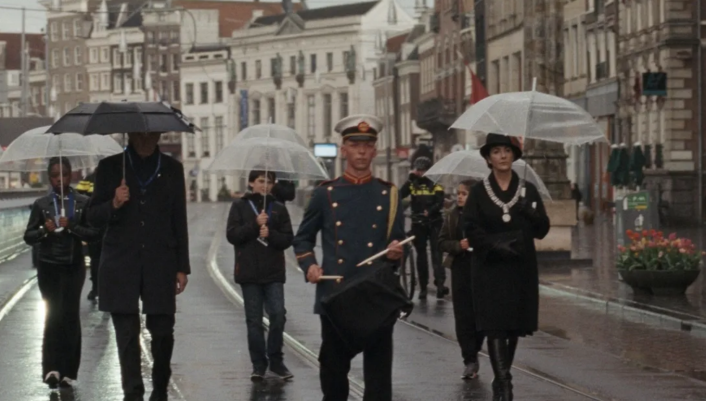
Sticking to its calmly objective attitude, the documentary continues to present and explain one spot after another, and we get more informed about how the situation was quite bad for the city and its people especially around the end of World War II. As the defeat of Nazi Germany became more apparent day by day, the oppression on the city and its people became more severe, and many local people hiding from Nazi Germany surely became more desperate than ever. While there were brave good people willingly risking their lives for saving and helping others, and there were opportunistic bad people gladly betraying others for their benefit and safety, and the documentary often shows where they once lived during the war – and what happened to them during or after the war.
Now Amsterdam surely looks quite different from how it was during the 1940s, and the past does not seem to hover over those numerous spots shown in the documentary, but we also see how the city and its people keep trying for not forgetting that dark past. The documentary looks at several monuments associated with the Holocaust, and there is a quiet but undeniably haunting moment when the camera slowly looks over the names of thousands of Jewish people who went through one of the main deportation centers in the city before eventually being sent to a number of different concentration camps and killing centers in Germany and Poland. Needless to say, most of these people were not lucky at all, and we get chilled when the documentary tells us how many Jewish people in Amsterdam actually died during the war.
On the whole, “Occupied City” is a little too dry and glacial for holding your attention for more than 4 hours, but you may come to admire the respectable efforts of McQueen and his crew members, while observing how it eventually arrives at the finale where it shows a little sign of optimism and progress. Sure, it frequently feels like going through a very, very, very long tour around Amsterdam with the constant presence of a docent to explain one thing after another, but I assure you that you will come to learn of many other interesting things about Amsterdam during World War II besides Anne Frank.


 Seongyong's Private Place