
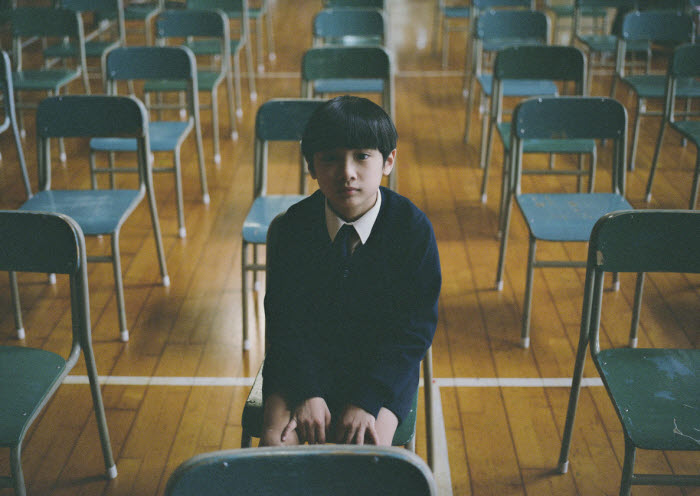
Hong Kong film “Time Still Turns the Page” is a sad, harrowing character drama which mainly follows the story of a young boy under lots of emotional pressure and torment. He simply wanted to be loved and recognized, but there was no one to support or stand by him even in his family, and it is really devastating to see how he was driven to more despair and sadness just because of being rather incompetent in his school study.
After the opening scene which may make you gasp briefly for a good reason, we are introduced to Mr. Cheng (Siuyea Lo), a secondary school teacher who happens to have one tricky matter in his classroom on one day. A school janitor recently found a piece of writing which seems to be written by someone quite depressed and pressured, and Mr. Cheng becomes naturally quite concerned as trying to get any clue on whoever wrote that, though not many of his students are willing to tell anything to him.
Mr. Cheng’s search for that very unhappy (and possibly suicidal) student in question is intercut with the story of a young boy named Yau-kit (Sean Wong). He and his younger brother Yau-chun (Curtis Ho) have grown up in a strict and harsh household dominated by their abusive lawyer father who has constantly pressured them in one way or another, and Yau-kit is frequently abused by his father mainly because, unlike his younger brother, he is not particularly good at many things including his school study despite his efforts. While his younger brother does not provide much emotional support as being busy with his own school study, their mother, who is also often abused by her husband, does not give him much consolation or comfort either, and this makes Yau-kit feel all the more miserable.

As struggling to get improved in his school study, Yau-kit begins to write a little private diary for himself, and we are not so surprised when that little diary of his appears later in Mr. Cheng’s story. Reading that aching chronicle of childhood pain and trauma, Mr. Cheng becomes more determined to help whoever wrote that troubling piece of writing at his school, though he also has his own personal problems to deal with. While he has been quite estranged from his dying father for years, he recently got divorced due to his serious failure to connect emotionally with his ex-wife, and he is not so sure about whether he can actually make his ex-wife change her mind about their deteriorated relationship.
Many of you may easily guess how these two main narratives come to overlap and resonate more with each other, but the screenplay by director/writer/co-editor Nick Cheuk takes time for more story and character development. There is a subplot involved with one of Mr. Cheng’s students who may tell him something important, and it is quietly touching to observe how tactfully and generously he and a fellow teacher of his handle this student’s emotional issues later. When Yau-kit and his younger brother come to have a little moment of fun together, the mood is brightened up a bit, and that moment becomes more poignant later in the story.
The movie also does not overlook at all how many of the children of the Asian family are constantly pressured a lot for their academic excellence, and I must confess that some of the most painful moments in the film came a little too close to me during my viewing. Although I was mostly good at getting high grades during my childhood days, I was still often pressured by my parents for better results, and that was the main reason why I became quite obsessed with getting better scores even during my young adult period without having many chances to think for myself. Even at present, I am very nervous and fastidious about giving the right answer to every question or task thrown at me, and I still find myself getting frozen and then feel quite humiliated if I cannot think of any answer good enough to me or others.

The last act of the story becomes very melodramatic as we come to see more of how much Mr. Cheng is haunted by the memories of the past, but the movie sticks to its phlegmatic attitude as going deeper into the human pain and sorrow at the center of its story. As a matter of fact, it even shows a bit of compassion to Yau-kit’s father, who is now mired in a lot of guilt and regret over how thoroughly he ruined his family during that time.
The main cast members are solid in their respective parts. While Siuyea Lo dutifully holds the ground, two young performers Sean Wong and Curtis Ho are believable in their unadorned natural performance, and Wong is utterly heartbreaking when Yau-kit receives another cruel emotional abuse from his father later in the story. In case of several other cast members, Ronald Cheng and Rosa Maria Velasco are well-cast as Yau-kit’s problematic parents, and Hanna Chan and Sabirna Ng hold each own small place well as the two substantial supporting characters in the story.
Overall, “Time Still Turns the Page”, which is incidentally Cheuk’s first feature film, handles its painful human drama with enough care and sensitivity, and it will remind you again of how important it is for anyone to have someone to provide emotional support and consolation. Due to my own personal experiences, I know well the value of reaching out and then saying that “You are not alone”, and I hope that the movie will do the same thing to many troubled kids out there.


 Seongyong's Private Place