
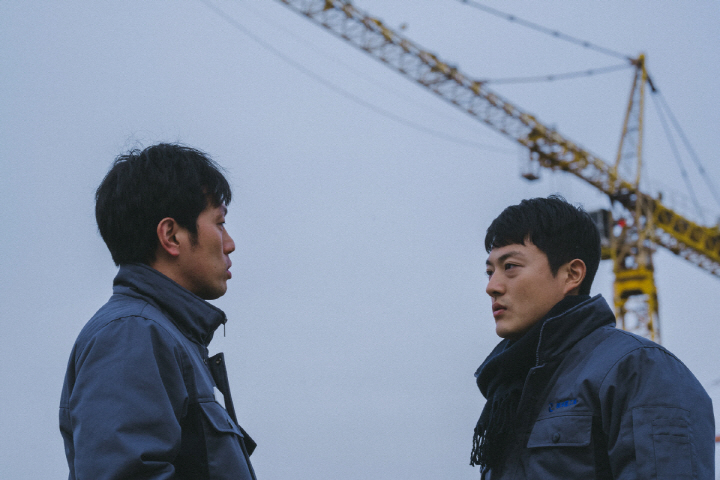
South Korean independent film “Work to Do” is about the moral dilemma of a young man tasked with one unenviable job to do. Phlegmatically observing how he and his colleagues do their rather unpleasant job step by step, the movie vividly and realistically depicts a certain very complicated circumstance for them and many others in their company, and its emerging big picture is certainly not pretty at all.
The movie, which is incidentally set around late 2016, opens with a little night drinking party to celebrate the recent employment of a lad named Kang Joon-hee (Jang Sung-bum). He has just got employed at some big shipbuilding company, and we soon see him hurriedly beginning his first day at the human resource department of that company. Although he understandably looks a bit awkward as being introduced to others at the department, he is certainly eager to do his best, and he soon gets more accustomed to his new work environment as showing more efficiency as required.
However, things have recently been not so good for the company and its numerous employees. Due to some serious financial problem, the company is demanded to lay off at least 150 employees, and Joon-hee and others at the human resource department are soon instructed to work on the upcoming process for sorting out a bunch of possible employees to be laid off. Once Joon-hee quickly sets a seemingly fair standard for this process, he and the other department members promptly make the list based on that, and all they will have to do next is making the following process as smoothly and painlessly as possible.

Needless to say, the representatives of the labor union of the company are not so pleased about this impending layoff. While Joon-hee’s direct supervisor manages to convince them that the layoff is the only survival option for the company as well as the employees, many employees in the company are naturally quite nervous about getting laid off at any point, and this inevitably leads to some serious conflicts inside the company.
Meanwhile, Joon-hee gradually finds himself getting more conflicted as watching how his and his colleagues’ ongoing task affects many others in the company in one way or another – especially after coming to realize that how willing the company is to fire many employees as swiftly and conveniently as possible. At one point later in the story, he must make a hard choice between the two employees particularly close to him, and he feels guiltier as painfully reminded again and again that there is really nothing he can do about the ongoing layoff process except doing whatever he is instructed to do. Although he does not say anything about this to his girlfriend yet, it does not take much time for her to notice that something is bothering him day by day, and their relationship becomes more strained as he still does not talk at all to her frustration.
Without particularly vilifying anyone in the story, the movie adds more realism and human complexity to the story. In case of Joon-hee’s direct supervisor, he remains mostly unflappable as ruthlessly handling the ongoing layoff process, but then there eventually comes a point where he runs out of his patience with the company. While they all are certainly quite disillusioned just like Joon-hee, most of Joon-hee’s colleagues are also concerned a lot about whether they will be included in the layoff list in the end, and they have no choice but to lay themselves as low as possible.
In case of several figures at the top of the company, they are not entirely bad people, and they simply follow whatever is necessary for the survival of the company in their viewpoint. Nevertheless, the movie also reminds us that these people are not exactly as desperate as their employees. For many of the employees in the company, strike and protest look more like a possible alternative as they get cornered more and more, and that certainly brings another headache to the company.
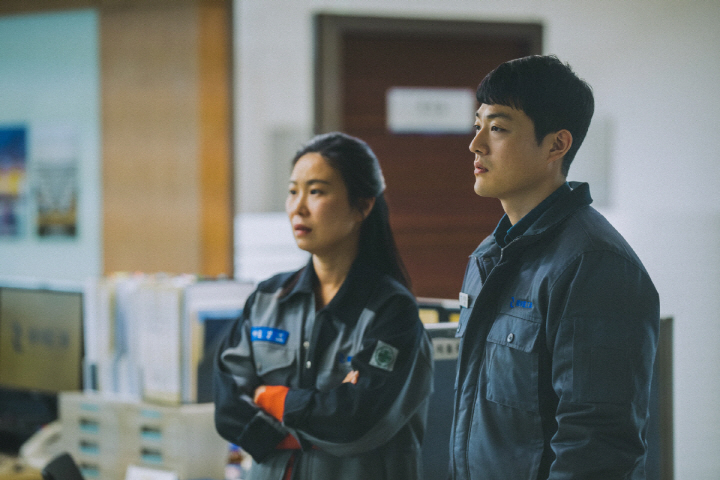
It helps that the main cast members of the film are believable human figures in their mundane appearances. As the center of the film, Jang Sung-bum is solid as subtly conveying to us his character’s growing inner conflict along the story, and he is especially terrific as Joon-hee silently conforms to his direct supervisor’s certain decision on the layoff process even though both of them know too well how wrong that is.
Jang is also supported well by a bunch of good performers, who all give well-rounded performances to be appreciated. Seo Suk-kyu, Kim Do-young, and Kim Young-woong are effectively cast in their respective supporting parts, and they bring each own human nuance to be observed. In case of Jang Liu, who incidentally plays the sole female employee in the human resource department, she has a brief but impressive moment when her character shows some little optimism despite her uncertain situation.
In conclusion, “Work to Do” is a modest but undeniably compelling piece of work to admire, and director/writer Park Hong-jun makes a commendable feature film debut here in this film. The overall result shows that he is a talented filmmaker who knows how to engage us via good story and character, and it will be interesting to see what may come next from him after this considerable achievement of his.


 Seongyong's Private Place
Pingback: 10 movies of 2024– and more: Part 3 | Seongyong's Private Place