
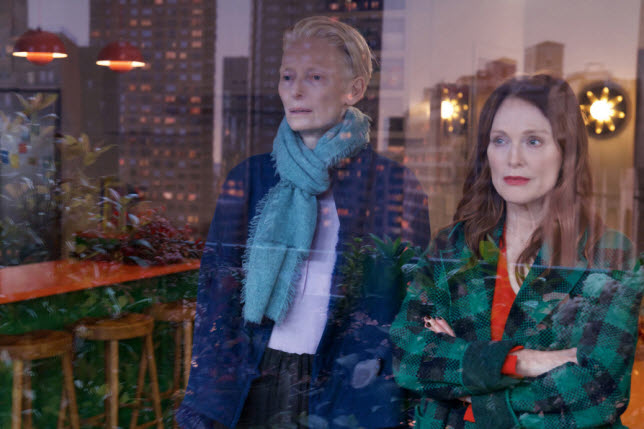
Pedro Almodóvar’s first English-language feature film “The Room Next Door”, which recently won the Golden Lion award at the Venice International Film Festival, is somber but elegantly compelling to work to be cherished. While it is an inherently elegiac melodrama about death and friendship, the movie is also as witty and colorful as you can expect from the director, and it is also carried well by two of the best movie actresses of our time.
At the beginning, we meet Ingrid (Julianne Moore), a successful middle-aged female novelist who has just published her latest novel. Not long after she is back in New York City, she encounters an old friend of hers when she is signing her books at a local bookstore, and she comes to learn that a mutual friend of theirs, Martha (Tilda Swinton) has been seriously ill due to cancer. Although she and Martha have been out of touch with each other for many years, Ingrid comes to a medical center where Martha has received some experimental medical treatment, and both of them are delighted to see each other again after many years.
While they come to spend more time with each other, we get to know a bit about their friendship and Martha’s private and professional life. Martha is a well-known war correspondent, and she was on the top of her field just like her friend before she got very ill, but she has some regret about not being a very good mother to her estranged daughter from the beginning due to her busy work around the world. Her daughter remains distant to her even after learning about her illness, but Martha accepts that without much bitterness nonetheless.
Sincerely hoping for the best for her friend, Ingrid is willing to spend more time with Martha for more emotional support, but things soon get really bad for Martha when it turns out that she does not have much time to live because her cancer turns out to be a lot more malignant than expected. While she is surely recommended to go through more medical treatment, she decides to live a bit more peacefully and painlessly before her eventual death, and she eventually returns to her cozy apartment, whose interior design is as slick and colorful as you can expect from an Almodóvar movie.

And then Martha asks a big favor of Ingrid. She is going to commit a suicide sooner or later, and she simply wants her friend to be around her for a while before her planned death. Needless to say, Ingrid instantly gets disturbed and conflicted about her friend’s suicide plan, but she eventually agrees to accompany her friend as much as possible until Martha decides to kill herself.
We subsequently see Ingrid and Marth embarking on what will be the last few days of their long-term friendship. They go to a slick and comfortable modern house located outside the city, and, as instructed to her in advance, Ingrid stays in a bedroom not so far from the one occupied by Martha, who will leave a certain sign for her friend before she really kills herself as planned.
For not getting her friend into any trouble in the aftermath, Martha thoroughly planned her suicide, but her planning turns out to be not wholly perfect, and Ingrid comes to have more doubt and conflict about their circumstance. Although she still cares a lot about her friend, she is not so certain about whether she can really stay next to her friend to the end, and that leads to more strain on their relationship.
Almodóvar’s screenplay, which is based on Sigrid Nunez’s acclaimed novel “What Are You Going Through”, steadily maintains its calm attitude as subtly building up the emotional narrative beneath the surface. When its two heroines watch together John Huston’s last film “The Dead” (1987), which is incidentally based on the short story of the same name by James Joyce, this key moment initially seems to emphasize the main subject of the story a bit too blatantly, but it is handled with enough care and sensitivity to engage and then touch us, and the movie later delivers something as sublimely poetic as the haunting last scene of Huston’s movie.

Almodóvar shows here that his storytelling talent is not inhibited by language boundary at all, and he and his crew members including cinematographer Ed Grau did a fabulous job of imbuing the screen with a palpable sense of sadness and melancholy. Often driven by the nervous string performance a la Bernard Herrmann, the score by Almodóvar’s longtime collaborator Alberto Iglesias effectively complements what is so dexterously presented on the score, and I will not be surprised if the score gets Oscar-nominated like his score for Almodóvar’s previous film “Parallel Mothers” (2021).
Above all, Almodóvar draws the terrific performances from his two lead actresses, both of whom are dependable as usual. Often shining with her own uncannily ethereal quality, Tilda Swinton ably embodies her character’s tranquilly melancholic acceptance of death, and Julianne Moore is equally excellent in her masterful illustration of her character’s emotional conflict along the story. Around these two great actresses, John Turturro and Alessandro Nivola provide small but effective supporting performances, and Turturro steals every minute of his in the film as providing some sense of humor to the story.
Overall, “The Room Next Door” is another superlative work from Almodóvar, who has rarely bored me and other audiences with his own distinctive style and storytelling during last several decades. In short, this is one of the more interesting movies of this year, and it is certainly much more recommendable than “Venom: The Last Dance” (2024), which happens to be released in South Korean theaters in the same week. While that forgettable flick is a waste of time, “The Room Next Door” is something you must watch at movie theater in my humble opinion, and you may later thank me for my enthusiastic recommendation.


 Seongyong's Private Place
Pingback: 10 movies of 2024– and more: Part 2 | Seongyong's Private Place