
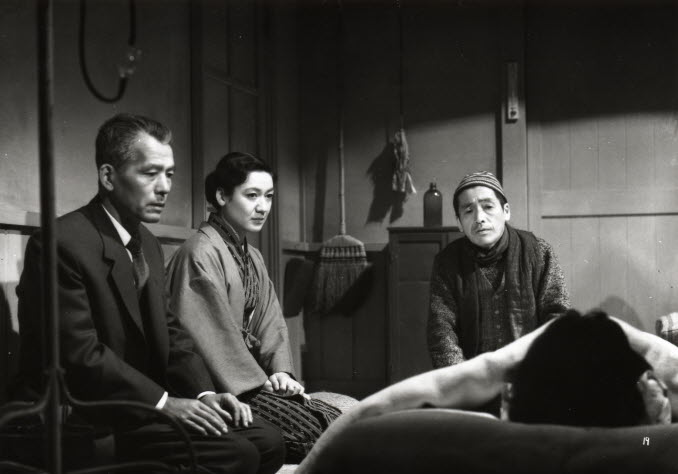
Yasujirō Ozu’s final black and white film “Tokyo Twilight” is quite bleak compared to many of his gentler movies. Yes, as I observed in my recent review on “Tokyo Story” (1953), there is always a subtle sense of sadness and melancholy under the surface in Ozu’s films, but “Tokyo Twilight” is willing to go much further with darker family drama materials, and it even approaches to the grimly harrowing territory of the works of Ozu’s fellow Japanese filmmaker Kenji Mizoguchi at times.
At the beginning, the movie slowly establishes several family characters at the center of the story. We meet a middle-aged senior bank employee named Shukichi Sugiyama (Chishū Ryū), and then we are introduced to his two adult daughters Takako (Setsuko Hara) and Akiko (Ineko Arima). Although she married a professor some time ago, Takako recently moved back to her family house along with her infant daughter, and it seems that she is not going back to her husband at least for now. In case of Akiko, both her father and his sister have wanted her to marry some nice lad someday, but she does not look so interested in marriage, and we later see her looking for someone here and there in a nearby area filled with bars and gambling sites.
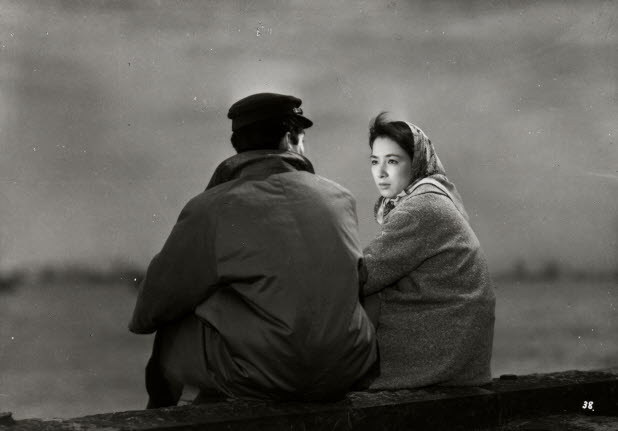
We gradually gather that Akiko has been looking for her boyfriend due to a very serious matter, and we are not so surprised by how callously he responds to her when she finally meets him and then reveals to him that, yes, she is pregnant. With no one to discuss with on this serious matter of hers, Akiko becomes quite desperate, and the only consolation for her is that she can quickly take care of her problem with some money behind her back, though this does not make her feel any better about her current plight.
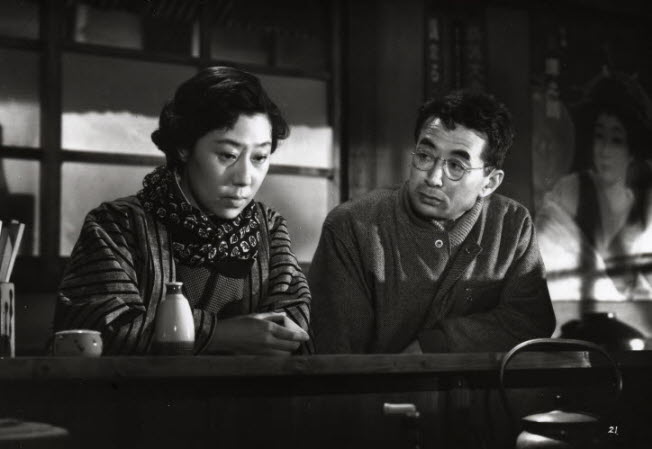
Of course, both Takako and Shukichi begin to sense that there is something odd about Akiko, but they only get more baffled as Akiko keeps quiet about her problem, and then there comes another big family matter to deal with. When Akiko drops by a local mahjong parlor, she comes across a middle-aged woman who works there, and, what do you know, this woman turns out to be her mother, who left the family with some other guy a long time ago. Although both Akiko and Akiko’s mother do not realize at first, Takako later comes to learn about her mother’s current status, and that naturally leads to a melodramatic moment between her and her mother.
As usual, Ozu slowly rolls the story and characters under his calm and reflective direction, but the mood feels much starker here compared to many of his other films such as “Tokyo Story” (1953). Again, every shot in the movie is carefully composed in the screen ratio of 1.33:1 ratio, but Ozu and his cinematographer Yuuharu Atsuta deliberately fill the screen with barren darkness in most of the nocturnal scenes in the film, and this visual strategy further accentuates the despair and loneliness felt by the main characters. As a matter of fact, there are even a number of striking visual moments instantly evoking the moody and pessimistic qualities of noir films, and you can clearly discern that Ozu is really trying to do something much darker here in this film.
Meanwhile, the story gets gloomier as its main characters become more distant to each other with more failure to communicate. At one point in the middle of the film, Shukichi attempts to make his younger daughter talk more about whatever she is struggling with, but he only ends up being too stern and angry to Akiko. Takako also tries to talk more with Akiko as her younger sister, but they only become more distant to each other, and the situation between them gets worse when Akiko comes to learn about what her older sister tries to hide from her.

Even when the story eventually reaches to the finale, Ozu does not soften anything in the movie, and the following ending is quite bitter to say the least. In “Tokyo Story”, we are often saddened by how an aging couple become more distant to their children, but there are also some poignant moments of family love which console not only us but also the aging couple. In case of “Tokyo Twilight”, we are devastated by how Shukichi and his family members are shattered up to the point of no return in the end, and we cannot help but observe how his house feels much barren than before – and how his life may be filled with more loneliness and emptiness during the rest of his life.
Like “Tokyo Story”, “Tokyo Twilight” is packed with Ozu’s frequent performers, and it is interesting to watch how several performers from the former feel quite different in the latter. While Chishū Ryū did a flawless job of embodying his patriarch character as he did many times for Ozu, Ineko Arima and Sestuko Hara are heartbreaking in their characters’ respective dramatic arcs along the story, and several other familiar cast members including Isuzu Yamada, Haruko Sugimura, and Nobuo Nakamura are also excellent in their substantial supporting roles.
Overall, “Tokyo Twilight” is a relatively tough stuff which surely stands out as being sandwiched between “Early Spring” (1956) and “Equinox Flower” (1958) in Ozu’s remarkably consistent filmmaking career. I may not love it as much as “Tokyo Story” or “Floating Weeds” (1959), but I admire it as another Ozu film which needs more attention in my inconsequential opinion, and you should certainly check it out as soon as possible if you have admired Ozu’s films as much I and many others have.


 Seongyong's Private Place