

South Korean independent film “Paper Man” works best when it humorously focuses on its pathetically desperate hero’s efforts for restarting his life. While we are sometimes amused by his comic struggles along the story, we come to care about this rather unlikable dude and a few people around him, and it is sad and harrowing to watch when they get another harsh dose of their grim reality later in the story.
The opening part of the movie quickly establishes how things get much worse for In-mok (Kwak Jin). There was a time when he was a promising young wrestling player who won a gold medal at some major international competition as shown from an old photograph of his, but his life has been going down and down since that brief moment of glory, and now he finds himself evicted from his current residence for failing to pay the rent for some time. Because he is almost penniless without anyone to help him, he considers becoming a Buddhist monk, but that turns out to require a lot of things besides enough qualification, and that makes his situation all the more desperate than before.
In the end, In-mok has no choice but to stay under a shabby bridge at least for a while, and there comes one seemingly nice idea via an unexpected encounter. It turns out that an old man has already been living under the bridge, and this old man has a pretty simple lifestyle. He just lives on a portable mat made from cardboard boxes, and he has earned his meager living day by day as collecting used cardboard boxes here and there in a nearby neighborhood.
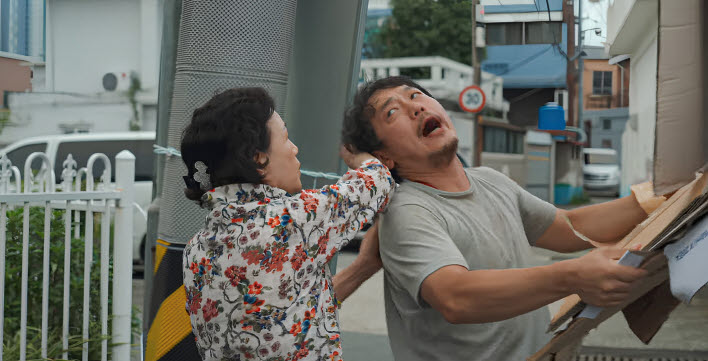
This looks pretty easy to a younger man like In-mok, but, of course, it turns out to be more challenging than expected. First, he has to spot used cardboard boxes as quickly as possible, and he also has to compete with several other old collectors in the neighborhood besides the old man. Fortunately, things get a bit easier for him once he happens to acquire a handcart, and he also recruits a mentally disabled man in the neighborhood as his helper, who gladly helps In-mok in exchange for the steady supply of his favorite snack.
As In-mok gets more accustomed to his new job and lifestyle, we see how things get better for him bit by bit. He constructs his own little private space with several used cardboard boxes, and he also finds some clever ways to improve his little business more. In addition, he also gets a little friendly with a woman who runs a local junk shop alone by for herself, and it seems that he may get closer to this lady if they continue their mutually beneficial business relationship.
However, In-mok is eventually reminded again of the harsh reality surrounding him after this brief period of hope and happiness for him. Just like those old competitors pushed away by him, he also gets pushed away by a bunch of younger people ready to earn money by any means necessary. In addition, selling used cardboard boxes soon becomes less profitable than before, and that certainly frustrates him a lot.
Furthermore, there is a young adolescent girl who comes to stay around him longer than expected. She is one of those many young boys and girls who have been cruelly exploited in one way or another, and her boss, who was incidentally one of In-mok’s junior athletes, is quite determined to make her pay for her temporary absence.
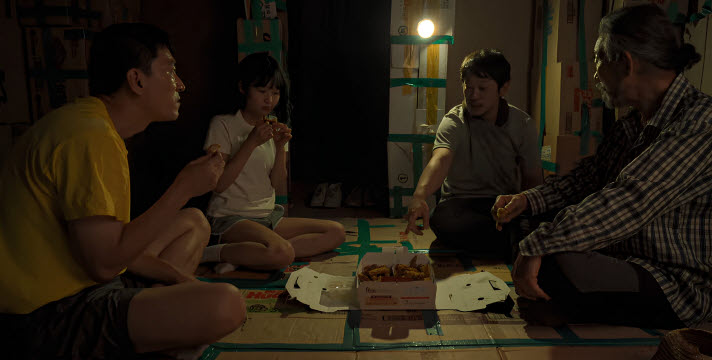
Around the point where In-mok belatedly comes to learn about the girl’s secret, the movie naturally becomes much darker with more despair and frustration, but the screenplay by director/writer Ki Mo-tae, who makes a feature film debut here, stumbles more than once during its contrived last act. For example, the scene between In-mok and a certain figure from his past feels too artificial to be as cathartic as intended, and the movie also resolves In-mok’s anger and despair too conveniently without much dramatic impact.
Nevertheless, the movie is supported well by the commendable lead performance from Kwak Jin. Although we do not get to know a lot about how much In-mok has struggled for years, Kwak embodies well what has been accumulated behind his character’s gruff appearance, and he also did a good job of balancing his character between humor and pathos without making any cheap excuse on his character’s more abrasive sides.
Several other main cast members of the movie also leave some impression as dutifully filling their respective spots around Kwak. While Kang Han-na brings enough sense of life and spirit to her supporting role, Jang Hyun-jun is gradually endearing as revealing more heart and soul behind his mentally disabled character, and Kang Dae-wook steals the show even when his character simply occupies his own place as usual.
Overall, “Paper Man” is alternatively bitter and humorous as realistically looking into the economic hardships of its hero and several main characters, and I enjoyed its story and characters enough to overlook its several weak aspects including its dissatisfying finale. Although his overall result is not totally successful, Ki shows considerable potential at least as another new talent to watch, and it will be interesting to see whatever may come next after this promising beginning for his filmmaking career.


 Seongyong's Private Place