

I could not help but get distracted more than once as watching South Korean independent film “No Heaven, But Love”. While it mostly works as a modest but intimate high school queer romance film, the movie is rather uneven on the whole as trying to unfold two different strong narratives together, and I am not so sure about whether its second half works as well as intended, though I still recommend it to you for its strong points.
At the beginning, the story, which is incidentally set in 1999, establishes how things have been hard and difficult for Joo-yeong (Park Soo-yeon), a female high school student who is also a member of her high school taekwondo team. Not long after she and other team members finish their latest training session, they get checked on their weight for the upcoming competition, and it is painful to see how Joo-yeong gets harassed by not only her abusive coach but also several other team members just because she fails to gain a few more kilograms for her qualification.
We observe how she often feels quite alone as there is no one she can really talk with about her serious issue of bullying. While Joo-yeong’s mother, who works as a counselor for juvenile delinquents, is often too busy to pay more attention to her daughter, Joo-yeong’s best friend Seong-hee (Shin Gi-hwan), who happens to be the most prominent member in her taekwondo team, is always ready to support Joo-yeong along with a certain mutual male friend of theirs, but Joo-yeong cannot possibly tell anything about her ongoing predicament to Seong-hee for now, mainly because Seong-hee prepares for an important match for her athletic career.

On one day, someone else comes into Joo-yeong’s life. As a part of her program for juvenile delinquents, Joo-yeong’s mother lets a girl around Joo-yeong’s age stay at their house, and, what do you know, Joo-yeong actually encountered that girl more than once before. Her name is Ye-ji (Lee Yoo-mi), and she and Joo-yeong met each other for the first time at a local fast-food restaurant where Ye-ji works as a part-time employee. In addition, Ye-ji later happened to save Joo-yeong from her latest trouble, and Joo-yeong certainly appreciated Ye-ji’s kindness, but she feels a bit awkward about sharing her bedroom with Ye-ji during next several weeks.
Nevertheless, Joo-yeong soon finds herself sexually attracted to Ye-ji. While she is at a loss with what to do with her romantic feelings toward Ye-ji, she and Ye-ji subsequently spend a little country vacation along with her two friends thanks to Ye-ji’s aunt, and that is when she comes to discover that the feelings between them are quite mutual. Although they still do not know what to do with their mutual feelings except simply going along with that, Joo-yeong feels much happier than before, and she and Ye-ji come to spend more time together.
Meanwhile, we get to know more about how the situation gets worse for Joo-yeong’s taekwondo team members including Seong-hee because of their abusive coach. When Joo-yeong and Ye-ji unexpectedly discover what has actually been happening to Seong-hee, Joo-yeong takes a decisive action for her friend, but, alas, the situation only gets worse for them because nobody believes what Joo-yeong and Ye-ji witnessed during that time.
And Joo-yeong and Ye-ji’s romance soon gets interrupted as expected. When she belatedly comes to learn about her daughter’s romantic relationship with Ye-ji at one one night, Joo-yeong’s mother, who is your average hardcore Christian, does not approve of that at all, and that inevitably leads to a moment of heartbreak for both Joo-yeong and Ye-ji.
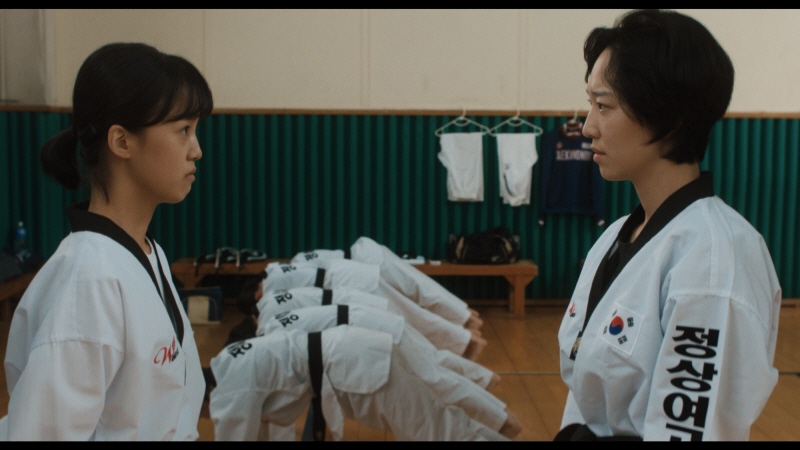
During its second half, the story becomes a lot more melodramatic with more cruelty against Joo-yeong and Ye-ji, and this feels a bit too jarring compared to the sensitive depiction of the development of their romantic relationship during the first half. In addition, their story is sometimes eclipsed by the other main narrative involved with Seong-hee’s serious plight, though her narrative is equally important considering how things were often pretty bad and unjust for many young girls like her before the #MeToo era.
At least, director/co-writer Han Jay, who will give us her second feature film “Favorite Restaurant” (2024) in the next year, handles her main characters with enough care and respect, and her two lead actresses generate enough chemistry between them whenever they share the screen together. While Park Soo-yeon is convincing in Joo-yeong’s gradual awareness of her sexuality along the story, Lee Yoo-mi effectively complements her co-star with her more confident appearance, and they are also supported well by several good main cast members including Kim Hyun-mok and Shin Gi-hwan.
In conclusion, “No Heaven, But Love”, which is released as “We Can’t Go to Heaven but Can Love” in South Korean theaters, is not wholly without flaws, but it is fairly engaging thanks to its good direction as well as the good chemistry between its two lead performers. Compared to several other recent South Korean queer films such as “The Handmaiden” (2016) or “Love in the Big City” (2024), it does not go that far with its queer story elements, but it is surely nice to see another well-made queer drama film available to many South Korean audiences out there, and I sincerely hope that it will put another dent on the prejudice against the LGBTQ+ people in the South Korean society just like many of its senior South Korean queer films have done during last several years.


 Seongyong's Private Place