

South Korean film “A Normal Family” is a darkly tense drama about the two different couples facing a serious moral issue involved with their respective kids. As they become conflicted more over their shared matter, the movie coldly exposes more of how superficial and hypocritical its four main characters can be in each own way, and we are alternatively chilled and repulsed while observing some morbid irony in their ethical struggles along the narrative.
At the beginning, we get to know about how these two couples have led a fairly affluent middle-class life. Jae-wan (Sol Kyung-gu) is a very successful lawyer, and he and his young second wife Ji-su (Claudia Kim) live comfortably in a big and cozy house along with their infant kid and an adolescent daughter from his first marriage. Jae-wan’s younger brother Jae-gyu (Jang Dong-gun) is an equally successful pediatrician, and he and his wife Yeong-kyung (Kim Hee-ae) live in their nice apartment with their adolescent son and his aging mother, who may soon have to be sent to the facility for old people considering her worsening dementia.
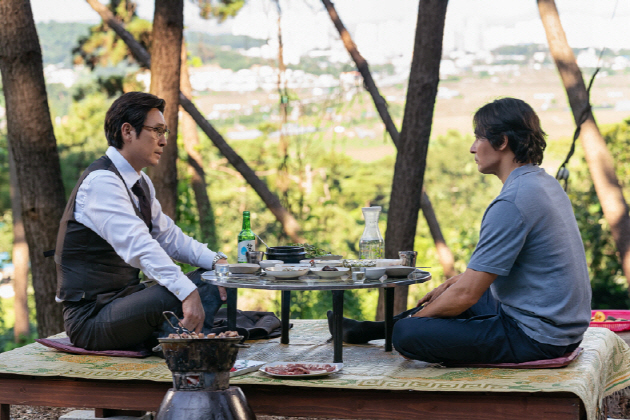
Jae-wan and Jae-gyu have routinely had a dinner at some high-end restaurant along with their wives, but both Jae-gyu and his wife do not like much spending time with Jae-wan and his wife. While Jae-gyu is annoyed with how his older brother often shows off his more affluent status, his wife still finds it difficult to accept Jae-wan’s second wife as a family member, and we sense more strain among these four people as they are seemingly courteous to each other at their dinner table.

And then there comes an unexpected trouble. When these two couples are having another dinner time together as usual, Jae-gyu’s son and Jae-wan’s daughter go outside for having some fun and drink together at the night party held at one of her friends. When they are later going back to their respective houses, they are quite drunk to say the least, and that is when they commit something quite serious which is reported on TV on the very next day.
After subsequently coming to learn of what these two kids did, their parents are certainly horrified, and they are also quite concerned as the police are already looking for the culprits. Although their criminal deed happened to be recorded by a nearby surveillance camera, the kids are not totally identified yet, so Jae-wan begins to consider covering up everything as much as possible. After all, there has not been any incriminating evidence yet, and Jae-wan believes that he and his younger brother really should focus on protecting their kids from any possible legal trouble.
In contrast to his older brother, Jae-kyu cannot help but feel more conflict about what he should really do about their difficult circumstance. His wife insists that they should worry about protecting their son’s supposedly promising future, and he is painfully reminded again that he has not paid much attention to his son as often caring more about his young patients.
After taking some time in establishing and then developing its four main characters during its first act, the screenplay by director Hur Jin-ho and his co-writers Park Eun-kyo and Park Jun-seok, which is based on Dutch novelist Herman Koch’s “The Dinner” (It was already adapted into three films including Oren Moverman’s “The Dinner” (2017), by the way), delve more into their respective inner conflicts. As Jae-kyu becomes more troubled about his son, his wife comes to show more of her hypocrisy, and this certainly strains their supposedly stable and amiable relationship. Although he seems unflappable at first, Jae-wan comes to feel more doubt and uncertainty later in the story, and the same thing can be said about his second wife, who becomes more watchful for her stepdaughter for an understandable reason.

These four people’s troubling personal circumstance is sometimes mirrored by another situation involved with both Jae-gyu and Jae-wan. Jae-wan defends the son of some wealthy man who recently caused a serious car accident, and Jae-gyu happens to be assigned to a young girl severely injured by this horrible accident. After watching his client’s sheer amorality, Jae-wan is more disturbed to see the same attitude from his daughter. As watching how much that injured young girl and her mother suffer, Jae-kyu feels more guilt about covering up his son’s crime, but he only ends up wondering more about whether his son deserves the second chance, and that eventually leads to an ironic moment between him and his older brother later in the story.
Although the finale is too heavy-handed in my inconsequential opinion, the four principal cast members did a solid job of carrying the film together under Huh’s good direction. While Sol Kyung-gu is dependable as usual, Jang Dong-gun’s more expressive acting complements well Sol’s restrained performance, and Kim Hee-ae and Claudia Kim hold each own spot well around Sol and Jang. Their characters are not particularly likable to say the least, but the four main members give us credible human figures to observe, and that is the main reason why we keep paying attention to the end of the story.
Overall, “A Normal Family” is not definitely something you can casually watch on Sunday afternoon, but it is recommendable for its engaging storytelling and competent direction. Although his recent films such as “Forbidden Dream” (2019) were less impressive compared to his early films such as “Christmas in August” (1998), Huh shows here that he has not lost his touch yet, and the movie will probably make you reflect on its main subjects for a while after it is over.


 Seongyong's Private Place
The 2014 Italian version of the novel, I nostri ragazzi (Our children) screened that year at BIFF. I thought it was excellent, a humble opinion I see not shared by all the critics.
SC: I should check the novel first…