

Japanese film “Worlds Apart” simply strolls along with its two very different main characters who somehow find a way to get along with each other as respecting each own boundary. While the movie itself is mostly mild and gentle on the whole, its two main characters and their story do not feel particularly realistic to me, and I must confess that my mind often went somewhere during my viewing instead of getting really engaged in how life goes on for them.
The movie opens with a very devastating incident for a young adolescent girl named Asa Takumi (Ikoi Hayase). Her parents get killed due to a sudden car accident which happens right in front of her eyes, and we soon see her going through the identification of her dead parents and then the following funeral for them. Amid those attending relatives gossiping about their parents, she continues to grieve over her immense personal loss, and, as shown from a brief imaginary moment of hers, she feels totally alone by herself.
And that is when Makio Kodai (Yui Aragaki), the estranged younger sister of Asa’s mother, comes forward. Although, as she frankly tells Asa later, she has always hated Asa’s mother, Makio decides to take care of Asa as her temporary guardian after sensing that Asa really needs someone around her, and Asa does not have any problem with her aunt’s decision even though she does not know her aunt that well.

While their initial interactions are awkward to say the least, Asa gets accustomed to her new environment more easily than expected, and Makio turns out to be more caring than she seems on the surface. Although she honestly admits that she is not exactly a responsible adult, she becomes more serious about taking care of her young niece as consulting with her ex-boyfriend who is incidentally a lawyer, and her best friend Nana Daigo (Kaho) is delighted to see how things become a little different in Maiko’s little apartment thanks to Asa. Once she sees that her aunt’s apartment needs some cleaning, Asa willingly does the job without hesitation, and her aunt surely appreciates that while focusing more on her writing (She wrote a popular book whose following success was big enough for buying her apartment, by the way).
Of course, Asa sometimes misses her parents, and the movie observes how she still struggles with her ongoing grief. Due to her best friend Emiri Nara (Rina Komiyama), everyone in her school comes to learn about her tragic incident right after their graduation day, and Asa becomes quite furious about that as clashing a lot with Emiri.
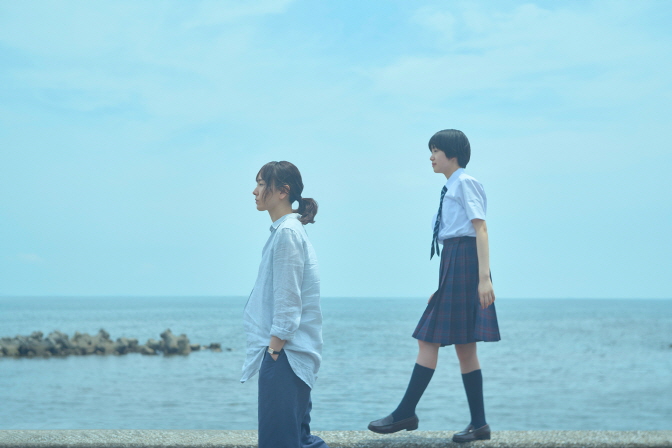
Nevertheless, like many other people in grief, Asa gradually recovers as her aunt wisely stands apart from her without any unnecessary interference. Because she still hates her older sister even after her older sister’s death, Makio understands Asa’s emotional status to some degree, and she just patiently waits for her niece to process her lingering sadness and then have a moment of reconciliation with her best friend.
Around that point, the screenplay by director/writer Natsuki Seta, which is based on the popular manga book of the same named by Tomoko Yamashita, becomes more episodic. While Makio keeps focusing on her writing, Asa begins her first year at high school along with her best friend, and she comes to join a school rock band even though she is not so sure about her musical talent. Nevertheless, she becomes more passionate about writing some lyrics, and she surely gets some advice from her aunt.
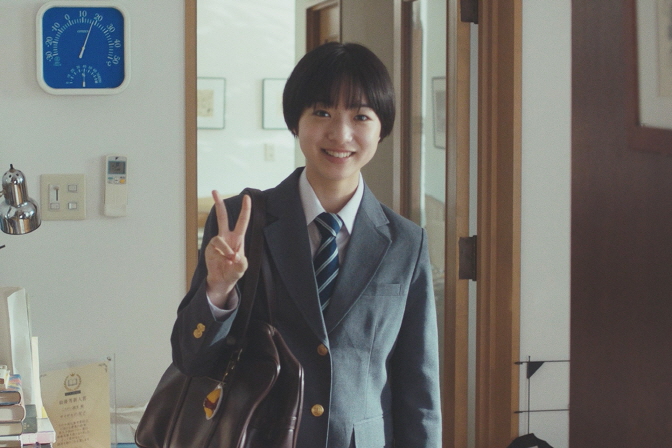
It goes without saying that Makio and Asa’s issues involved with Asa’s dead mother will eventually come back during its last chapter, but the movie is sometimes too unfocused to bring enough human depth to its story and characters. While we get to know a bit more of several schoolmates around Asa, they simply come and go without much impression, and I wish the movie delved deeper into her friendship with Emiri, which gets seriously tested when Emiri reveals her little personal secret to Asa later in the story.
Above all, both Asa and Makio are rather flat archetypes without much realistic human quality even though Ikoi Hayase and Yui Aragaki try their best in filling their respective roles with some sense of life. We often see Makio trying to write a few words at least, but we never get to know much about her writing process, and her relationship with her older sister turns out to be less complicated than expected. In case of Asa, she swings back and forth between innocence and maturation so frequently that she is more like a product of creative writing than a real human figure to observe, and you may feel some urge to take her to a psychiatrist whenever she feels harshly judged by her dead mother inside her young mind.
Several supporting characters around Makio and Asa are also superficial in my inconsequential opinion, but the supporting performers acquit themselves fairly well. Kôji Seto, Kaho, Rina Komiyama, and Guin Poon Chaw manage to compensate for their cardboard roles, and Guin Poon Chaw, who plays Makio’s concerned mother, has a sincere moment when her character comes to have a little private conversation with Makio around the end of the movie.
Overall, “Worlds Apart” did not engage me enough, but it has some good elements including its gentle and sensitive mood at least. I must point out that Shô Miyake’s recent movie “All the Long Nights” (2024) is a better and more realistic example of your average Japanese healing drama, but you may enjoy “Worlds Apart” more than I did, especially if you have read that popular manga book it is based on.


 Seongyong's Private Place