

As revisiting Yasujirō Ozu’s “Tokyo Story”, whose 4K restoration version is being shown in South Korean theaters now, I was reminded again how it is sublimely gentle and bittersweet in the intimate depiction of the human sadness and melancholy observed from its family characters. While many of them just softly and quietly interact with each other throughout the film, the emotional undercurrents below the surface are more palpable to us as we look more into their feelings and thoughts, and that is the main reason why this movie is one of the most universal human dramas of all time.
The story premise is pretty simple to say the least. At the beginning, we are introduced to Shūkichi (Chishū Ryū) and Tomi (Chieko Higashiyama), an old couple living in some seaside village quite far from Tokyo. Except their second daughter who works as a local elementary school teacher, all of their children left their home for each own life some time ago, and Shūkichi and Tomi are now going to visit two of their children currently living with their respective families in Tokyo. Although it will take quite a long time to go to Tokyo by train, both of them are very excited about seeing their two children again, and we later see them welcomed at the house of their eldest son, who works as a doctor in a little suburban area around Tokyo.
However, we gradually come to discern that they are actually not welcomed that much by their children. While they are pretty much like old strangers to the two sons of their eldest son, their eldest son is frequently busy with taking care of local patients day by day, and we do not sense much affection between them and the wife of their eldest son, though they and she interact with each other as courteously as possible. Their eldest daughter, who has run a beauty parlor, is also always occupied with her own business, and we are not so surprised when she suggests to her older brother later that they should make their parents stay at a local spa outside the city for a while at least.
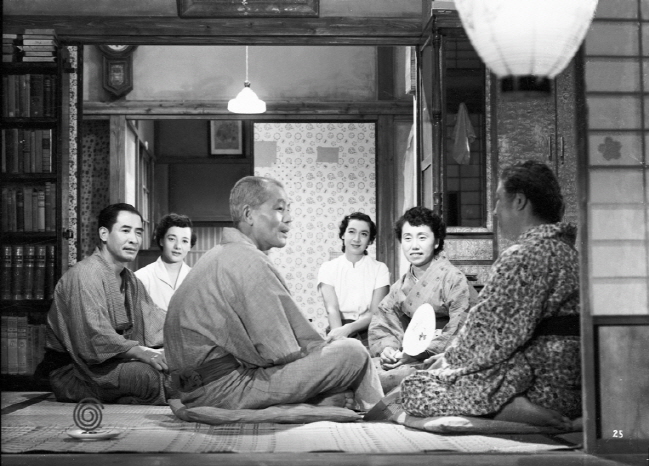
Ironically, the only person who really cares a lot about Shūkichi and Tomi besides their second daughter is Noriko (Setsuko Hara), the widow of their second son who died during the World War II. Although 8 years have passed since her young husband’s unfortunate death, Noriko remains devoted to her parents-in-law as before, and she is willing to spend some time with them when no one else in the family happens to be available for them.
As leisurely rolling the story and characters under that distinctive tranquil mood observed from many of Ozu’s films, the movie effortlessly moves back and forth between humor and pathos. While we are saddened by the growing melancholy surrounding Shūkichi and Tomi’s circumstance, we are also amused by a series of small comic moments observed among the main characters, which add more human qualities to them along the story. Yes, most of Shūkichi and Tomi’s children are pretty selfish at times just for being busy with each own daily matters, but they care about their parents to some degree, and we come to accept and understand their human flaws just like their parents.
Ozu and his cinematographer Yūharu Atsuta usually observe the characters from the distance, but it is really remarkable how they subtly engage us without drawing much attention at all to their storytelling approach. Shot in black and white film of 1.33:1 ratio, the movie mostly feels static on the surface as the camera does not move that much during many of the conversation scenes, but then we come to pay more attention to whatever is being exchanged among the main characters mainly thanks to Ozu’s precise and thoughtful scene composition, which is often distinguished by how the characters and objects in the film are carefully arranged on the screen. Just look at how Shūkichi, Tomi, and a family member of theirs sit together during one certain brief moment in the middle of the film, and you will see what I mean.
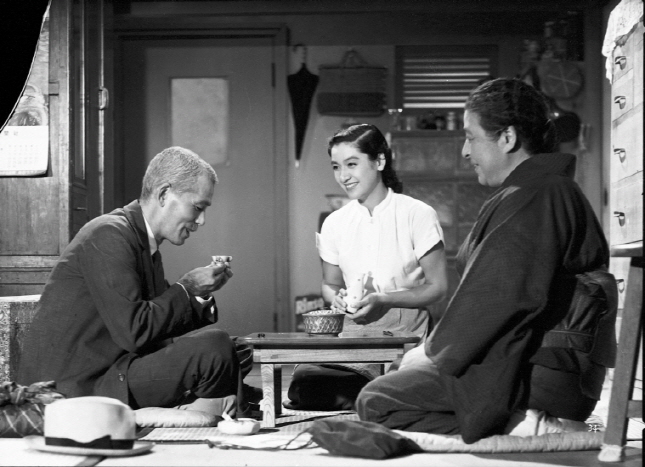
In addition, the camera closely sticks to the level of the viewpoints of the main characters sitting together, which is crucial in those distinctive “Tatami shots” in Ozu’s works. The conversation scenes in the movie are sometimes accentuated by the camera directly looking right into a talking character, and, though this feels too plain and obvious at first, we gradually pay more attention to the understated nuances beneath the conversation scenes.
The performers in the film, many of whom were Ozu’s frequent collaborators, dutifully fill their respective role as adding more human elements to the story and characters. While Chishū Ryū and Chieko Higashiyama are often heartbreaking even though their characters do not signify much to us during their gradual realization on how they have become more distant to most of their children, Setsuko Hara always brings a warm sense of empathy and compassion to the story, and several other cast members in the movie including Haruko Sugimura, So Yamamura, Kuniko Miyake, and Kyōko Kagawa are also effective in their substantial supporting parts.
Overall, “Tokyo Story” is simply unforgettable for its haunting human qualities to be observed and appreciated. While this film and “Floating Weeds” (1959) are definitely the first ones to recommend, Ozu also made many other excellent films which deserve more attention in my humble opinion, and I assure you that you will not be disappointed all with any of these hidden gems. As a matter of fact, “Tokyo Twilight” (1957) is released along with “Tokyo Story” in South Korea, and I am already ready to watch this rather obscure film at last.


 Seongyong's Private Place
Pingback: Tokyo Story (1953) A great family drama – kisafilms.com