

Chinese film “Suzhou River”, whose 4k restoration version was somehow released in South Korean theaters a few days ago, is a gritty and bitter urban tale of romantic obsession. Like many of other contemporary Chinese arthouse films, the movie requires some patience due to its slow narrative pacing, but this rather modest work is impressive for the raw juxtaposition between shabby realism and dreamy style, and I observe it with enough interest even when feeling impatient from time to time.
The story is mainly told via the viewpoint of a young aspiring filmmaker who is simply named “The Videographer” in the end credits while not being shown much on the screen throughout the running time, and the opening part of the movie serves us a series of random moments captured from here and there in a shabbier area around the Suzhou reiver of Shanghai, China. Although the city is going through a big social/economical change around 2000, this area often looks like being totally left behind from the ongoing national development, and the Videographer naturally adds some melancholy comments on these gloomy sights.
On one day, the Videographer is asked to shoot the mermaid show at a local bar, and that is how he meets Meimei (Zhou Xun), a pretty young woman who is going to wear a mermaid costume for that show. Right from their first encounter, the Videographer becomes quite attracted to Meimei, and Meimei willingly lets him a bit into her life as they get closer to each other for a while.
However, their relationship is actually not the center of the story. Meimei later asks the Videographer about whether he will look for her if she is ever vanished, and that is how she comes to tell the story about Mardar (Jia Hongsheng), a delivery man who got quite obsessed with one young beautiful girl he happened to be associated with. Even though it was quite possible that that young girl was already dead, this dude kept looking for her nonetheless, and then he found himself fixated on Meimei just because she looks a lot like that young girl.

Via a number of flashback scenes, we get to know more about Mardar’s relationship with that young girl, who was incidentally the daugther of some affluent local businessman. Whenever her father is having a little private time with any of his mistresses, Moudan, who is also played by Zhou Xun, has to be taken to her aunt’s apartment for convenience, and Mardar is the one who does that job for her father. At first, he does not care that much about Moudan, but he cannot help but get attracted to her as they spend more time together, and Moudan seems to enjoy getting his attention even though she remains rather elusive behind her plucky façade.
However, it later turns out that Mardar is involved in a little kidnapping scheme along with his two criminal associates. Everything seems to go well for their plan once Mardar keeps Moudan somewhere for a while, but, of course, things eventually go quite wrong for everyone including Mardar, who is consequently arrested and then sentenced to several years of incarceration.
When he is subsequently released from prison, Mardar searches for any clue to find Moudan, who has been presumed to be dead after she impulsively threw herself into the river at that time. When he comes across Meimei later, he is surprised by how much she resembles Moudan, and, what do you know, he soon goes after her just like James Stewart did to Kim Novak in Alfred Hitchcock’s “Vertigo” (1958).
Regardless of whether Meimei is actually Moudan, the movie toys with the growing ambiguity along the story as Meimei occasionally has some fun with Mardar’s intense attention. She sometimes asks him more about Moudan, but she never admits anything to him at all while keeping the distance between them as usual, and this strained relationship of theirs remains unresolved even after the Videographer enters the picture later.
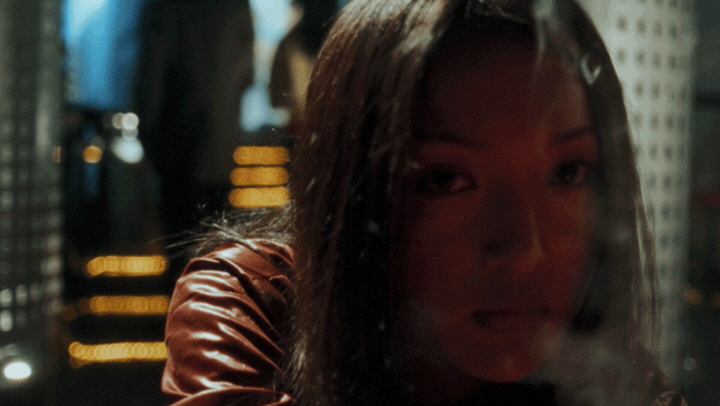
As both the videographer and Moudan struggle to deal with their tricky situation with Meimei, the movie frequently soaks itself into a dreamy atmosphere, which makes a striking visual contrast with its grim mundane background. Director/writer Lou Ye and his cinematographer Wang Yu willingly show the far less pleasant sides of the city on the screen, and, not so surprisingly, Ye was banned from filmmaking for two years when the movie was shown outside China without getting the permission from the Chinese government. The movie was eventually authorized later, but this was followed by more conflicts between him and the Chinese government during next several years, though he recently got his latest work premiered at the Cannes Film Festival early in this year.
Because of the constantly distant attitude of the movie, it is often hard for us to care that much about the story and characters, but Ye’s raw but stylish filmmaking holds our attention, and he also draws good performances from his two lead performers. While Jia Hongsheng holds the ground as required, Zhou Xun has several juicy moments as deftly handling her two different roles, and she is especially good when the line between her two characters is blurred a little later in the story.
In conclusion, “Suzhou River” is a dry but interesting exercise in style and mood, and I admired it even though I observed its good moments from the distance instead of fully engaged in them. In short, this is one of the notable works from the sixth generation of the Chinese Cinema during the early 2000s, and I think you should check it out if you want to know and learn more about the Chinese Cinema.


 Seongyong's Private Place