

Japanese film “Single8” will bring a smile to anyone who has ever been fascinated with filmmaking. Like many similar films such as other recent Japanese film “It’s a Summer Film” (2020), the movie is brimming with the joy and excitement of filmmaking, and we gladly go along with that while often being tickled a lot by many silly aspects of the micro-budget filmmaking process of several main characters in the movie.
The story is set during the summer of 1978, when millions of Japanese audiences belatedly joined the enormous global enthusiasm toward George Lucas’ monumental SF film “Star Wars” (1977). After watching that great movie, our high school student hero Hiroshi (Yû Uemura) has been quite eager to recreate its magnificent opening shot, but, alas, he still does not know how to do that with his old 8mm movie camera.
However, he eventually finds a rather brilliant idea on how to make his model spaceship look bigger and wider for the camera, and this eventually reignites his passion for filmmaking. Along with one of his friends and a college student who is the part-time employee of a local camera/photograph shop, Hiroshi comes to hone his filmmaking skill more as learning about how to operate a movie camera more skillfully, and, what do you know, his final result shows considerable improvement compared to several initial trials.
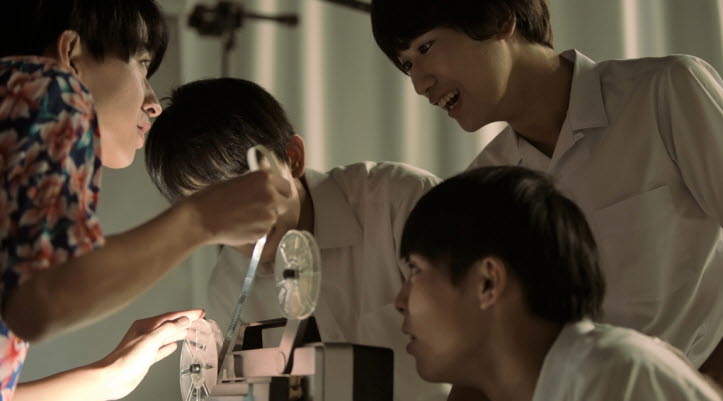
And then there comes an unexpected opportunity for Hiroshi. When his classmates discuss what they should do for the upcoming school festival to be held not long after the summer vacation, he impulsively suggests that they should make a little movie even though he does not have any idea on what kind of movie he is going to make. Mainly thanks to Natsumi (Akari Takaishi), a pretty female student he has liked a lot since their middle school period, their classmates eventually agree to Hiroshi’s suggestion, and he soon embarks on his first official movie project along with his two friends.
What follows next is a series of amusing scenes where Hiroshi and his two friends struggle through something equivalent to pre-production process. First, they must get the approval of their classroom teacher, and, fortunately, their classroom teacher turns out to be quite more supportive than expected. For example, the teacher emphasizes the importance of a narrative to engage their audience, and we soon see Hiroshi and others doing some brainstorming on the story and characters for their movie.
As it was already decided from the beginning, Hiroshi and his friends are going to make a SF movie, and they manage to complete their screenplay before their due date, but there is one big problem. While one of his friends is willing to be the lead actor of their film, they also need a girl who will be their lead actress, and Hiroshi is determined to persuade Natsumi, but she is not so willing to do more for them than showing some support along with many other classmates.
However, Natsumi eventually changes her mind at the last minute to the delight of Hiroshi and his friends, and they all try their best during the following shooting period. There naturally come a number of small and big technical challenges, but Hiroshi and his friends always find a solution in one inventive way or another to our little amusement, and they become all the more spirited as getting assisted by several classmates of theirs, who are also quite excited about being behind and in front of the camera.
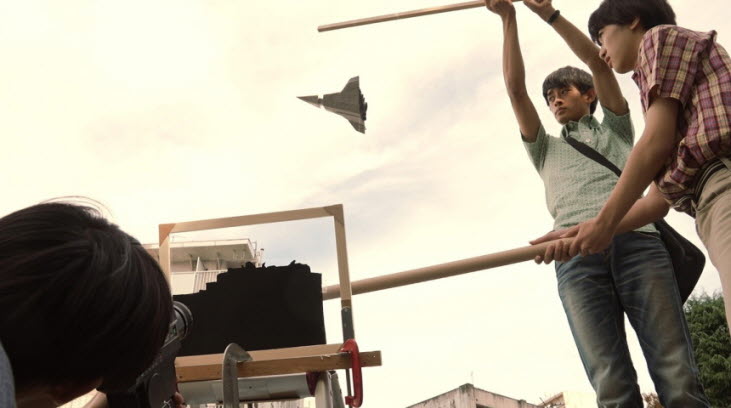
Meanwhile, Hiroshi comes to feel more attraction to Natsumi, but he still cannot reveal his old feelings toward her even when he gets a chance to act a bit along with her during the following post-production step. While she sometimes seems to be aware of this, Natsumi does not cross the line between them at all, and that certainly frustrates Hiroshi a lot, though he continues to throw himself into filmmaking along with his friends as usual.
As reflected by what is shown to us in the middle of the end credits, the movie has some autobiographical elements derived from the early filmmaking years of director/writer Kazuya Konaka (He has been mainly known for making Ultraman movies and TV series episodes, by the way), and his personal affection toward the story and characters is evident especially when Hiroshi’s movie is finally completed and then shown to many of his schoolmates at the school festival. What Hiroshi and his friends made is quite amateurish to say the least, but their creativity and enthusiasm are palpable between frames nonetheless, and you will not be surprised much by the following responses from their audiences.
The young main cast members of the movie carry well the film together with their earnest acting. While Yû Uemura diligently holds the center, Noa Fukuzawa and Ryuta Kuwayama provide extra humor as Hiroshi’s two different friends, and Akari Takaishi brings charm and presence to her rather under-developed supporting character.
On the whole, “Single8” is an amiable mix of filmmaking and coming-of-age drama, and I must confess that I often found myself silently chuckling while also touched at times by the unadorned enthusiasm of Hiroshi and his friends. While he may never reach to the ultimate goal of his burgeoning filmmaking career, he is still ready to step forward for making something better and greater, and you will surely root for him in the end.


 Seongyong's Private Place