

“Love According to Dalva” closely observes the emotional turmoil of a troubled young girl who feels quite hurt and confused for understandable reasons. While it is sometime difficult to watch during a number of emotionally intense scenes, the movie depicts her constant emotional struggles with enough care and sensitivity, and it surely earns a small but significant moment of recovery and empowerment around the end of the story.
The movie begins with the striking opening scene showing how things are suddenly turned upside down for Dalva (Zelda Samson), a 12-year-old girl who turns out to have been sexually abused by her father for several years. When the police promptly take away her father from her shortly after one of their neighbors reported to the police, she becomes quite upset due to having been emotionally dependent on her abuser for a long time, and she even demands to see him again while still being oblivious to what he has done to her.
After she is examined for any more sign of physical abuse, Dalva is sent to a facility where kids without any legal custodian are temporarily sheltered, and she surely draws much attention right from the first day due to her rather adult appearance. Not realizing yet how she looks odd with her adult attire and makeup, she wants to believe that she is a grownup woman, but we soon observe how naïve and vulnerable she really is – especially when she later has her first experience with menstruation.

At least, there are several people who care about her despite her stubborn refusal to face what happened to her body and mind. Although their first encounter is not exactly agreeable, her roommate, a feisty black girl named Samia (Fatna Guirassy), helps Dalva in one way or another, and many other kids in the facility are also fairly nice to Dalva because, well, they all have each own issue just like her. In case of the employees of the facility, they are all dedicated professionals, and Dalva’s handler comes to show more compassion and understanding than expected, though he knows too well how tough and tricky it is to handle very troubled kids like her.
What follows next for our little heroine is a classic progress of anger, denial, bargaining, depression, and acceptance. At first, she angrily rejects any help or support from others as frequently demanding to see her abuser again. After that, she insists that her and her abuser really loved each other, though it goes without saying that her abuser groomed her a lot for his truly deplorable purpose. When her mother, who incidentally left her husband before he took away their daughter, shows up, Dalva still clings on her misguided notion on her sexually exploited status, and she naturally comes to show more anger and frustration at others around her.
Of course, there comes a point where she has no choice but to face the truth, when she seems to get what she wants at last after some bargaining. I will not go into details here, but I must tell you is that I was marveled by the dynamic raw performance from Zelda Samson. Despite being a young newcomer who had no previous movie acting experience, she ably swings from one emotional mode to another during this crucial scene without any single false note, and she is particularly harrowing as her character consequently goes down into a very depressed status.
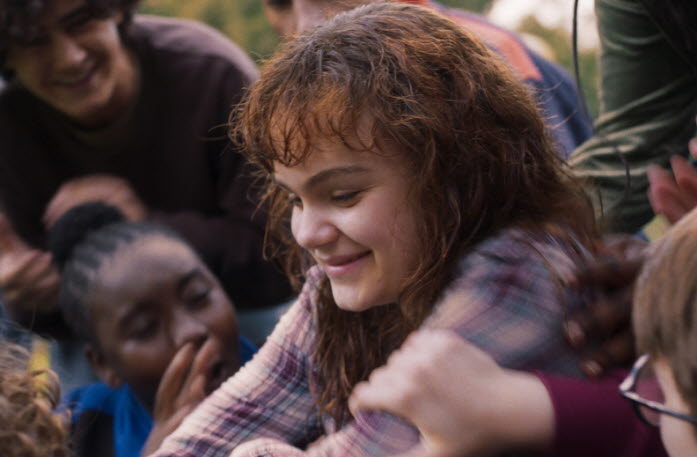
During its second half, the screenplay by director/writer Emmanuelle Nicot, who collaborated with Jacques Akchoti and Bulle Decarpentries for writing her screenplay, shifts to a more reflective mode as its young heroine struggles to recover bit by bit. While she comes to look more brightened than before, Dalva still has remaining emotional issues to deal with, and we come to observe more of her emotional vulnerability. She just wants to be a plain normal girl, but that is sometime not so easy for her as shown from a couple of rather alarming moments, and that inevitably leads to the conflicts between her and her friends and supporters.
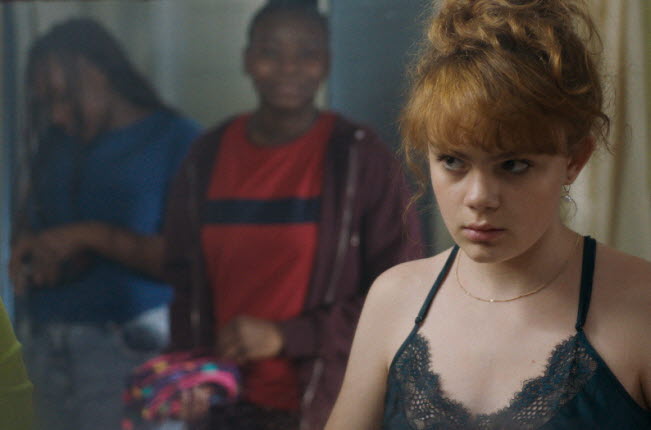
However, the movie never loses its compassion toward Dalva as usually sticking close to her limited viewpoint, which is further accentuated by the screen ratio of 1.33:1. As the camera of cinematographer Caroline Guimbal always hovers around her, the movie generates a considerable degree of verisimilitude, and we accordingly become more engaged in Dalva’s frequently troubled state of mind.
While Samson’s fierce natural acting the heart and soul of the film, she is also supported well by several good cast members surrounding her. Alexis Manenti, who has mainly known for his substantial participation in Oscar-nominated French film “Les Misérables” (2019), balances his character well between care and principle, and Fanta Guirassy, who is also a young non-professional performer just like Samson, is excellent in her several key scenes with Samson.
On the whole, “Love According to Dalva” is a modest but undeniably engaging coming-of-age drama, and Nicot, who previously made short film “À l’arraché” (2016), made a commendable feature film debut here. While its realistic mood and storytelling approach are apparently reminiscent of the works of the Dardenne brothers, her movie distinguishes itself with enough substance and sensitivity, and it will be interesting to see what will come next from this talented filmmaker to watch.


 Seongyong's Private Place