
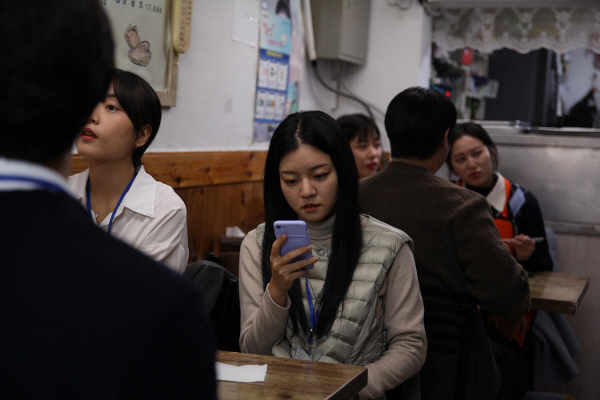
South Korean film “Because I Hate Korea” did not surprise or interest me enough despite its acerbic viewpoint on the South Korean society. Yes, I and many people have been well aware of how things can be hellish for many of us due to numerous social/economic reasons, and the movie sometimes makes some sharp points on why we usually call the South Korean society “Hell-Korea”. However, the movie is rather thin and aimless in terms of story and character, and I came to observe its story and characters from the distance instead of getting engaged more along the story.
Go Ah-sung plays Gye-na, a young woman in her late 20s who suddenly decides to leave South Korea as getting more tired of struggling to live in the South Korean society. After the opening scene showing her departure, a series of flashback scenes show how much she gets frustrated in one way or another, and it seems that everything will get better for her once she begins to start her life again in New Zealand.
Of course, like anyone trying to settle in a foreign land, Gye-na finds herself struggling more than expected. While she luckily gets some help besides a temporary place to stay during next several months, she certainly needs to do any menial job for earning her living day by day, and she also has to do some college study for getting a better job some time later.

As she goes from one menial job after another, Gye-na becomes more conflicted about whether she can actually live there in New Zealand. While feeling quite isolated and anxious at times due to her increasingly loneliness, she is often reminded of her status as a minority person in the country, and there is not anyone to support or console her except a very few people including a young fellow expatriate named Jae-in (Joo Jong-hyuk), who was rather rude to her during their first encounter but eventually becomes friendlier to her.
And Gye-na’s mind sometimes reflects on her current situation as comparing that to how things are miserable for her in South Korea. In her previous job in South Korea, she often felt quite suffocated, but she tried to endure and then prevail for having more economical stability someday. In case of her rather poor family, they do not support her that much except providing a place to live, and we come to gather that there is not much hope to her aging parents, who desperately hope to sell their shabby residence and then move to some better place when their neighborhood eventually gets re-developed someday.
In case of her long relationship with a lad named Ji-myeong (Kim Woo-gyeom), several flashback scenes between them show more of how careless and thoughtless he can be despite his sincere love and affection toward Gye-na. When she is invited to a dinner with his parents, she instantly feels how patronizing they are to her, and she becomes more displeased when she talks about her feelings with Ji-myeong later.
These and other bad memories of hers in South Korea keep Gye-na moving in her ongoing struggle for settlement in New Zealand, but happiness still seems beyond her reach even though she feels a bit better about being outside the South Korean society. Sure, her jobs are menial and difficult at times, but she gets fairly paid without any particular inconvenience at least, and she may succeed in her eventual goal in the end.

However, the screenplay by director/writer Jang Kun-jae, which is based on the 2015 novel of the same name by Chang Kang-myoung, only scratches the surface without delving more into its main subject and characters. We are surely reminded more than once about how many young people in South Korea are very unhappy, but it simply points out the extremely competitive sides of the South Korean society without recognizing the causes of this alarming social trend in South Korea. In addition, many of the characters in the story besides Gye-na are not particularly developed well, and we never really get to know any of them much even at the end of the story.
Anyway, the main cast members of the film try their best with their rather superficial roles. Go, who has steadily advanced during last two decades since her notable supporting turn in Bong Joon-ho’s “The Host” (2006), conveys well her character’s constant anxiety and frustration to us via her calm but undeniably expressive face, and her good performance often keeps things rolling even when the movie feels quite meandering. In case of several supporting performers around her, Joo Jong-hyuk, who was quite memorable in his electrifying performance in “Iron Mask” (2023), fills his thankless role with enough presence and personality, and Kim Woo-gyeom manages to make his character more sympathetic even though we can clearly see that his character is not so suitable for Gye-na despite his genuine sincerity.
Overall, “Because I Hate Korea” does not work as well as intended mainly due to its weak narrative and characterization, and this is quite a letdown compared to Jang’s previous film “A Midsummer’s Fantasia” (2014), which was incidentally one of the best South Korean films in 2015 in my trivial opinion. Its message is certainly clear, direct, and relevant to me and many other South Korean audiences, but, folks, it did not engage me enough on the whole.


 Seongyong's Private Place