
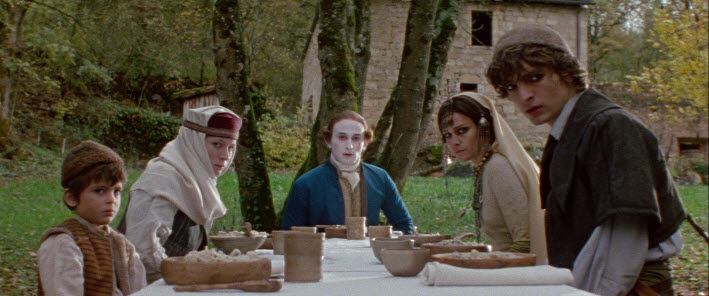
French film “The Vourdalak” is a dry but occasionally humorous horror film to be appreciated for its offbeat deadpan touches. As its unfortunate hero clumsily attempts to deal with the increasingly dangerous circumstance surrounding him, the movie phlegmatically doles out one creepy moment after another along with some dark sense of humor, and the result is alternatively chilling and amusing to the end.
At first, the movie quickly establishes the ongoing plight of Marquis Jacques Antoine Saturnin d’Urfé (Kacey Mottet Klein), a young French nobleman who was sent to somewhere in Eastern Europe during the 18th century as a courtier and envoy of the King of France. Regardless of whatever his mission actually was, Jacques has been all alone by himself after his horse and company were robbed, and the opening scene shows him desperately seeking for any help from some local dude, who flatly refuses to let Jacques in his residence but suggests that he should instead go to the house of some other local man who may let him in his house.
Although he subsequently gets lost in a local forest for a while, Jacques eventually comes across the two children of that man in question, and he is soon allowed to stay at the house of that man for a while, but we cannot help but sense something strange about his family. While that man is absent for some unknown reason, his older son Jegor (Grégoire Colin) functions as the de facto head of the house, and his two younger siblings, Sdenka (Ariane Labed) and Piort (Vassili Schneider), and his wife Ania (Claire Duburcq) have no problem with that at all, though they all seem quite nervous about something they are not so willing to tell Jacques.
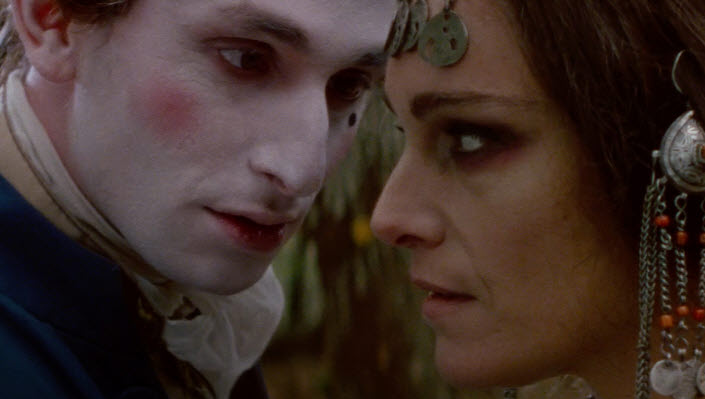
Anyway, while frequently feeling uncomfortable about this rather odd family, Jacques soon finds himself attracted to Sdenka, who is very beautiful but will probably be stuck with her family for the rest of her life because of getting her reputation tarnished due to her forbidden romance with some outsider. Nevertheless, Jacques is still willing to draw more attention from her, and she seems a bit interested in whatever he may provide her despite her disaffected attitude.
Meanwhile, the situation becomes more unnerving for Jacques after Jegor’s father finally returns to the house after successfully accomplishing his personal mission. When he fully reveals himself in front of others including Jacques, his appearance is quite disturbing to say the least, and Jacques subsequently comes to learn more of how this dude has unnerved and terrorized his family members for some time.
Around that narrative point, the screenplay by director Adrien Beau, who incidentally makes a feature film debut after making two short films, and his co-writer Hadrien Bouvier, which is based on Aleksey Konstantinovich Tolstoy’s 1839 novella “The Family of Vourdalak” (He is a second cousin of Leo Tolstoy, by the way). comes to reveal more of what it intends to do. Yes, “Vourdalak” is an old local word for vampire, and it goes without saying that the patriarch of the house is actually a vampire quite ready to suck the blood of everyone in the house.
While Jacques comes to believe what Sdenka and Piotr tells him later, Jegor adamantly refuses to believe that his father is now your average bloodsucker. As a victim and supporter of his father’s toxic patriarchy, Jegor keeps trying to maintain the status quo of the house without listening to his other family members at all, and he does not change his position even when his father comes to crave for the blood of his little son.

As Jegor’s vampire father continues to his reign of terror over the others in the house, the movie subtly dials up the level of gloomy creepiness on the screen. Shot in 16mm film by cinematographer David Chizallet, the movie deliberately looks grainy and old-fashioned on the whole, and that naturally take us back to a number of old classic vampire films such as F.W. Murnau’s masterpiece “Nosferatu: A Symphony of Horror” (1922).
While it is sometimes alarming to watch how helpless Jacques and several other main characters are in front of an unspeakable horror to sweep upon them, it is also morbidly funny to observe the absurd aspects of their gradually horrific circumstance, and the main cast members keeps their acting as straight as possible without showing any hint of self-awareness. While Kacey Mottet Klein, a young Swiss actor who drew my attention for the first time via his excellent child performance in Ursula Meier’s “Home” (2008) and “Sister” (2012), willingly throws himself into his character’s pathetic silliness, Ariane Labed, Grégoire Colin, Vassili Schneider, and Claire Duburcq are also effective in their respective parts, and Beau has some little naughty fun as providing the voice of the vampire figure in the film.
In conclusion, “The Vourdalak” is a modest but competent genre piece peppered with distinctive style and personality to be savored. While it may require some patience from you due to its rather slow narrative pacing, the movie is a rewarding experience on the whole, and you should not miss it especially if you are a genre fan willing to try something different.


 Seongyong's Private Place