
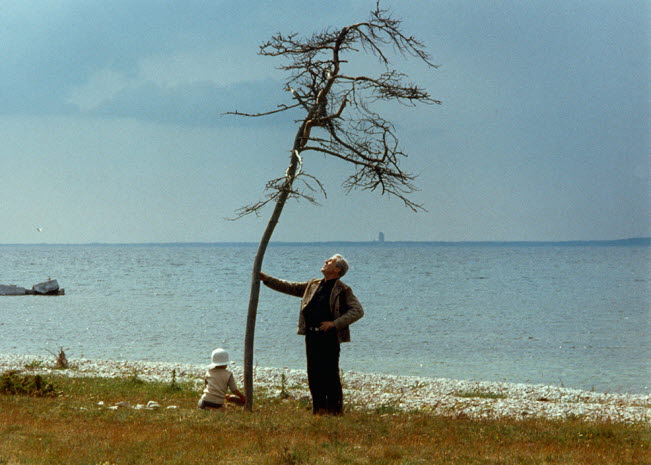
Andrei Tarkovsky’s last film “The Sacrifice”, which happens to be released in South Korean theaters in this week, is definitely slow but undeniably fascinating in many aspects. While the story and characters are pretty simple on the surface, the movie will gradually immerse you into its calm and reflective mood once you go along with how it is about, and you may willingly go along with that even if you sometimes scratch your head on what it is about.
The movie is mainly set in and around a little country house belonging to Alexander (Erland Josephson), a middle-aged dude who was once a famous actor but retired to work as a critic and journalist at present. During the opening scene, we see him and his little son planting a dead tree outside his house, and the camera focuses on their ongoing activity from the distance as he talks about his purpose to his little son, who has incidentally been mute due to his recent throat surgery.
Anyway, it turns out that Alexander is about to have a little birthday party for himself, and we get to know a bit about several figures who will attend his birthday party. Besides his wife and their older daughter who have lived with him in his house, a close friend of his who is a doctor will join him along with a local part-time postman, and he and others will be served by the two housemaids during their upcoming party in the evening.

However, something quite unexpected happens later in the outside world. For some unspecified reason, the World War III is about to happen, and everyone in the house becomes quite alarmed and devastated after seeing a TV announcement on whatever will happen to them and many others in the whole world. As trying to process that the end might be quite near to them, Alexnader and the others in the house go through some soul-searching, and the mood among them naturally becomes a lot gloomier while they get isolated more and more from the outside world.
Watching a series of somber but intense human moments generated among a small number of characters within a small space, you will be instantly reminded of those powerful chamber drama movies of Ingmar Bergman, and you will not so surprised to see that some of the cast and crew members of the film actually worked in some of Bergman’s notable films. For example, Erland Josephson, who was particularly memorable in “Scenes from a Marriage” (1973), was one of Bergman’s frequent performers, and cinematographer Sven Nykvist was mainly known for how he closely worked with Bergman throughout their whole respective careers.
Nykvist, who won two Oscars for “Cries and Whispers” (1972) and “Fanny and Alexander” (1982), deservedly received the award for his technical contribution to “The Sacrifice” when it was shown at the Cannes Film Festival in 1986 (It also received the Grand Prix award, by the way). In most of many extended sequences in the film, his camera seems static at first, but then it makes some subtle moves here and there as steadily patiently focusing on the mood and characters, and the overall result is quite absorbing and striking to say the least. As the possibility of the apocalypse constantly hovers over the characters, the interior of Alexander’s house becomes darkened bit by bit, and Nykvist and Tarkovsky deliberately go for more color desaturation for accentuating the growing sense of existential dread among the characters.
Meanwhile, Alexander is approached by the aforementioned postman, who tells Alexander that Alexander can actually save not only him and others but also the whole world. According to the postman, all Alexander will have to do is approaching and then sleeping with one of his maids, who incidentally resides alone in a nearby abandoned church. Alexander naturally does not believe this at first, but, of course, as things get all the more desperate and hopeless later, he eventually goes to that maid’s residence later in the story.

What follows next is rather hard to describe, but the film steadily holds our attention while also making its hero’s viewpoint less reliable than before. Regardless of what actually occurs between him and that maid, Alexandre comes to reveal more of himself in front of her, and that leads to an ambiguous but utterly spellbinding moment to remember.
While being a bit baffled and then overwhelmed a lot by the following final act of the film, I was reminded of Akira Kurosawa’s “I Live in Fear” (1955), which is about a middle-aged man constantly anxious about the possibility of nuclear war. As comparing the devastating finale of “I Live in Fear” to the climactic part of “The Sacrifice”, I wonder whether the movie is actually the reflection of Alexander’s fear and anxiety on what may happen-to the world and his dear little son in the future, and I guess I can understand more of why Tarkovsky dedicated the film to his young son.
On the whole, “The Sacrifice” requires some patience at first, but it will eventually come to you as a rewarding cinematic experience to remember just like Tarkovsky’s other works including “Andrei Rublev” (1966) and “Solaris” (1972). Although I am still not so entirely sure about what and how it is about, the movie engaged me a lot as it did when I watched it for the first time more than 20 years ago, and I am willing to revisit it someday just for more appreciation and admiration.


 Seongyong's Private Place