

South Korean film “Land of Happiness” is a tediously fictional presentation of one historical trial which does not interest me much on the whole. Mainly because recent other South Korean film “12.12: The Day” (2023), which is incidentally set in the same period background while also overlapped with “Land of Happiness” to some degree in terms of story and characters, leaves a strong impression on me and many other South Korean audiences, the movie feels quite tame and bland in comparison, and, above all, it is not engaging enough to hold my attention.
The story, which is set in South Korea during 1979-1980, is mainly depicted via the viewpoint of Jeong In-hoo (Cho Jung-seok), a young cocky lawyer who happens to be requested to represent one of the key figures in the assassination of President Park Chung-hee on October 26th, 1979. Although it is apparent from the beginning that there is not much hope for that figure in question, In-hoo eventually agrees to take this thankless case for free, just because that may help his currently imprisoned father.
However, his case turns out to be much more difficult than In-hoo expected. First, his client, Colonel Park Tae-joo (Lee Sun-kyun), is not particularly willing to try anything for avoiding being eventually executed for treason, and this certainly frustrates In-hoo a lot right from his first meeting with Colonel Park. In addition, the military judges presiding over the trial are already quite determined to hand out death sentence to Colonel Park and several other defendants including his boss, and they do not even hide their intention at all in front of many others in the courtroom.

Above all, there is a powerful and ambitious military figure watching over the trial. Although his name is different here in this film, I and South Korean audiences know too well that he is a fictional version of President Chun Do-hwan, another military dictator who ruled over South Korea after his successful coup d’état in 1979 December. As quickly suppressing the social turbulence caused by the assassination of President Park, he is preparing to go all the way to the top of the South Korean government, and getting Colonel Park and other defendants executed is simply another stepping-stone for his ongoing political rise.
Nevertheless, In-hoo tries his best for saving Colonel Park after getting to know more about his rather uncooperative client, who turns out to be a rare soldier of principle and integrity. Regardless of whether the assassination of President Park can be justified in the name of democracy, Colonel Park feels quite guilty about several guys killed by him in the middle of the assassination incident, but he still sticks to his position as a principled soldier who simply followed an order from his boss as shown from a series of occasional flashback scenes.
However, the movie fails to develop its two leading figures into really interesting humans to observe and care about. While Colonel Park remains mostly distant without revealing to us much about himself, we do not get to know a lot about In-hoo either, except his estranged relationship with his imprisoned father. Furthermore, many of the supporting characters around them are more or less than mere plot elements, and the movie is also seriously deficient in case of substantial female characters (I can only remember one or two minor female supporting characters except the devastated wife of Colonel Park, for example).
In case of several obligatory courtroom scenes, the movie unfortunately falters more than once. Although In-hoo is supposed to be your average wily lawyer, all he does throughout these courtroom scenes in the film is doling out one showy moment after another without helping the case much on the whole, and we become bored by his rather monotonous persistence instead of rooting more for him and his client.
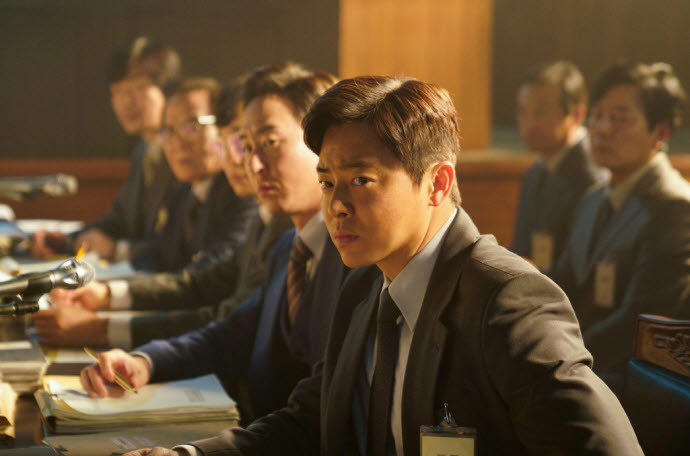
Cho Jung-seok tries here as much as he did in his recent other film “Pilot” (2024), but his performance is sometimes excessive instead of boosting the story and characters more along the story. Both “Land of Happiness” and “Pilot” surely demonstrate the considerable range of his acting skill, but both of them sadly fail to support or control his efforts, and that is really a shame considering how his acting talent has been utilized much better in a number of notable films such as “Architecture 101” (2012).
On the opposite end, Lee Sun-kyun, who committed suicide several months ago due to a disgraceful drug/sex scandal and the following police investigation, simply looks as despondent as required, and the result is a rather disappointing footnote to his fairly solid acting career distinguished by several acclaimed films including Oscar-winning film “Parasite” (2019). As the main villain of the story, Yoo Jae-myung surely does everything for making his character look quite sleazy and deplorable, but his performance is bound to be compared or eclipsed by how grandly Hwang Jung-min chews every moment of his as the fictional version of President Chun in “12.12: The Day”.
Overall, “Land of Happiness”, directed by Choo Chang-min, is a mediocre minor work compared to “12.12: The Day” and “The Man Standing Next” (2019), which gives a closer look into the historical background of the assassination of President Park. Yes, I do not like “The Man Standing Next” enough for recommendation, and watching “12.12: the Day” was one of the most stressful movie experiences for me during last several years. Nevertheless, I think both of these two South Korean period drama films will enlighten and entertain you more as vividly showing how turbulent things were in South Korea during 1979-1980, and I assure you that you will have a more productive time as watching either of them instead.


 Seongyong's Private Place