
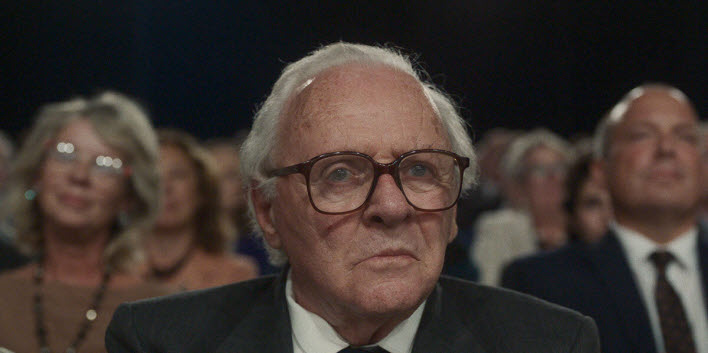
It is hard not to be touched by the story of “One Life”, which is about one compassionate British man who tried to save many kids right before the World War II. Once he saw what was going on at that time, he could not possibly walk away from that, and it is really moving to watch how he tried hard to the end – and how much his and several others’ humanitarian efforts were appreciated in the end.
His name is Nicholas Winton, and the movie opens with how old Winton, played by Anthony Hopkins, lives day by day along with his wife in 1987. Whenever he is not handling those daily matters, old Winton focuses on some old documents from his past, and that often takes him back to when he and several others attempted to rescue refugee kids from the Nazi-occupied territory during 1938-1939.
At that time, young Winton, played by Johnny Flynn, was just a mid-level stockbroker. He was simply supposed to help his colleagues a bit in Prague, Czechoslovakia just for a few days, but he immediately changes his mind after seeing how things have been getting worse and worse for many Jewish refugees who fled from Nazi Germany. Around that time, Nazi Germany took over Austria and then the considerable part of Czechoslovakia, and it became quite more apparent that it was also going to occupy the rest of Czechoslovakia.
While trying to think of any possible way to help the refugees, Winton comes to have a rather daring idea. He and his colleagues are going to transport the children of the refugees from Prague to London, and, of course, they certainly have to set up their operation as quickly as possible, especially when the German takeover of Czechoslovakia looks more and more imminent. First, they must convince the refugees to cooperate with them, and then they must also gather enough money to fund their operation while also getting the approval from the British government.

All these and other things have to be quickly prepared within a very short time, but Winton and his colleagues manage to do that as pushing their noble cause as much as possible in public. In the end, they amass enough fund for their operation, and, above all, the British government approves of their operation, as long as they can provide foster parents willing to take care of those refugee kids at least for a while.
And we see how things go fairly well for their operation during next several months. While there is always considerable risk for those refugee children as they will pass through Germany for reaching to England, Winton and his colleagues become more confident after their first trial, and they come to handle far more refugee children than expected before Europe is eventually thrown into the World War II in September 1939.
Still feeling regretful over how their last attempt was tragically failed, old Winton wants the story of those refugee children to get known more in public, but he becomes frustrated as nobody seems to be particularly interested in the story. Some time later, he approaches to one certain public figure who might help him, and, what do you know, he soon finds himself appearing in a well-known BBC TV program.
While the part associated with young Winton’s efforts feels rather generic, the part involved with old Winston is undeniably poignant even though we can clearly see where it is heading. Yes, his and his colleagues’ efforts are surely recognized and appreciated in the end, and he certainly comes to have a big moment to remember. Nonetheless, this modest but powerful moment is presented well enough to move us, and it will surely remind you of the importance of doing the right thing for others in the need of help.
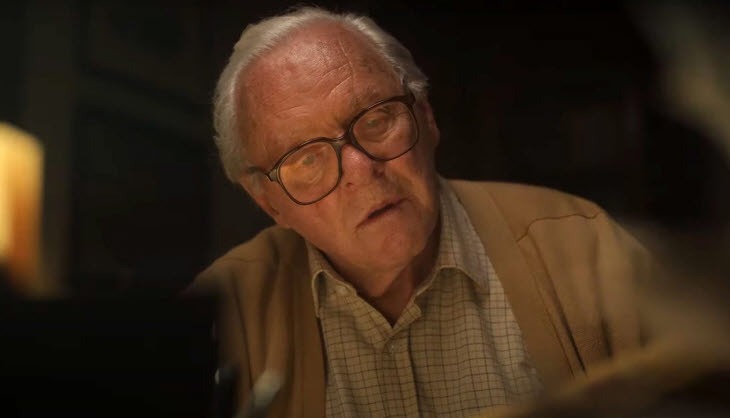
Anthony Hopkins, who has been always a pleasure to watch for more than 50 years since his solid debut performance in “The Lion in Winter” (1968), is inarguably the best thing in the film. As bringing some class and humanity to his several key scenes, Hopkins demonstrates again that he is still one of the best performers of our time, and his understated acting is especially wonderful when he subtly illustrates how much his character is surprised and then touched around the end of the story.
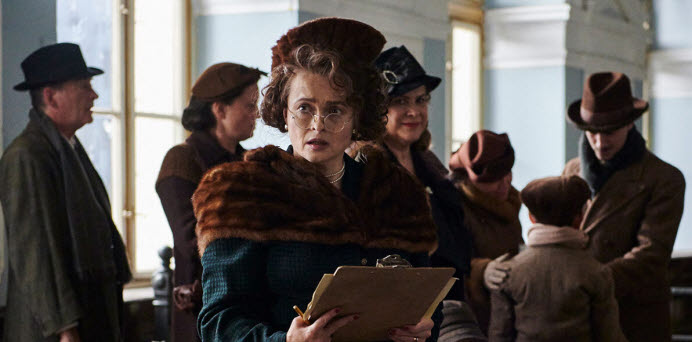
Around Hopkins, several other cast members dutifully fill their respective spots. While it is a bit difficult to connect his performance with Hopkins’ acting, Johnny Flynn acquits himself fairly well as effectively supported by Romola Garai and Alex Sharp, and Lena Olin, Jonathan Pryce, and Helena Bonham Carter fill their supporting roles with enough presence, though Olin does not have much to do as merely being around Hopkins.
In conclusion, “One Life”, which is adapted by Lucinda Coxon and Nick Drake from Barbara Winton’s nonfiction book “Into the Arms of Strangers: Stories of the Kindertransport”, is an engaging human drama, and director James Hawes did a competent job of handling the story and characters with enough respect and sensitivity. If you have ever watched Oscar-winning documentary film “Into the Arms of Strangers: Stories of the Kindertransport” (2000), you surely know that Winton’s story is just a small part of the bigger story, but the movie is still worthwhile to watch at least, and you will be certainly pleased to see Hopkins still active as usual.


 Seongyong's Private Place