
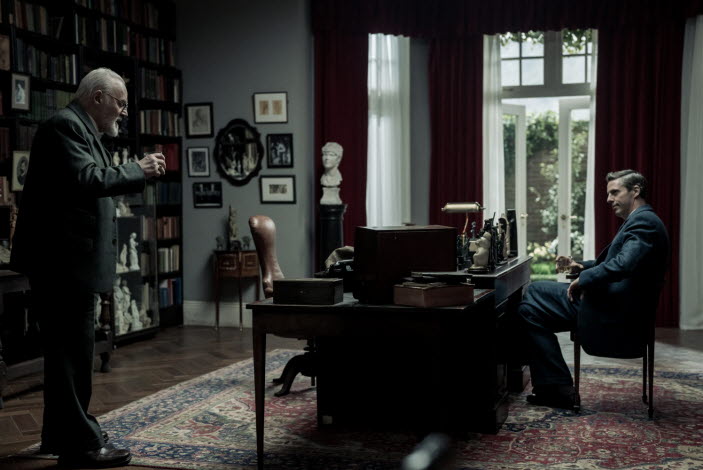
Any good two-hander movie should trust its characters and performers, but “Freud’s Last Session” does not do that much. Here are two fascinating real-life figures who might have an interesting conversation if they had really had a private meeting in real life, but the movie often gets distracted by some other things besides what is going on at the center of its story, and the overall result is rather middling despite the good efforts from its two lead performers.
These real-life figures in question are Dr. Sigmund Freud and C.S. Lewis, and the movie, which is based on the stage play of the same named by co-writer Mark St. Germain, focuses on one fictional meeting between them shortly after the beginning of the World War II in 1939. As an Oxford professor who has a deep faith in God and religion, Lewis (Matthew Goode) surely has a lot of things to discuss with Dr. Freud (Anthony Hopkins), and Dr. Freud is eager to meet Lewis even though he knows well that his atheistic viewpoint will clash with Lewis’ religious faith in one way or another.
Once they meet each other in Dr. Freud’s current residence in London, they naturally begin to pull and push each other in their following intellectual conversations, and they certainly come to talk more about themselves to each other. While Lewis willingly talks about how his father became quite distant to him and his younger brother after their mother’s death, Dr. Freud tells a bit about his difficult relationship with his strict Jewish father, and he also shows his growing concern about the ongoing war in Europe. After all, he recently fled to England from his country along with his dear daughter Anna (Liv Lisa Fries), and his mind often cannot help but swept by the memories of how things were grim for him and his family in Austria due to the political rise of Adolf Hitler and his Nazi party.
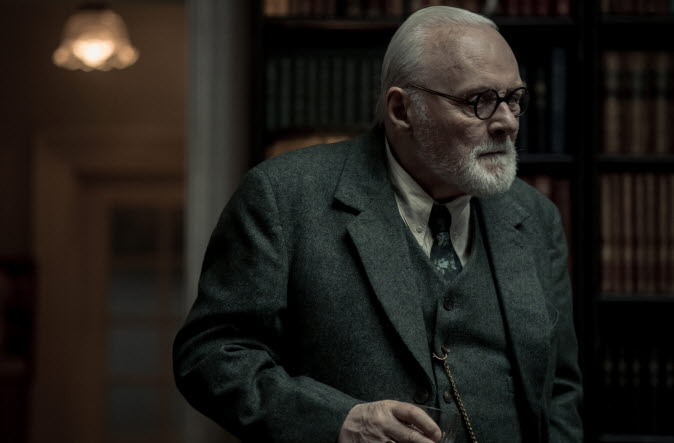
Of course, their different viewpoints on God and religion lead to some argument between Lewis and Dr. Freud, but the movie somehow fails to generate more interest to hold our attention. Their argument simply shows what has been generally known about each of them to us, and it is also frequently interrupted by several things including an air raid alarm and Freud’s deteriorating medical condition. In addition, there is also a subplot involved with Anna’s complex relationship with her father, who still depends a lot on her but does not approve much of what is going on between Anna and her female romantic/professional partner.
If these and other supposedly minor plot elements just stayed around the fringe of the story instead of interrupting the narrative flow between its two main characters, the movie could be more focused in terms of story and characters. After all, it has two very talented performers at its center, and I wonder whether the movie could be more improved if it simply observed and listened to whatever is being exchanged between them for around 2 hours.
Their efforts are sadly undermined by the rather unfocused screenplay, but Anthony Hopkins and Matthew Goode are mostly solid whenever their characters make some interesting interactions across the screen. Hopkins, who remains active as before even though he will soon have his 87th birthday, has some fun with his role as expected, and that is always evident whenever we see the twinkles in his eyes. Although he is frequently reminded of how he is dying day by day, Dr. Freud still cannot resist having an intellectual argument with somebody as smart as him, and Hopkins did a good job of balancing his role between humor and pathos while thankfully not resorting to a thick German accent (I can easily imagine how Laurence Olivier would ham it up like he did in “The Boys in Brazil” (1978), you know).
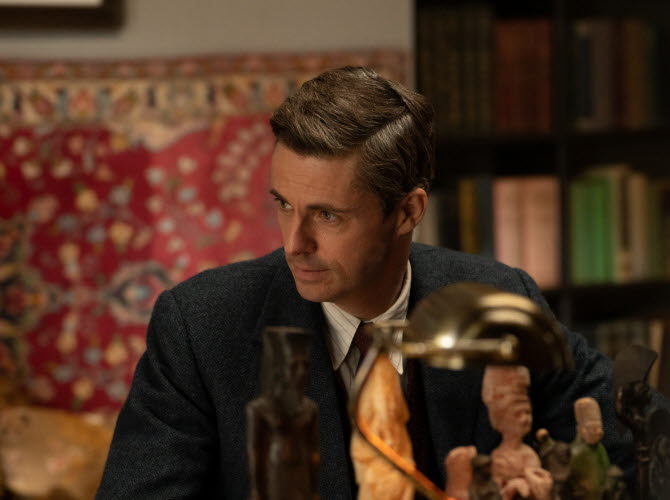
On the opposite, Goode is less showy in comparison, but his unflappably earnest acting complements well Hopkins’ showier acting, and he is particularly good when his character, who was incidentally played by Hopkins in “Shadowlands” (1993), reminisces about how traumatizing his World War I experience was. Even though the movie throws another redundant flashback scene at that point, Goode manages to convey to us how his character was changed a lot by his war experience, and we come to understand a bit of his strong faith in God and religion.
Around Goode and Hopkins, there are several other performers who manage to leave some impression despite their thankless supporting roles. Liv Lisa Fries is well-cast as Freud’s long-suffering daughter, who surely deserves her own story to tell in my humble opinion. Jodi Balfour clicks well with Fries as Anna’s romantic/professional partner, and Jeremy Northam is rather under-utilized as a caring friend of Dr. Freud.
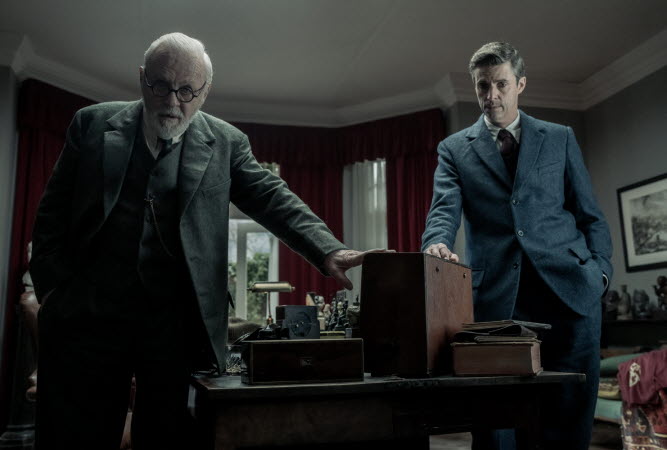
On the whole, “Freud’s Last Session”, directed by Matthew Brown, has some interesting moments to observe thanks to Hopkins and Goode, but it eventually fizzles without much satisfaction, and you probably should check out some other movies associated with Lewis or Dr. Freud instead. “Freud” (1962) and “Shadowlands” already came to my mind, and I especially recommend the latter, where Lewis comes to question a lot on his faith in God and religion as going through the joy and pain of his unexpected middle-age romance. After being dissatisfied with “Freud’s Last Session”, I felt an urge to revisit “Shadowlands”, and I will surely do that sooner or later.


 Seongyong's Private Place