

“The Devil’s Bath”, which was recently selected as the Austrian submission for Best International Film Oscar in the next year, made me seriously conflicted about whether I can recommend it to others. Here is a well-made psychological horror period drama film which will definitely leave you a very unpleasant but undeniably strong impression for good reasons, and I suggest you that you should brace for yourself before trying this relentlessly grim and chilling film.
The movie, which is set in some rural town of Austria in the 18th century, establishes its chilly mood and austere attitude right from the shocking opening scene, where some woman kills a little baby just because she wants to die. Yes, she could kill herself instead, but suicide is not an acceptable option for her from the beginning due to a religious reason, and she willingly submits herself to the local authorities without any hesitation.
And then we are introduced to another woman living in that area. Her name is Agnes (Anja Palschg), and she is about to marry a guy named Wolf (David Scheid), but things turn out to be far less hopeful than she expected. While her husband is a fairly nice guy, he does not seem to be particularly attracted to her as shown from their utterly joyless wedding night. Furthermore, her mother-in-law frequently hovers around them as Wolf and Agens’ residence happens to be not so far from his family home, and Agnes’ mother-in-law usually points out how unprepared Agnes is as a wife in many aspects.
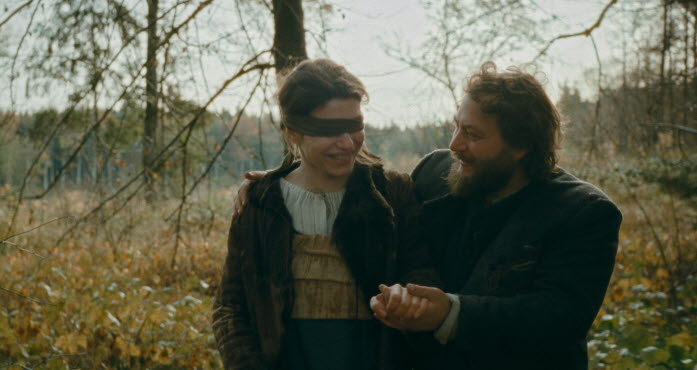
While Agnes struggles to get accustomed to her new environment, the movie gradually conveys to us her apparently fragile state of mind. She often feels lonely and isolated without anyone she can casually talk with, and that makes her more anxious and depressed day by day. At one point, she actually looks like considering befriending a certain pregnant woman in the town, but her mother-in-law does not approve of that at all because that pregnant woman seems to have some bad reputation. In addition, the movie implies a hidden reason behind Wolf’s apparent disinterest in his wife, and that leads to a devastating personal moment later in the story.
As she is frequently demanded to work more and also have a child someday as usual, Agnes slowly descends into more mental deterioration. While the movie does not spell out each step of this disturbing happening of hers, directors/writer Veronika Franz and Severin Fiala, who previously drew our attention for their very disturbing debut film “Goodnight Mommy” (2014), fills the screen with the gloomy aura of inevitable doom, and they firmly stick to their coldly detached storytelling approach. Even when their heroine is driven further into her ongoing downward spiral, the movie remains cold and distant as before, and that makes us all the unnerved than before.
In the end, as already announced to us during the early part of the film, Agnes eventually begins to pass the point of no return, and that is where I came to have more reservation on how the movie is about. Based on the historical research and records on the two shocking real-life incidents in Austria during the 18th century, the movie surely wants to make a strong feministic point about how numerous women got their spirit crushed by those toxic influences of patriarchy during that point, but I must confess that I winced more than once as observing its cold-blooded objective presentation of the stark horror of its real-life stories. This is quite unpleasant to say the least, and this disagreeable impression is further accentuated by the truly nihilistic finale which comes right after when Agnes finally gets what she has desperately wanted.

Nevertheless, I also found myself admiring how the technical details serve the directors’ uncompromising vision and storytelling. The cinematography by Martin Gschlacht, who deservedly received the Silver Bear award for his considerable technical contribution when the movie was premiered at the Berlin International Film Festival early in this year, is vivid and realistic in every individual shot, and you will come to sense more of what has been tormenting Agnes’ mind, even while observing her descent into madness from the distance. The editing by Michael Palm is concise and efficient as steadily building up the narrative momentum of the film, and the sparse but effective score of the film provides extra moodiness to the screen.
As the center of the film, Anja Plaschg, who also composed the score, dutifully carries the film with her good low-key performance. While we never get to know much about her character, Plaschg is still believable in the accumulating madness inside her character, and she is also supported well by several supporting performers including Maria Hofstätter and David Scheid.
On the whole, “The Devil’s Bath” is certainly not something you can casually watch on Sunday afternoon, but I eventually decided to recommend this gut-wrenching piece of work for its mood, storytelling, and performance despite some reservation. As my late friend/mentor Roger Ebert once wrote in his famous rebuttal letter to the filmmakers of “Chaos” (2005), we should merely not depict evil, but we should express an attitude toward evil, and, for now, I guess “The Devil’s Bath” did that job fairly well even though it made me very, very, very uncomfortable from the beginning to the end.


 Seongyong's Private Place