
Jane Schoenbrun’s first feature film “We’re All Going to the World’s Fair” alternatively baffled and fascinated me. On one hand, I was fascinated with its interesting storytelling approach which clearly shows its director’s distinctive personality and talent. On the other hand, I was often frustrated with its rather slow and opaque narrative which may also demand some patience from you.
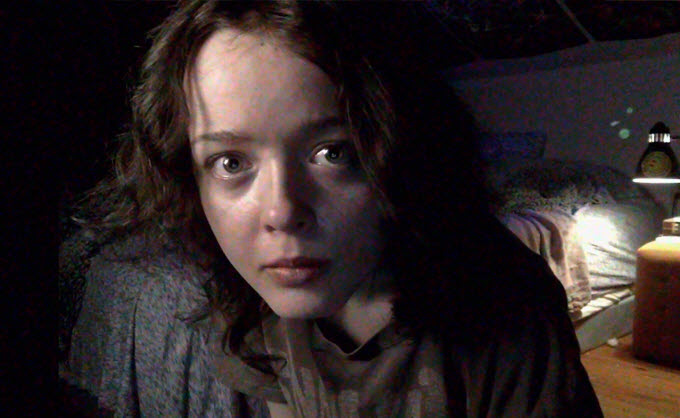
At first, the movie revolves around Casey (Anna Cobb), an adolescent girl who looks quite isolated in one way or another. While she lives in the attic of a cozy suburban house, we never get any information about whom she has lived with, except when someone comes in the house and then complains about the noise from her attic later. It seems that she is your typical loner, and we are not so surprised to see that her daily life is usually spent on making videos to be posted on her private online channel, though, as far as I can see from the screen, she has not drawn many viewers yet.
The opening scene shows Casey trying what may draw more viewers. There has been a viral online activity called “World’s Fair Challenge”, and she is willing to participate in this activity even though it looks like something much riskier than, say, ice bucket challenge. All one has to do is saying “I want to go to the World’s Fair” three times and then doing several required things in front of a computer screen, but those online people have claimed that this seemingly harmless act can lead to some serious mental/physical changes.

Anyway, Casey seems willing to take the possible risk because she is lonely and desperate. During the first half of the film, we see more of her isolated status filled with ennui and loneliness, and she is eager to show anything weird which may happen to her. As closely observing her, you may come to have some understanding on why some people gladly record themselves doing weird things and then post that on the Internet.
When she attempts to record her sleep at one night, Casey happens to receive a weird warning message from an unknown person. This unknown person, JLB (Michael L. Rogers), wants to talk with her about whatever is happening to her right now, and Casey accepts this guy’s approach because, well, she has no one else to talk with, though this person keeps his identity hidden even when they talk more and more about the possible consequences of World’s Fair Challenge.
Because his voice sounds much older than Casey, we naturally fear for her safety, but then the movie shifts its viewpoint a bit to JLB, who turns out to be a plain older dude who is probably as lonely and desperate as Casey. Just like her, he also resides in a suburban house located somewhere, and we seldom see anyone else besides him in the house. At one point, we see a person moving in the background, we are never sure about who that person is or what that person is doing over there.
During the second half of the film, the movie observes Casey slowing going down her own online rabbit hole along with JLB, who keeps encouraging her to make more videos of hers. As days go by, she comes to show a series of strange behaviors, and the movie sometimes shows rather disturbing online videos associated World’s Fair Challenge. Not so surprisingly, she eventually looks more disturbed than ever, and there is a painfully harrowing scene involved with a certain precious childhood stuff of hers.

However, the movie never clarifies what is exactly going on inside Casey’s mind, and it is also rather ambivalent about the disturbing sides of World’ Fair Challenge. Is this challenge really as dangerous as calling the titular character of “Candyman” (1992) three times in front of the mirror? Or, is this just another mindless online trend which happens to become too popular around the Internet? The movie does not answer these and other questions at all even, and we also cannot be totally certain about a supposedly sincere confession scene later in the story.
Nevertheless, the movie still holds our attention as steadily maintaining an elusive aura of creepiness under Schoenbrun’s deft direction, and Anna Cobb, who incidentally made a debut here in this film, did a splendid job of embodying her character’s growing desperation behind the disaffected façade. Although we are not always sure about whatever her character is feeling and thinking, Cobb constantly draws our attention with her unadorned acting, and we come to care more about whatever may happen to her character in the end. On the other side, Michael J. Rogers effectively complements his co-star throughout the film, and his detached performance also never makes us less guarded as contributing extra creepiness to the screen.
On the whole, I am less enthusiastic about “We’re All Going to the World’s Fair” than many other reviewers, but it surely shows Schoenbrun’s considerable potential as a filmmaker, and Schoenbrun already moved on to “I Saw the TV Glow” (2024), which is the second part of Schoenbrun’s Screen trilogy after this movie. Although watching “We’re All Going to the World’s Fair” turned out to be more like doing a homework before “I Saw the TV Glow”, but it was an interesting experience to some degree, and I hope I will be more interested and entertained in “I Saw the TV Glow”.


 Seongyong's Private Place