

Jane Schoenbrun’s second feature film “I Saw the TV Glow” is a disorienting but compelling piece of work to admire for mood and style. While it feels rather thin in terms of story and characters, it is at least filled with enough personality and atmosphere in addition to being driven by considerable emotional intensity, and its strikingly mind-bending aspects are something you cannot easily forget after it is over.
The early part of the film, which is mainly set in 1996, is about how its introverted hero gets obsessed with “The Pink Opaque”, a fictional TV show for young adults. Although he has only watched its promotional clips on TV, Owen, played by Ian Foreman at this point, becomes quite fascinated with this fictional TV show, but he is not allowed to watch it at late night just because his father thinks it is just for girls.
However, Owen soon comes to find a way to watch “The Pink Opaque”. On one day, he happens to come across an older girl named Maddy (Brigette Lundy-Paine), who happens to be reading the episode guide of “The Pink Opaque” during their first encounter. Maddy gladly suggests that he should spend a night along with her at her house for watching “The Pink Opaque” together, and Owen does not hesitate to go along with that, though he has to tell a little lie to his parents for that.
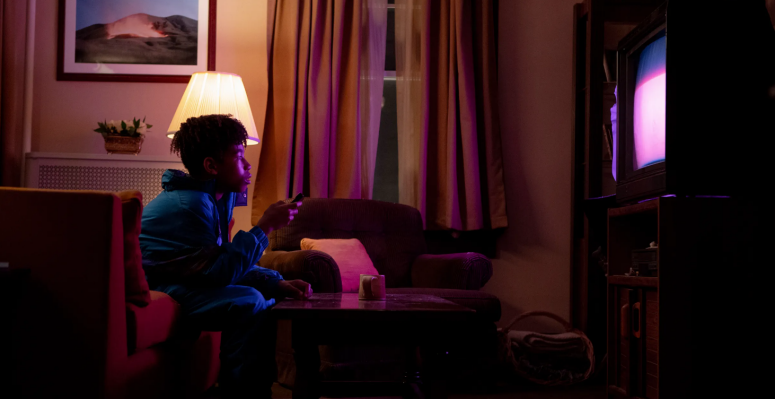
After their first night with “The Pink Opaque”, Maddy begins to show Owen more episodes of “The Pink Opaque”, which may amuse you a bit for its authentic details which will probably take you back to those old popular TV series of the 1990s such as “Buffy the Vampire Slayer”. It is about two adolescent girls who happen to share a supernatural power between them, and each episode is about how they bravely fight against a number of various henchmen sent by their powerful archnemesis including a vicious duo named Marco and Polo (I am not kidding at all).
While they become closer to each other during next two years, Maddy comes share more of herself with Owen, who is now played by Justice Smith. At one point, she frankly reveals her sexual identity to him, and then Owen finds himself getting confused about his sexual identity. He does not know how to express and then handle his confusion, and he becomes more distant to his parents even when her mother is about to die due to her unfortunate terminal illness. He has no idea on how to deal with this impending personal issue, and he becomes more nervous when he comes to learn about how much Maddy wants to get away from their suburban neighborhood.
During its second half, which moves the story forward to 10 years later, the movie goes for more bafflement and confusion, and Schoenbrun and cinematographer Erik K. Yue continue to fill the screen with dreamy qualities. As its hero becomes more confused about his status of mind, the movie often catches us off guard with odd but undeniably striking moments, and everything eventually culminates to a stupefying monologue scene where Owen’s mind gets more shaken up by his growing confusion. Is his life actually a fake reality? Or, is he simply stuck in his increasingly disturbed mind?
If you watched Schoenbrun’s previous film “We’re All Going to the World’s Fair” (2021), you surely know well in advance that Schoenbrun will not give you any easy answer at all. The movie keeps going back and forth between the two possibilities surrounding its hero as he gets more baffled about whatever he is experiencing, and it does not let us get off easily even during its adamantly ambiguous finale.
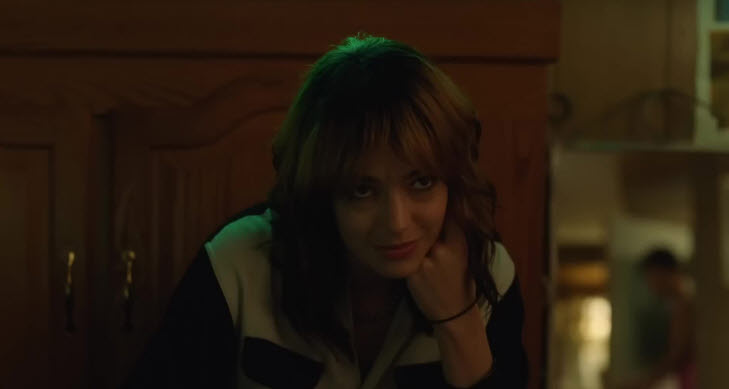
In case of thematic aspects, the movie is certainly a rich ground filled with queer materials to be appreciated. Considering how both Maddy and Owen are not so fine or comfortable with who they are supposed on the surface, the story can be interpreted as a transgender fantasy fable, and “The Pink Opaque” can be regarded as the projection of whatever they feel inside themselves.
Although the movie sometimes stumbles more than once during its second half, it is still carried well by its two lead performers, who come to function as its emotional center as they revolve around each other along the story. Justice Smith, a promising actor who has steadily advanced during last several years since I noticed him in “Jurassic World: Fallen Kingdom” (2018), gives his best performance to date, and he is often poignant in his character’s emotional struggles with his sexual identity. On the opposite, Brigette Lundy-Paine, who has been mainly known for her supporting turn in Netflix TV series “Atypical”, is equally wonderful as bringing enough spirit to the screen whenever coming upon the screen, and I am sure that we will see more of this non-binary actor’s considerable talent during next several years.
On the whole, “I Saw the TV Glow” is distinctive and interesting enough to compensate for its several weak aspects including its rather uneven narrative pacing, and the overall result shows how much Schoenbrun has advanced after “We’re All Going to the World’s Fair”. This non-binary filmmaker’s movies are still an acquired taste to me, but “I Saw the TV Glow” confirms that they are another interesting filmmaker to watch, and I will certainly have some expectation on whatever will come next from them.


 Seongyong's Private Place
Pingback: 10 movies of 2024– and more: Part 2 | Seongyong's Private Place