

Canadian film “Brother” surprises me for being more sensitive and thoughtful than I expected. On the surface, it may look typical as another black slum neighborhood drama film, but it comes to show more heart and soul as its introverted hero struggles to deal with his past and present along the story, and it is really poignant for us to observe and understand how much he is haunted by the memories of his dear big brother.
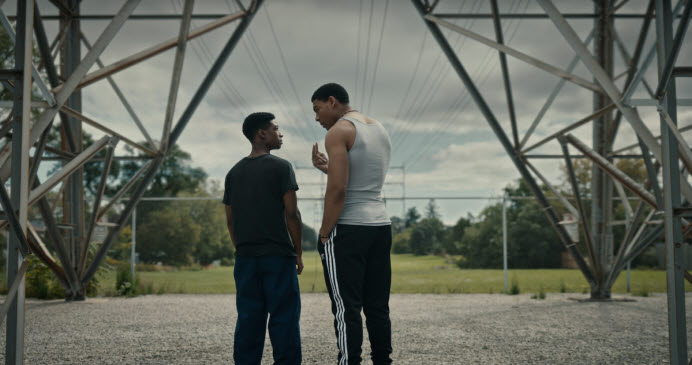
At first, the movie, which is mainly set in the 1990s, gradually establishes the history between a young black man named Michael (Lamar Johnson) and his older brother Francis (Aaron Pierre). They grew up together under their single Jamaican mother Ruth (Marsha Stephanie Blake), and a series of early flashback scenes show us how often Michael leaned on his older brother even they were just little young boys. When they grow up more later, Francis becomes a big, hulking dude who is virtually a father figure/protector to his younger brother, and Michael, who always looks rather timid whenever he is with his older brother, still depends a lot on his older brother while not so sure about what to do about his life.
And we see how things can be pretty harsh in their black slum neighborhood in the Scarborough district of Toronto, Ontario. Like many other black people in their neighborhood, their mother is frequently absent due to her demanding menial job, and she is often too exhausted to pay attention to them even when she is at their little apartment. Outside their little residence, many criminal incidents occur day by day, and it goes without saying that the local police are not so nice to any young black man out there.

Not so surprisingly, Francis wants to get out of his neighborhood as soon as possible, but that inadvertently causes a conflict between him and his mother, who is not so pleased at all when he suddenly decides to quit his high school for pursuing the career of a rap music producer. While he eventually moves out of his family residence, Francis remains close to his younger brother as before, and Michael sincerely hopes that things will eventually work out well for his older brother.
We already know well that things did not go that well for them, as the movie often moves forward to how Michael tries to move on without his older brother several years later. While stuck in a plain part-time job as his older brother once was, Michael also has to deal with taking care of his increasingly senile mother, but he cannot help but feel lost as being more aware of his older brother’s absence, and he is not even consoled much by his old sweetheart Aisha (Kiana Madeira), who returned to their neighborhood shortly before her father’s death. Understanding well how painful it is to lose a loved one, she generously attempts to help him dealing with his anger and grief, but Michael still hesitates to do that, and this causes a big conflict between them.
As frequently going back and forth between several different time periods, the screenplay by director/writer Clement Virgo, which is based on the novel of the same name by David Chariandy, reveals more depth in terms of story and characters. While we come to see that Ruth has had a fair share of frustration and exasperation as trying to support and raise her two boys alone by herself, Francis turns out to have a little soft and sensitive side behind his confidently masculine side, and that is evident particularly after he and his younger brother get their hearts broken by the rejection of someone who may be their biological father.

These and other personal moments are often alternated with the grim moments of the harsh reality surrounding the main characters. There is an intense scene when Michael and Francis happen to confront a bunch of local thugs, and the mood becomes quite tense when Francis shows these thugs that he is definitely not someone they can mess with. In case of several scenes involved with police brutality, the movie does not pull any punch at all, and we see how traumatic these infuriating moments are to both Francis and Michael.
The movie is supported well by the two very good performances from Lamar Johnson and Aaron Pierre, who gradually come to us as the heart and soul of the film. While Johnson, who recently drew more attention thanks to his Emmy-nominated guest appearance in HBO TV drama film “The Last of Us”, diligently holds the center with his earnest performance, Pierre, who recently appeared in Barry Jenkins’ acclaimed TV miniseries “The Underground Railroad”, is equally solid in his nuanced acting, and they did an effortless job of embodying the long history between their characters. As Francis and Michael’s long-suffering mother, Marsha Stephanie Blake has several strong moments to remember, and Kiana Madeira brings some warmth to the story as her character tries her best for the man she still cares about.
In conclusion, “Brother” is a rather tough stuff, but it handles its story and character with enough sensitivity and thoughtfulness, and you will be moved by a little glimpse of hope around the end of the film. Considering that it was quickly released and then gone in US in last year, this little but impressive piece of work deserves some more attention in my humble opinion, and I assure you that you will not forget it easily after it is over.


 Seongyong's Private Place