

As watching Sylvain Chomet’s live action film “Attila Marcel”, which was somehow re-released in South Korean theaters in last week, I could not help but wonder whether it worked better it were an animation film. In my inconsequential opinion, many of the colorfully whimsical touches here and there in the movie could be more impressive if they were presented in animation, and, after all, Chomet already delighted us a lot with his own distinctive animation style in his two Oscar-nominated animation films “The Triplets of Belleville” (2003) and “The Illusionist” (2010). Sure, it is quite clear that Chomet has a fun with making his first live action film, and the result is fairly enjoyable on the whole, but I still have some reservation on whether the movie works as well as intended.
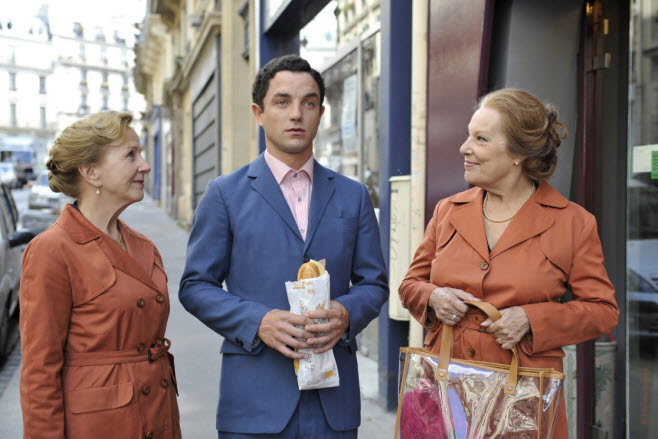
The story mainly revolves around Paul (Guillaume Gouix), a mute young Parisian pianist who has lived with his two aristocratic aunts for many years since his parents died under some unfortunate circumstance when he was very young. As a matter of fact, that incident in question is so traumatizing that he has been incapable of speaking, and he usually focuses on honing his piano performance skill whenever he is not working at a dance class managed by his aunts.
Paul and his aunts have resided in a big and cozy apartment full of old stuffs besides one grand piano which has been the center of his daily life, and we observe how domineering both of his two aunts can be to their nephew. They frequently behave like your average overprotecting parents, but they always make sure that their nephew’s daily life is consistently maintained everyday, and they also tolerate his several quirky sides including the nearly obsessive fondness of chouquettes, a small French patisserie which looks a bit like cookie on the surface.
And then, of course, there comes an unexpected change into Paul’s seemingly repetitive daily life. Via a blind man who has worked as a piano tuner for him and his aunts, he happens to encounter Madame Proust (Anne Le Ny), a middle-aged woman living below his apartment. When he enters her smaller apartment, he is caught off guard by how she made her apartment into a little secret garden of hers, but then he soon finds himself quite soothed by the enchanting qualities of her garden, and, above all, he finds herself drawn to the magical power of her special tea, which is incidentally handed to him with pieces of madeleines.
Now some of you are probably reminded of French novelist Marcel Proust’s magnum opus “In Search of Lost Time”, which was incidentally one of the most important novels in my adolescent period along with James Joyce’s “Ulysses”. Despite reading all of it twice during that time, I cannot tell you whether I totally get this masterpiece even at present, but I still remember lots of things vividly remembered by its hero, and that is probably the whole damn point of that fascinatingly sprawling novel.
Anyway, just like that tea and madeleines initiates a long stream of memories from the mind of the hero of “In Search of Lost Time”, Madame Proust’s special tea served with madeleines awakens the repressed childhood memories somewhere inside Paul’s consciousness. Although he was only 2 not long before his parents passed away, he could somehow vividly remember his parents more than before, and their several happy moments in the past are accompanied with a series of colorful musical scenes. While they were not exactly a perfect couple, Paul’s parents passionately and sincerely loved each other nonetheless, and their deep trust and love are wildly and amusingly depicted when they are going to perform a rather risky act of entertainment together in front of their cheering audiences.

It is not much of a spoiler to tell you that the story subsequently gets darker as Paul’s mind eventually approaches closer to the origin of his personal trauma, but that is where Chomet’s screenplay begins to stumble more than once. While the mood becomes quite melodramatic as expected during the last act, the whimsical style of the movie sometimes prevents it from generating more necessary gravitas for the story, and its main characters remains merely broad and cartoonish without much human depth for engaging us more. In case of a subplot involved with the possible romance between Paul and a certain adopted Chinese girl, this feels rather under-developed to my disappointment, and the movie is not that successful when it attempts for more laughs via the racial prejudice of Paul’s aunts.
Anyway, the main cast members are solid in their respective parts. Besides playing Paul’s father in the flashback scenes, Guillaume Gouix brings some poignancy to Paul’s isolated status, and Anne Le Ny is believable with the aura of your average spiritual healer. Bernadette Lafont and Hélène Vincent are as boisterous as required by their comic supporting roles, and Fanny Touron is also solid as Paul’s spirited mother.
In conclusion, “Attila Marcel” is not as impressive as Chomet’s previous works, but I recommend it mainly because it has enough visual goodies to hold your attention at least for a while. Although he has been not so active after “Attila Marcel” for more than 10 years, Chomet is currently working on the biopic of Marcel Pagnol which may come out in the next year, and I sincerely hope that I will be more engaged and entertained by his next work.


 Seongyong's Private Place