
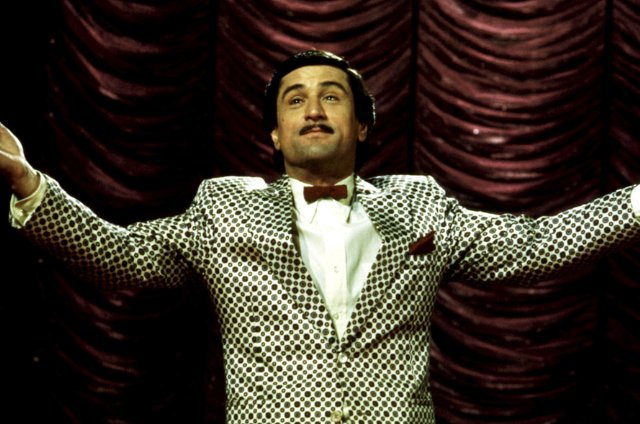
Congratulations, Mr. Rupert Pupkin. You are definitely one of the creepiest movie antiheroes in the history of cinema, but you and your little “comedy” movie, Martin Scorsese’s “The King of Comedy”, have somehow persisted for more than 40 years, despite being weirdly not “funny” on the surface. You are truly incorrigible as being so obtuse to a series of painful rejections along your story. You are utterly delusional as being so absorbed in your loony obsession with fame. You are truly pathetic even as you seem to fulfill your crazy goal at last. Nevertheless, you remain in our collective memory even though most of us think your movie is neither comic nor tragic in any conventional way.
Pupkin is played by Robert De Niro, who gives a one-of-kind performance which feels quite different from whatever he did later in a bunch of comedy films such as “Analyze This” (1999) during last 25 years. Those films show that he can be fairly funny, but his performance in “The King of Comedy” is not exactly something which can be merely described as funny. Here is a hopelessly isolated character rather chillingly incapable of having any kind of meaningful communication with several others who unfortunately happen to be around him, and we usually wince a lot whenever he attempts to be funny or social to them. Along with the movie, De Niro’s performance deliberately blocks any possibility of pity or empathy from us, and Pupkin comes to feel more like a case study to observe with more horror and embarrassment on the way.
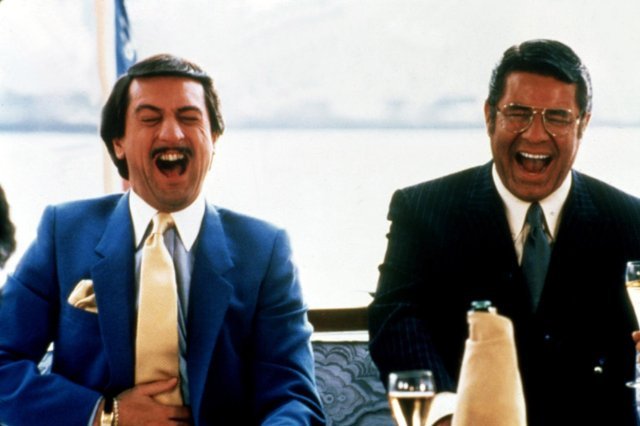
Pupkin’s target of obsession is a popular late-night TV talk show host named Jerry Langford (Jerry Lewis), who has already been quite accustomed to being pursued by many fanatic fans not so different from Pupkin. As a matter of fact, we see him caught off guard by the sudden ambush of one of his more deranged fans, and that is how Pupkin comes to have a little private conversation with Langford as Langford is returning to his apartment. As Pupkin clumsily tries to impress Langford more, it is quite evident to us that Langford distances himself from Pupkin as much as possible, and we get all the more embarrassed as observing more of how much Pupkin is oblivious to Langford’s increasing annoyance.
Mainly for getting rid of Pupkin, Langford makes a little inconsequential promise in the end, but, alas, this leads to more delusion in Pupkin’s troubled mind, and then the movie begins to blur the line between reality and delusion. As his delusion is getting bloated more and more, Pupkin’s pathetic reality is much more obvious to us, and we get a small bitter laugh whenever Pupkin’s self-absorbed state is disrupted by the voice of his annoyed mother from the upstairs (It is actually the voice of Scorsese’s mother, by the way).
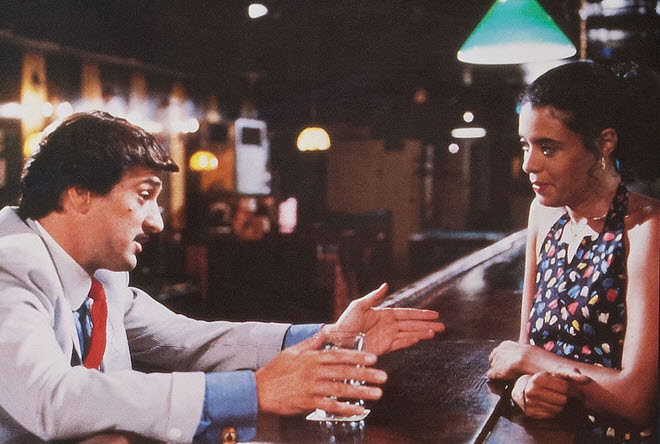
At least, Pupkin gets a likely chance for admiration via Rita Keene (Diahnne Abbott), a young black female bartender who was one of Pupkin’s schoolmates during his high school years. Probably because of their old time’s sake, she lets him have a dinner date with her, and he gladly boosts himself a lot in front of her, but she is just mildly amused while noticing more of what is going on right behind his back. A certain guy sitting alone in the background is quietly listening to everything and then silently making a fun of Pupkin, but Scorsese makes an interesting visual choice here. As the camera keeps focusing on Pupkin and Keene, that minor supporting figure remains in the background all the time. Consequently, a sense of embarrassment slowly dawns upon us as we gradually come to discern what is really going on, and we cringe more as watching how Pupkin’s date night ends unsuccessfully.
Meanwhile, Pupkin is getting rejected again and again by Langford and his associates, but, not so surprisingly, he still does not understand his grim and pathetic situation at all. This eventually results in one of the most painfully embarrassing moments in the film, which still made me wince a lot as I revisited the movie yesterday. Pupkin willfully comes into a private space of Langford along with Keene, and Langford is certainly not so amused to say the least. Even when Keene belatedly comes to realize that Pupkin lied to her, Pupkin remains obtuse to Langford’s growing anger and annoyance, and we are all more embarrassed before Langford finally decides that enough is enough.
Curiously, Scorsese presents this supposedly big comic moment as dryly as possible just like many other key scenes in the film. The camera of his cinematographer Fred Schuler often sticks to static positions, and it usually maintains the distance from the main characters while mostly avoiding close-ups throughout the movie. In addition, the spaces occupied by the main characters frequently feel empty and barren without much sense of life. Langford’s apartment and country house look more like under-furnished art galleries than real human places to live, and New York City in the film is presented as a bland and uncaring urban environment where its main characters are isolated in one way or another. Yes, New York City shown in “Taxi Driver” (1976) may feel like a very unpleasant nightmare at times, but it is full of life and personality at least, and “The Comedy of King” is often devoid of that.
The screenplay by Paul D. Zimmerman seems to go for a cathartic punchline when Pupkin and a fellow fanatic fan kidnap Langford later in the story, but, again, Scorsese adamantly restrains himself and the movie. When Pupkin finally gets the chance of presenting himself on TV, Scorsese and his longtime editor Thelma Schoonmaker simply cut to the aftermath, and the movie continues to stick to its hero’s delusional viewpoint as before. We do see him appearing on TV later, but we are never sure about the audience reactions, and the same thing can be said about the ending, which may be as delusional as the final scene in “Taxi Driver”.
It is well known that Scorsese was not exactly in a good condition when he was making the movie at that time. While his third marriage was over, he was also quite physically exhausted after making “Raging Bull” (1980) and two other works within a rather short period of time, and he was even not fully recovered yet when the production of “The King of Comedy” began. This probably explains why the movie is less visually lively and kinetic compared to many of his works in addition to often feeling dry and distant, but the result is still memorable in some ways, and that surely says a lot about his immense filmmaking talent.
Now I wonder whether the movie can be regarded as a sort of apology to “Taxi Driver” just like Brian De Palma’s “Carlito’s Way” (1993) is to “Scarface” (1983). As many of you know, “Taxi Driver” was controversial especially when it got associated with the assassination attempt of President Ronald Reagan in 1981, and Scorsese might have intended to present “The King of Comedy” as the comically straight-jacketed version of “Taxi Driver”. While Travis Bickel, the equally pathetic hero of “Taxi Driver” who is also played by De Niro, gets some emotional ventilation via his very violent act in the end, Pupkin looks destined to be stuck in his delusional mind without any emotional catharsis even at the end of the story, and that makes him all the more pathetic and chilling than before.
Although De Niro’s performance is the main show, the three other main cast members in the film show considerable commitment in their substantial supporting parts. While he is usually remembered for those wacky comedy films such as “The Nutty Professor” (1963), Jerry Lewis ably dials down his comic persona here for playing an aloof counterpart to De Niro, and the result is one of his best performances. As Pupkin’s possible love interest, Diahnne Abbott holds her own place well during her several key scenes, and Sandra Bernhard is simply unforgettable as a woman who may be a lot more toxic and dangerous than Pupkin. These three performers and De Niro are quite convincing in the lack of any genuine communication between them, and Roger Ebert aptly points out that in his 1983 review; “…because nobody listens in this film; everybody’s just waiting for the other person to stop talking so they can start.” He might as well be describing what is happening on the Internet everyday. Sigh.
On the whole, “The King of Comedy” is one of those movies you cannot easily like but then cannot help but remember at times, and its status has surely been growing during last several decades. As we get more accustomed to comedy of embarrassment thanks to many other comedy films and TV series such as “The Office”, the movie becomes more, uh, accessible to us, and it garnered much more attention as being a major influence on “Joker” (2019) along with “Taxi Driver” (Whether that movie can be regarded as the 21st century heir to both of these two Scorsese movies is another matter to discuss).
By the way, I heard from one of my online acquaintances that there have actually been lots of people who identified themselves a lot with Pupkin, and I was both horrified and amused by that. I understand to some degree why some people can identify themselves too much with Travis Bickle or Arthur Fleck in “Joker”, but Rupert Pupkin? Are you serious? Considering how Pupkin can be regarded as someone more dangerous and degenerate than Bickle or Fleck, now I am seriously wondering whether this is another sign of the ongoing human devolution in our time.


 Seongyong's Private Place