
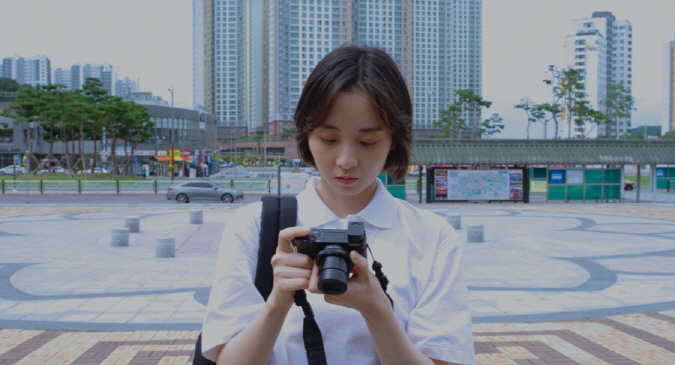
South Korean independent film “Jinju’s Pearl” is a simple but intimate drama to be appreciated for several good reasons. Although it stumbles more than once due to the uneven mix of comedy and melodrama during its last act, the movie works whenever it simply and calmly regards the locations of one local city in South Korea, and you come to understand and empathize more with what its heroine and several other characters sincerely try to preserve.
That local city in question is Jinju, and the first act of the movie establishes how its heroine comes to this little but considerably historic city. Her name is also incidentally Jin-ju (Lee Ji-hyun), and she is an aspiring young filmmaker who is about to shoot her first movie, but there comes an unexpected big trouble. A certain old cafe in Seoul was chosen for the main location of her movie, but it suddenly undergoes construction without any notification to her in advance, and Jin-ju becomes quite desperate because of being a week away from the first day of the shooting.
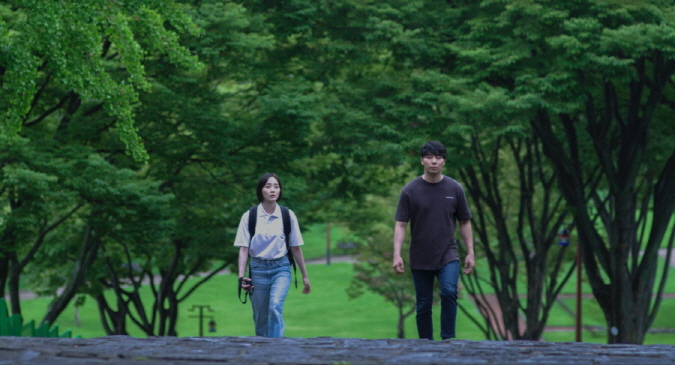
At least, it looks like there may be a quick solution for her big trouble. As suggested by a senior of hers, Jin-ju goes to Jinju where she can probably find not only some other old cafe but also several alternative locations for her movie. As she is guided by a colleague of her senior here and there around the city, it seems that she can actually make her movie there, but she still cannot find any suitable old cafe for her movie, and her guide does not help her much before eventually going away due to some personal matter.
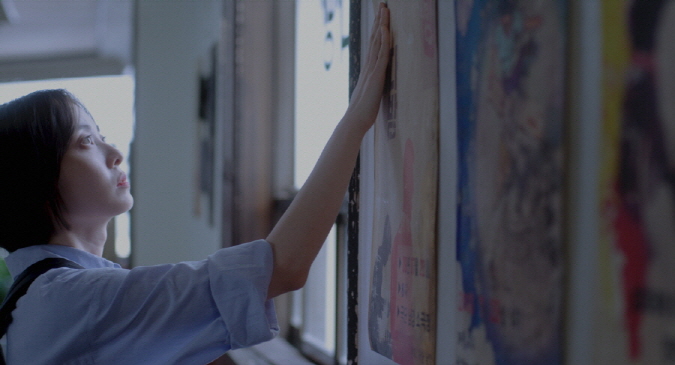
After wandering around in an old neighborhood for some time, Jin-ju comes across the one which can be quite ideal for her movie. Although it looks very plain and shabby, this cafe is filled with a sense of long history with several old posters and paintings on the walls, and that is exactly how she wants the fictional cafe in her movie to look and feel on the screen.
However, Jin-ju soon comes to learn that this cafe will be under construction a few days later because its current owner recently handed it to the next owner. Several local artists who have been its longtime customers are not so pleased about this as the cafe has been their main gathering spot, but it looks like there is really nothing they can do about this immediate change, and that makes them all the more frustrated.
Nevertheless, these artists are determined to try as much as possible for saving and preserving the cafe, and so is Jin-ju, who becomes more motivated as discerning more of how the cafe has been precious for her accidental colleagues for many years. They may look rather silly and inconsequential, but they are also sincere and passionate in their attempt to preserve their dear old place, and Jin-ju understands their feelings well for a person reason to be revealed later in the story.
As Jin-ju and her accidental colleagues try in one way or another, the movie takes its time for observing more of the various locations in Jinju, which is incidentally the homonym of ‘pearl’ in Korean. As it leisurely looks around the locations and people of the city, the movie immerses us more into the local atmosphere of the city, and we come to understand more of why it is sometimes really important to preserve old places for not only mere nostalgia but also history preservation.

And we also come to see how the situation is a bit more complicated than expected. While he has been an old friend to those local artists, the current owner of the cafe has no choice but to give up his failing cafe business, and that certainly makes him feel more conflicted as his artist friends protest more and more. In case of the new owner, who will be revealed later in the story, he is not heartless or thoughtless at all, and, as shown from his subsequent conversation with Jin-ju, he simply chooses whatever will be best for the cafe in his viewpoint.
When Jin-ju and her accidental colleagues become all the more desperate later in the film, the movie tries a little too hard for pulling our heartstrings, and the finale does not work as well as intended as a result. Fortunately, it still holds our attention thanks to the competent direction of director/writer Kim Rok-kyung, and he also draws a quiet but strong performance from his lead actress. As the main emotional center of the movie, Lee Ji-hyun, who played a small supporting role in Kim’s previous film “Festival” (2020), did a good job of carrying the film with her earnest performance, and she is also supported well by several main cast members including Moon Sun-yong, Kim Jin-mo, Lim Ho-jun, and Lee Jeong-eun, who also worked under the director in “Festival”.
In conclusion, “Jinju’s Peral” is another modest but solid work from its director, and it made me more reflective about those old places in my hometown city Jeonju. It is rather overrated as a city for tourism in my humble opinion, but it does have some old valuable places which still mean a lot to me, and now I am thinking of a very old mosque on the east side of my hometown city. Although I mistook it for a bathhouse when I saw it for the first time in the early 1990s, I have been proud of my hometown city having such an old interesting place to admire and cherish, and I will certainly provide some help and support for maintaining and preserving this special place more.


 Seongyong's Private Place