

Japanese animation film “The Imaginary”, which was released on Netflix in last week, will delight anyone who has enjoyed and admired those fabulous animation films from Studio Ghibli. While it does not surpass the better works of Studio Ghibli, the film is still filled with visual goodies to charm and impress you, and you will gladly go along with that while occasionally touched by its earnest storytelling.
At first, we get to know the relationship between a young girl named Amanda (voiced by Rio Suzuki) and her imaginary friend Rudger (voiced by Kokoro Terada), who is well aware of his existence as a piece of his dear friend’s boundless imagination. As Amanda imagines one thing after another in their little fantasy world, she and Rudger have one adventure after another, and it looks like nothing can possibly separate them, though Rudger knows well that their time will not last forever as Amanda grows up day by day.
Amanda is willing to share her imaginary friend with her recently widowed mother Lizzy (voiced by Sakura Ando), but Lizzy’s attention is mostly drawn to how to begin again after her husband’s death. Just like many adults, Lizzy does not believe much in imaginary friend although she did once have such an entity a long time ago as her mother tells her at one point. Nevertheless, she lets her daughter keep playing with her imaginary friend at least, while expecting that she will grow out of that someday.

Meanwhile, something unexpected occurs. Amanda and Lizzy are visited by a stranger who introduces himself as “Mr. Bunting” (voiced by Issey Ogata), and Amanda and Ludger are instantly alarmed because they see a shady ghost figure accompanying Mr. Bunting. It soon turns out that Mr. Bunting has a horrible purpose behind his back, and Amanda and Ludger consequently find themselves in a very dangerous situation.
Around that narrative point, the screenplay by writer/producer Yoshiaki Nishimura, which is based on the children’s book of the same name by A.F. Harrold, takes a sudden plot turn to our little surprise. After getting separated from Amanda due to an unfortunate incident, Ludger comes across a mysterious cat, and Jinzan (voiced by Takayuki Yamada) leads him to a secret place for numerous imaginary figures, which incidentally turns out to be a big public library. Led by a plucky girl figure named Emily (voiced by Riisa Naka), they happily exist and play together whenever they can, and they are certainly looking for any chance to be a temporary imaginary friend to any of those imaginative kids out there.
Needless to say, the film fills the screen with a heap of colorfully wondrous stuffs and details as Ludger gets to know more about his new world and its rules via Emily and his other new friends including a big pink hippopotamus named Snowflake (voiced by Mitsuaki Kanuka). Whenever the library is silent and empty at night, Emily and her fellow imaginary figures make a little fantasy town of their own, and it looks like nothing bad can happen as long as they stay together in this little haven of theirs.
However, Ludger still misses Amanda, and he becomes all the determined to reunite with her even though their time is limited as before. As he goes out to the world outside, he is soon noticed by Mr. Bunting and his ghost associate, and the situation becomes more dangerous as Ludger and his fellow imaginary friends confront the dark imaginary power of Mr. Bunting.
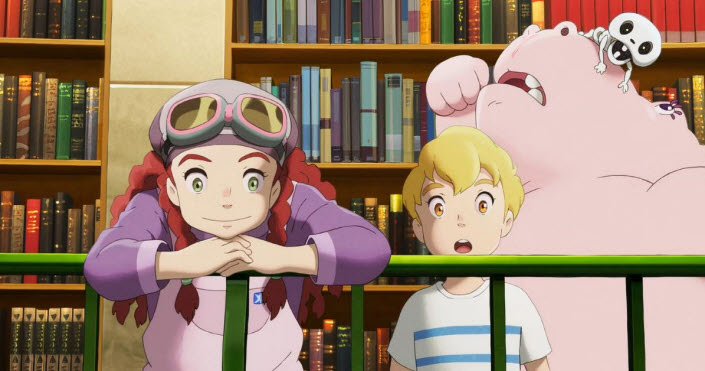
Although the story becomes a bit shaky during its last act, the film continues to engage us with not only its lovely hand-drawn animation style but also the genuine emotions coming from its main characters. While there is undeniable poignancy in Ludger’s attempt to meet Amanda again, we are also moved as getting to know about how Amanda came to have Ludger after her dear father’s death, and there is a modest but powerfully emotional moment when her mother comes to understand her daughter’s grief more while also dealing with her own grief. When the story eventually reaches to the climax part, a lot of things are busily unfolded across the screen, but we still stay focused on the main characters and their drama, and the film also shows some sense of humor to brighten up the mood a bit, as shown from when Ludger comes into the imagination of a friend of Amanda at one point later in the film.
The Japanese voice cast members are solid in their respective parts (Netflix has the other options including the American dubbing, of course). While Kokoro Terada and Rio Suzuki function well as the heart and soul of the story, they are supported well by several other voice cast members including Sakura Ando, Riisa Naka, Takayuki Yamada, Mitsuaki Kanuka, and Issey Ogata, who has a lot of naughty fun with his diabolical villain character.
“The Imaginary” is directed by Yoshiyuki Momose, who also previously worked in several works of Studio Ghibli just like his producer/writer. While it sometimes emulates the works of Studio Ghibli a bit too much, it has its heart in in the right place as doing its own things, and I sincerely hope that more animations films like this will come to remind us that the legacy of Studio Ghibli will continue to live even after its closing time.


 Seongyong's Private Place