

I still remember when I looked around the Contemporary Art section of the Art Institute of Chicago in April 2010. Many of those artworks in that section looked pretty valuable as far as I could see, but I often wondered whether they were simply profound or profoundly simple, and this musing of mine still amuses me even at this point.
And that is why I was quite tickled when I watched “Kill Room”, which is now available on Netflix in South Korea. Although it does not fully push its absurd juxtaposition of crime and art to the end, the movie still provides a number of delicious comic moments making a big naughty fun on the world of art dealing business, and you will be more amused if you are familiar with how things can be pretty silly and outrageous in that business field.
The early part of the movie establishes how things have been desperate for Patrice (Uma Thurman), the owner of a prominent art gallery in New York City. There was a time when her art gallery was one of the hottest ones in the city, but it has often been surpassed by many of its competitors, and she is also losing some of her biggest artists and clients just because she and her art gallery do not look that cool anymore.
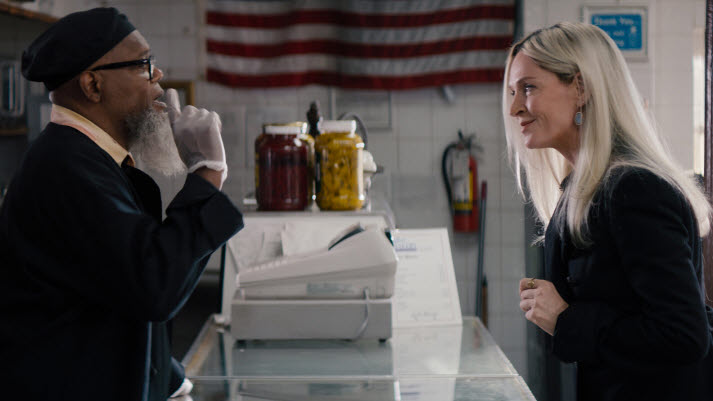
Meanwhile, we also meet Reggie (Joe Manganiello), who has worked for years as a killer under a certain big criminal organization in the city. Although he does not like much his criminal occupation, he has no choice from the beginning because of a personal reason explained later in the story, and we see how he handles his latest job as instructed by Gordon (Samuel L. Jackson), his longtime handler who has incidentally run a little bakery shop as his front business.
On one day, Gordon suggests one supposedly good idea for the money-laundering process of their criminal organization. Considering how artworks are purchased at very high prices in the city everyday without drawing much attention from IRS, they can hide the transaction of their dirty money behind the frequent dealing process of an art gallery, and Patrice’s gallery comes handy to Gordon thanks to her drug dealer who happens to one of Gordon’s associates. While initially rejecting Gordon’s offer, Patrice is reminded again of how she and her gallery are on the verge of bankruptcy, so she eventually agrees to work along with him.
It goes without saying that they need the artworks to cover their money-laundering business from the very beginning, and Reggie comes to take the job although he does not know anything about painting. Because the paintings do not have to be good at all, he can freely draw as inspired by whatever he thinks or feels, and both Gordon and Patrice have no problem with that as long as the money keep flowing around them.
However, Reggie’s paintings turn out to be much more successful than he and his associates can possibly imagine. Mainly because his first paintings are sold at very high prices, everyone in the town naturally pays more attention, and they are actually all the more interested and fascinated as Patrice understandably tries not to say much about her hot new artist.

As quite confounded by this unexpected fame and popularity, Reggie gradually finds his little artistic spirit growing further and further. While trying to provide more artworks, he also comes to express himself more into these artworks, and there is a darkly amusing moment when Patrice comes upon a sudden moment of horrible epiphany on what the latest artworks from him are actually about. After all, the main purpose of art is expression and communication, and she surely gets it in a rather unpleasant way.
Around that narrative point, the screenplay by Jonathan Jacobson becomes conventional as Patrice and Reggie struggle to find to get out of their complicated situation, and that is where the movie comes to lose some of its comic momentum. The last act, which is unfolded at a big convention held in Miami, Florida, is a bit too neat and convenient, and the movie also does not utilize well several notable supporting performers such as Maya Hawke and Debi Mazar.
At least, the movie is buoyed by its three charismatic main performers. While Joe Manganiello dutifully holds the ground as a man who happens to get a chance for emotional ventilation via his, uh, primitive art, Uma Thurman and Samuel L. Jackson constantly bring a sense of humor to the film. Thurman, who also participated in the production of the film, somehow makes her neurotic character more sympathetic than expected, and Jackson, who incidentally appeared along with Thurman in Quentin Tarantino’s “Pulp Fiction” (1994) 30 years ago, is clearly enjoying his colorful role, and it is always engaging to see how smoothly he and Thurman handle several comic scenes between them.
In conclusion, “Kill Room” is not without weak points, but its strong parts are good enough to compensate for that, and director Nicol Paone, who previously debuted with “Friendsgiving” (2020), did a good job of maintaining the lightweight mood for the story and characters. It could do more, but I got a fair share of fun and entertainment, so I will not grumble for now.


 Seongyong's Private Place