

South Korean film “Hijacking 1971” almost made me forget that it is actually the heavily fictionalized version of one real-life incident. While I and many other audiences knew where it will eventually land, we all were gripped by its dramatic flight course thanks to its efficient and intense storytelling, and I would have fastened my seat belt if it had been on my seat.
The movie begins with a real-life hijacking incident about which I happened to learn when I was young and wild. On December 11th, 1969, Korean Air Lines YS-11 was hijacked in the middle of its flight to Seoul, and the hijackers forced its pilots to fly the plane to Pyongyang, North Korea. After the negotiation between North and South Korea, most of the flight crew members and passengers were eventually sent back to South Korea, but North Korean government held the remaining 11 persons, who are incidentally not returned to South Korea even at this point.
When this shocking incident is happening, a South Korean Air Force pilot named Tae-in (Ha Jung-woo) and his partner are doing their usual training session on the East Sea, and they instantly go after the hijacked airplane. When he is ordered to shot down the airplane before it crosses the border, Tae-in hesitates and then decides not to obey the order, and that ultimately leads to his discharge while he feels more guilt about the incident.
Around one year later, Tae-in is now working as one of the pilots of Korean Air, but he remains haunted by the incident while still not allowed to handle the landing for himself. As he prepares for another flight to Seoul along with his captain, we are also introduced to a number of passengers ready to get on the airplane, and you may be quite amused as watching the passengers hurrying themselves just for getting a better seat first (Yes, it was a time when one could not select a seat in advance).

Like any flight disaster movies, the movie briefly introduces some of many different passengers on the airplane. There are 1) a newly wedded young couple, 2) a young student who happens to sit right next to some sassy young lady, 3) a pompous businessman and his meek assistant, 4) a grouchy middle-aged man and his wife, 5) a deaf old lady and her son, and 6) another old lady who innocently brings a chicken onto the airplane, which is not incidentally her comfort animal (It is for some other purpose you can easily guess, by the way).
Of course, our attention is already drawn to one particular passenger. Just because he heard that those hijackers were rewarded a lot by the North Korean government, Yong-dae, a despaired young man who has been frequently harassed just because of his North Korean family background, decides to do the very same thing, and he instantly takes over the airplane once it takes off from the airport.
Mainly because the captain of the airplane happens to be seriously injured as a result, Tae-in has no choice but to take its control and then fly it toward North Korea as demanded by Yong-dae. As the airplane is being closer to the border second by second, Tae-in is trying to find any possibility for saving the passengers and flight crew members before it is too late, but Yong-dae is willing to achieve his goal by any means necessary, and that makes the situation all the more perilous.
Steadily and fully focusing on what is going on inside the airplane, the movie deftly dials up the level of tension along the story. While the battle of wills between its two conflicting main characters constantly swings back and forth between them, we get a series of tense scenes which add more intensity and suspense to the screen, and we come to pay more attention to what is being on stake for everyone on the airplane. When everything dramatically culminates to where our pilot hero must make a very bold decision at the eleventh hour (Is this a spoiler?), you may find this moment a bit too exaggerated, but there is enough tension for making you suspend your disbelief at least for a few minutes.
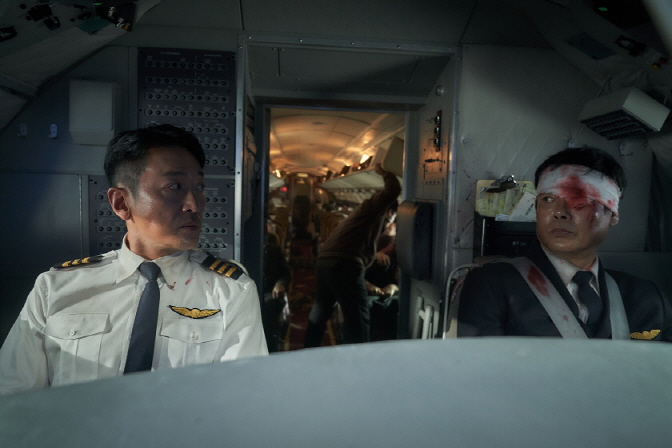
As the main center of the film, Ha Jung-woo is believable as a principled man struggling to handle the increasingly tricky circumstance for him and others on the airplane, and he is countered well by the intense performance by Yeo Jin-goo, who is alternatively frightening and tragic as a lad resorting to a very desperate measure. While we are often shocked by Yong-dae’s brutal acts of violence, we also understand his anger and desperation nonetheless, and you may pity him more around the end of the story.
The supporting performers surrounding Ha and Yeo dutifully fill their spots around Ha and Yeo. While Sung Dong-il has some good moments as his injured character tries his best for helping Ha’s character, Chae Soo-bin holds her small place well as a female flight attendant who turns out to be more resourceful than expected, and the performers playing the passengers also bring some personality to their archetype characters.
In conclusion, “Hijacking 1971”, which is directed by Kim Seong-han and written by Kim Kyung-chan, is a competent genre film which does its flight better compared to “Emergency Declaration” (2021), another recent South Korean flight disaster movie. While that movie ended up being as clichéd as “Airport” (1970) and many other similar flight disaster films, “Hijacking 1971” handles its familiar genre elements well enough to entertain the audiences from the beginning to the end, and it is surely one of better movie experiences for me and other South Korean audiences during this summer season.


 Seongyong's Private Place