

South Korean “Jango: Uncharged” is a merely goofy B-spoof which mildly amused me from time to time. While it is thoroughly silly and outrageous from the beginning to the end, the movie eventually goes nowhere as showing its many limits including the very limited production budget, and I came to wonder whether its production process is more interesting the film itself.
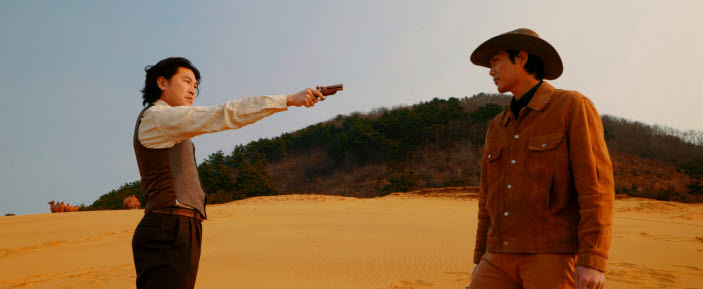
As reflected by its title, the movie is an apparent parody of Quentin Tarantino’s “Django Unchanged” (2012), and it even opens with a bunch of slaves being transported to somewhere by one vicious slave trader. Although the background is supposed to be somewhere in some southwestern region of US around the 19th century, it is very, very, very evident to us that the movie is shot in somewhere in South Korea instead, and you may get some small laugh from how it willingly sticks to its preposterous background setting.
By the way, this opening scene has the funniest thing in the film which is not so far from those hilarious moments associated with a pair of coconuts in Terry Gilliam and Terry Jones’ “Monty Python and the Holy Grail” (1975). Because they could not use real horses due to their limited production budget, director/writer Back Seung-kee and his crew members used something else for depicting horse riding, and I would not mind if they used this amusingly silly method more in the film.

Anyway, the evil slave owner and those unfortunate slaves soon encounter a figure who introduces himself as Dr. Salt (Seo Hyun-min), who surely reminds you of Christoph Waltz’s similar character in “Django Unchained”. Dr. Salt is particularly interested in one of those slaves, and he does not mind at all using some violence just for having that slave in question.
The name of slave is incidentally Jango (Jung Kwang-woo), which should be pronounced as “Jaan-go”. As the subsequent flashback sequence, which is incidentally shown in black and white silent film style, Jango was a poor lad who wanted to be a filmmaker someday while diligently working as a delivery guy, and he and his younger sister, Jan-di (Jung Soo-jin), support each other’s dream while living together in a cardboard box which seems bigger inside just like that telephone booth in British TV drama series “Dr. Who”. However, things became more difficult for Jango after he gave up most of his saved money for helping his younger sister fulfill her lifelong dream, and that was how he eventually tumbled into slavery.
After getting some help from Jango for finishing his latest job, Dr. Salt offers a partnership to Jango because he sees some potential from Jango, and that is followed by a montage sequence where they eliminate lots of targets including bad cats and dogs (Note: No animal was harmed during the production of the film). When he later comes to learn about what happened to his younger sister, Jango becomes determined to save her by any means necessary, and Dr. Salt is certainly willing to accompany his partner.
It turns out that Jango’s younger sister, who has always wanted to be a movie actress, has been a captive held by some powerful evil movie producer, who, as reflected by his silly name, is based on Leonard DiCaprio’s pompous villain character in “Django Unchained” (He even has a servant clearly inspired by Samuel L. Jackson’s character, by the way). During the introduction scene of this sleazy character, the movie has a bunch of performers appear as famous Hollywood stars, and I must confess that I chuckled a bit when I correctly guessed one of the names in advance.

However, the movie only ends up scratching the surface without much comic inspiration, and its middling result reminds me again that “Django Unchained” is parody-proof from the beginning. Just like Tarantino’s many other works, that movie frequently shows a sly sense of humor in addition to those witty dialogues. Compared to that, “Jango: Uncharged” seriously lacks wit and style, and it is not even that clear about what it is exactly poking fun at besides Tarantino’s film. At first, it seems to be a satire on the economic hardship of young poor people in debt, but then it also attempts to satirize movie business, but none of its comic attempts sticks that well on the wall.
Although they often suffer from the absence of any kind of acting chemistry between them, the main performers in the film sincerely stick to their straight acting despite delivering a lot of silly English dialogues mixed with some Korean elements, and they look as committed as I was on the stage for a little amateurish parody of Kang Je-gyu’s “Shiri” (1999) during my high school years. They actually show more spirit and energy during the behind-the-scene footage clip around the end of the film, and that naturally takes me back to late American critic Gene Siskel’s famous question: “Is this film more interesting than a documentary of the same actors having lunch?”
The answer for “Jango: Uncharged” is unfortunately no, and I must remind you that there are actually several better and more skillful South Korean parody films including Ryoo Seung-wan’s “Dachimawa Lee” (2008), which not only understands but also loves its numerous comic targets to be lampooned in one way or another. To be frank with you, I would rather recommend “Dachimawa Lee” instead, and I assure you that you will get much more laugh and entertainment once you get along with its free-for-all parody approach.


 Seongyong's Private Place