

“The Breaking Ice”, which was selected as the Singaporean entry for Best International Film Oscar in last year, is a somber but poignant drama about three different young people who happen to be stuck together during several cold winter days in the northeastern area of China. While it requires some patience from you at first mainly due to its slow narrative pacing, the movie will gradually immerse you in its vivid local mood and details to observe and appreciate, and you will also come to care about its three main characters more than expected.
The main background of the film is Yanji, a country-level city in the east of the Jilin Province of China which is also the center of the Yanbian Korean Autonomous Prefecture. As some of you know, many of its citizens are the descendants of Korean people who moved there during the Japanese colonization era during the 20th century, and they have proudly maintained their heritage for many years as reflected by the frequent appearance of Korean language throughout the film.
The story begins with the big wedding ceremony between one Chinese dude and some Korean Chinese woman, and it soon comes to focus on one of the guests at the spot. This person in question is a lad named Haofeng (Liu Haoran), and it is slowly revealed to us that he is from Shanghai and also has been struggling with some serious mental problem. As a matter of fact, he later becomes so depressed that he seriously considers suicide, and then he changes his mind when he happens to spot a pretty young woman who works as a guide for visiting Chinese tourists.
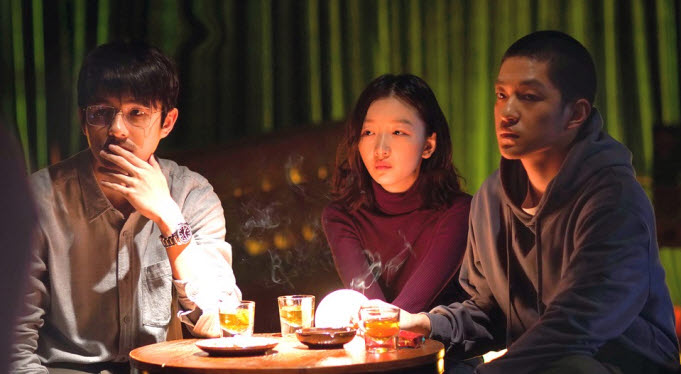
Her name is Nana (Zhou Dongyu), and the movie observes her daily work for a while once Haofeng impulsively joins those Chinese tourists under her supervision. At one point, she and her tourists drop by a big tourist spot showing more of the local Korean culture in Yanji, and I must tell you that this is quite an interesting sight for South Korean audiences like me.
After that, Nana takes her tourists to a local restaurant for lunch, and then we get to know more about her friendship with a lad named Xiao (Qu Chuxiao). While not knowing what to do for his currently aimless life, Xiao usually works for his aunt and her husband who have incidentally run that local restaurant, and it is evident to us that he wants to get closer to Nana, though she is not so interested in that despite still regarding him as a close friend of hers.
When Haofeng happens to lose his smartphone, Nana is willing to help him a bit, and then she suggests to him that he should spend some time along with her and Xiao before going back to Shanghai. Although he is reluctant at first, Haofeng eventually agrees to have some fun along with his two accidental friends during the following evening, and we come to see more of the city and its surrounding area as observing how they go through a few more days and nights together.
On the surface, nothing much seems to be happening, but the three characters of the film gradually reveal themselves bit by bit along the story. Although the movie never specifies whatever Haofeng has been struggling with, we come to gather a bit about how much he has been pressured in one way or another, and that is the main reason why he and Nana come to form a sort of kinship between them. As revealed later in the story, she also ran away from lots of expectation and stress, and she understands Haofeng to some degree even though she never asks any direct question on his depressed status. In case of Xiao, he still yearns for Nana’s affection, but he is willing to accompany her and Haofeng as their friend nonetheless, and several playful moments among them in the film may take you back to those young main characters of Jean-Luc Godard’s “Band of Outsiders” (1964).

Patiently rolling its story and characters, the movie establishes more of its realistic local background which will haunt your mind as much as its three youthful but melancholic main characters. Thanks to cinematographer Yu Jing-pin, the cold ambiance of the city and its surrounding area on the screen feels quite palpable with the frequent shots of ice and snow, and this icy atmosphere is accentuated more during one sequence where Nana, Haofeng, and Xiao try to climb to the top of the Changbai Mountains, which are also known as the Great Paekdu in Korea. As more snow and fog come, the mood becomes rather surreal, and we are not so surprised when they experience something unbelievable before eventually going back to Yanji.
Under the thoughtful direction of director/writer Anthony Chen, a Singaporean filmmaker who won the Camera d’Or for his first feature film “Ilo Ilo” (2013) at the 2013 Cannes Film Festival, the three main cast members are convincing in their earnest low-key acting. While Zhou Dongyu brings some tranquil beauty to her character, Liu Haoran is effective in the restrained depiction of his character’s deeply troubled state, and Qu Chuxiao is also solid as another crucial part of the story. Because they never spell out whatever is happening among their characters, it is always engaging to observe the subtle interactions among their performances, and the movie wisely avoids any unnecessary melodrama even during its eventual finale.
In conclusion, “The Breaking Ice” is worthwhile to watch for its cold but haunting poetic qualities to be savored. You may struggle a bit at first for getting what and how it is about, but it is fairly rewarding on the whole thanks to its solid mood, storytelling, and performance, so I recommend you to give it a chance someday.


 Seongyong's Private Place