
“Shortcomings”, which recently came to Netflix in South Korea, is often amusing for how it tackles the representation of Asian Americans. As a matter of fact, the movie opens with the screening of a popular flick not so different from “Crazy Rich Asians” (2018) at some local Asian American film festival held in Berkeley, California, and that is just the beginning of a series of little humorous moments popping here and there around its disagreeable Asian American lad who really needs to grow up in my trivial opinion.
While everyone around him including his current girlfriend is delighted and excited by that feel-good movie, Ben (Justin H. Min) is not so amused in contrast as an aspiring filmmaker who has not made anything substantial yet. Not long after the movie is over, he argues a lot with Miko (Ally Maki) about why he does not like the movie at all, and now I wonder what he thinks about Justin Lin’s “Better Luck Tomorrow” (2002), a sadly overlooked film incidentally about a bunch of Asian American suburban kids who are not exactly the wholesome representation of their race.
Anyway, Ben’s cranky response to that feel-good movie certainly put more wedges on his strained relationship with Miko, and we observe more of how he lets himself more estranged from her in one way or another. He is actually attracted more to white women, but he cannot possibly admit this to Miko when she comes across the glaring evidence on that, and his eyes are already drawn to a young white woman who gets employed in a local arthouse theater managed by him.

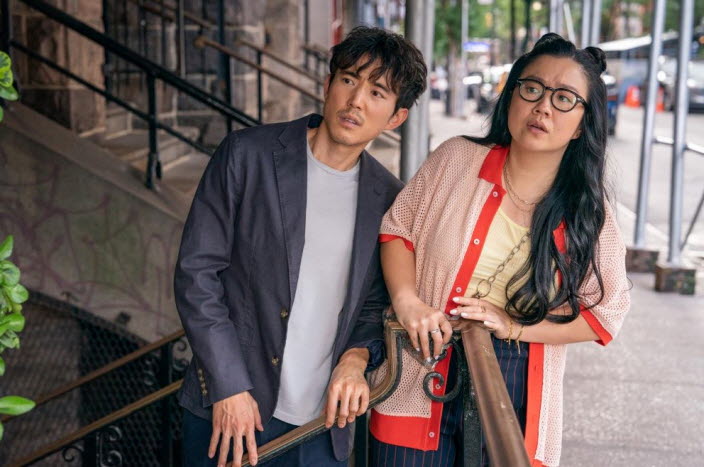
The movie also focuses on his friendship with Alice (Sherry Cola), an Asian American lesbian girl who has been his best friend for many years. At one point, Ben willingly becomes her ‘boyfriend’ in front of her Korean family members attending the wedding of one of her cousins, and, as a gay guy who has often pressured by my parents toward heterosexual marriage, I must say that this brief but funny moment gets every detail right about how burdening Korean parents can really be in case of marriage.
Meanwhile, Miko eventually comes to decide that enough is enough, so she announces to Ben that she will soon move to New York City for some independent filmmaking internship, Coming to see that their relationship is being over, Ben tries to get closer to that young white woman, but, not so surprisingly, she turns out to be not so right for him, and he also hurts her feeling a bit when she shows him a little art project of hers at one point.
When Alice later takes him to a party for lesbians just because she needs someone to accompany her, Ben is not so excited at first, but, what do you know, he comes across a young white woman who turns out to be a bisexual. Despite Alice’s warning on how unreliable this bisexual woman can really be, he decides to go a little further with her, but then she comes to change her mind, and he ends up showing her more of how unlikable he can be.
Dryly bouncing from one episodic moment to another, the screenplay by Adrian Tomine, which is based on his acclaimed graphic novel of the same name, feels like going nowhere at times just like its increasingly pathetic hero, but it is steadily buoyed by its edgy sense of humor, and I was often amused by how it is willing to make its Asian American hero all the more unlikable along the story. Around its last act, Ben becomes more disgruntled and self-absorbed than before, and it is a bit relieving to see that he somehow comes to grow up a bit in the end.

Everything in the movie depends a lot on its lead actor’s talent and presence, and Justin H. Min, who looks and feels quite different from his gentle supporting turn in Kogonada’s “After Yang” (2021), did a commendable job of bringing enough life and personality to his decidedly unpleasant character. Although Ben is definitely someone I will instantly avoid as much as possible, he is an interesting case study to observe from some distance, and I enjoyed small nice details including several Criterion Blu-rays and a big poster of Nobuhiko Obayashi’s cult horror comedy film “House” (1977) in his residence. I still do not like this dude much, but I must admit that he surely has some good taste in case of movies.
Around Min, several supporting performers hold each own spot well. Sherry Cola is often funny as an effective counterpart to Min’s character, and she also brings some gravitas to the story when even her character cannot tolerate Ben later in the story. While their roles are rather under-developed, Ally Maki, Tavi Gevinson, Debby Ryan, and Sonoya Mizuno are well-cast on the whole, Timothy Simons, Jacob Batalon, Ronny Chieng, and Stephanie Hsu provide some extra humor during their brief appearance in the film.
In conclusion, “Shortcomings”, which is the first feature film of director/co-producer Randall Park, is a comedy of acquired taste which took some time for me to decide whether I was entertained enough despite its, yes, shortcomings. To be frank with you, I still feel like not totally getting its comic moments as a foreign audience outside US, but I appreciate its storytelling and performances at least, so I recommend you to give it a chance someday.


 Seongyong's Private Place