
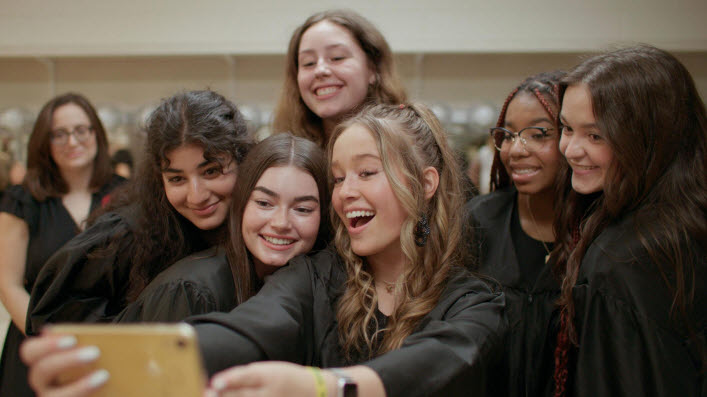
Documentary film “Girls State”, which is currently available on Apple TV+, observes a bunch of American female teenagers going through a well-known week-long leadership and citizenship program. While they sometime find themselves limited by gender bias and inequality, these young girls also often excel themselves in one way or another, and that surely reminds us again that girls can indeed do anything just like boys.
The documentary is intended as a companion piece to directors/producers Jesse Moss and Amanda McBaine’s previous documentary “Boys State” (2020), which is incidentally also available on Apple TV+ now. In nearly all of the states in US, the American Legion Boys State and the American Legion Auxiliary Girls State have been separately held in every summer, but there was some significant change in case of the Girls State held in Missouri for 2022 summer. This time, the Girls State was held along with the Boys State at the campus of the Lindenwood University in St. Louis during the same week, though the boys and the girls were still separated from each other nonetheless.
Anyway, those numerous participants of the Girls State were ready to do their best, and the documentary closely follows what some of them did and experienced during their one dynamic week. While they are all different from each other in terms of family background and political belief, all of them are eager to engage in a series of discussions and arguments with many other participants, and they certainly aspire to achieve each own goal in their little democratic experiment during next several days.
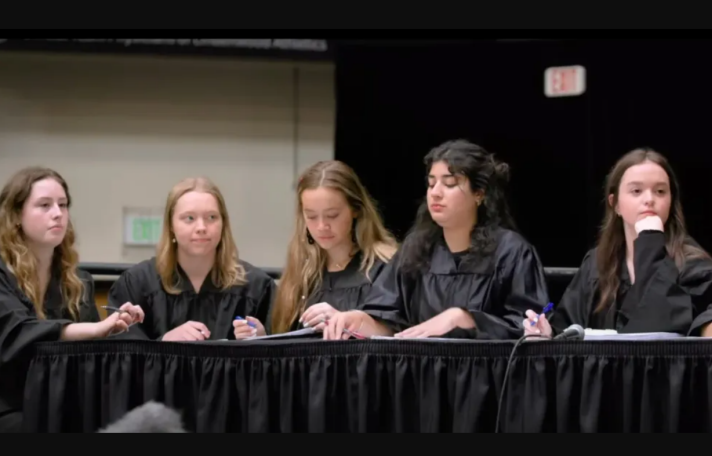
To many of the participants of the Girls State, the recent news on the impending decision of the US Supreme Court on the female rights on abortion naturally becomes a big issue to talk and discuss about. In case of Emily Worthmore, she seems to be your average conservative Christian girl at first, but, despite her strong conservative viewpoint, she keeps her mind open while showing much willingness to listen to different viewpoints, and she also agrees that female autonomy always comes first above all. Compared to those petty and deplorable American right-wing politicians out there, she surely looks a lot more reasonable and sensible to say the least, and you may hope that she will eventually become a good politician someday as she sincerely hopes.
In case of Nisha Murali, she surely feels like an outsider as the daughter of an immigrant family right from the first day, but she is not so daunted by this at all. Like Emily, Nisha is willing to express her political belief more in front of other girls as diligently reaching for her own goal, and the same thing can be said about Tochi Ihekona, who is another notable girl from immigrant family in the group and wants to take the position of the general attorney in the program.
Nisha and several other participants later attempt to be appointed as the Supreme Court Judges, and we see how each of the girls tries to show more of their intelligence and passion during the following evaluation process, which is incidentally supervised by a few selected participants. When the eventual picks are announced, some of the candidates are understandably disappointed, but everyone congratulates on those chosen participants, nonetheless.
Meanwhile, Emily and several other girls embark on the upcoming Governor election, and we observe them respectively working on how they can appeal to more participants during next several days. In case of Cecilia Bartin, she draws a lot of attention from others via her forceful presence coupled with her own strong political opinions, and it is evident that she is going to be the one to beat for Emily and other prominent nominees.
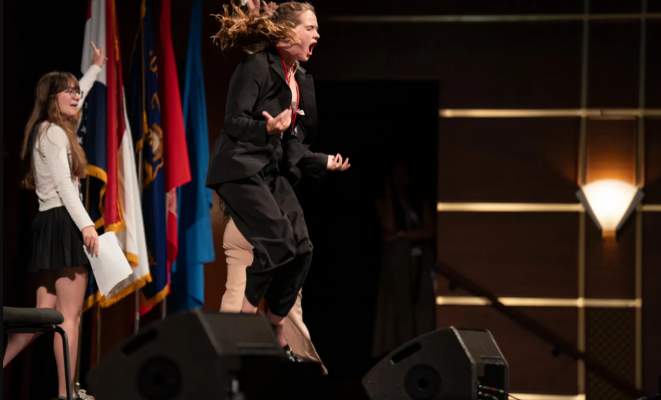
As these and many other participants of the Girls State try to excel themselves as much as possible, the documentary makes some sharp point on the considerable gender gap between the Boys State and the Girls State. As pointed out later in the documentary, the Girls State has received less fund and support compared to its male counterpart, and many of its participants become more aware of this glaring inequality as often watching the Boys State from the distance. In fact, Emily subsequently tries to publish an article on this unfairness in the newspaper of the Girls State, but, to her frustration, her strong opinion on that is diluted to considerable degree by her supervising adult editor.
In addition, the documentary looks into the Boys State from time to time, and the difference between the Boys State and the Girls State is quite glaring to us at times. Both the girls and the boys are equally competitive, but those elected participants of the Boys States receive an aggressive mix of boos and cheers, while their counterparts of the Girls State are wholeheartedly applauded by everyone at the spot. In my humble opinion, that says a lot about why we really need much more female politicians and activists.
In conclusion, “Girls State” is a commendable documentary which surely deserves to be watched along with “Boys State”. While it bitterly reminds us again of the current social/political backlash on the female rights in the American society before its end credits, it powerfully shows us the considerable hope for more change via those smart girls to observe and admire, and it is certainly one of the better documentaries of this year.


 Seongyong's Private Place