
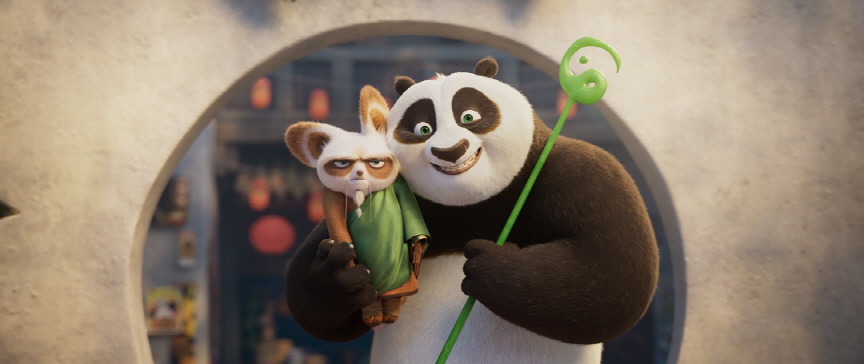
Animation film “Kung Fu Panda 4” is a passable product not bringing anything particularly new or surprising to its franchise, which was started with “Kung Fu Panda” (2008) and then continued in the two following sequels during next several years. I must confess that I do not remember anything much from any of them, but I do remember at least that I enjoyed all of the first three films in one way or another. Sadly, this new Kung Fu Panda film just mildly entertained me as being rather deficient in several aspects including story and character, and the result is another disappointing animation film of this year.
Again, our bumbling Panda hero Po (voiced by Jack Black) finds himself challenged inside as well as outside for more adventure and some spiritual growth on the way, so we are accordingly served with lots of physical comedy and some action as expected, but the film sometimes lacks humor and spirit compared to its predecessors. Sure, it is competent in technical aspects, but what we get here is pretty much same as what we got from those three previous films, and the film simply just stays on autopilot mode from the beginning to the end without trying anything fresh or interesting at all.
Most of all, the villain of this film is a big letdown compared to the villains of the previous films. Viola Davis, who seems to be more uninhibited in her stellar acting career especially after recently becoming another EGOT (Emmy, Grammy, Oscar, and Tony) winner, is certainly having a ball with her villain character here as she previously did in “The Hunger Games: The Ballad of Songbirds and Snakes” (2023), but her good voice performance still does not wholly compensate for her colorless character, and you will come to wish that the film utilized her distinctive talent more effectively.

Anyway, Po’s internal challenge comes when Master Shifu (voiced by Dustin Hoffman), an old red panda who has been Po’s master, notifies that Po must find someone to succeed him as a new Dragon Warrior. Because 1) he has had so fun and excitement as the current Dragon Warrior and 2) he is not so sure about whether he can actually decide who will succeed him, Po is naturally reluctant at first, and Master Shifu only tells his dear pupil that the time for change will come sooner or later no matter how much he resists.
Meanwhile, Po also comes to learn about the menace from Davis’ villain character, and, what do you know, he happens to encounter someone who may lead to his very dangerous opponent. That figure in question is a young corsac fox named Zhen (voiced by Awkwafina), and she gets imprisoned after being caught for stealing some artifacts in Po’s temple, but Po agrees to release her if she accompanies for helping him.
It goes without saying that Po and his rather unreliable companion do not click that well with each other during their bumpy journey to a big city dominated by Po’s latest opponent, and I do not even have to tell you that there is something sneaky about Zhen right from the very beginning. As a matter of fact, her and Po’s narrative arc so predictable to the core that we are not so surprised by her hidden agenda to be revealed later in the story – or how her resulting inner conflict is eventually resolved.
As many of you will agree, both Jack Black and Awkwafina are good comedians, but their voice performance often feels perfunctory in my inconsequential opinion. At least, Black seems a little more committed compared to his rather generic voice performance in “The Super Mario Bros. Movie” (2023), and Awkwafina also brings some sassy pluck to her character as she previously did in “Raya and the Last Dragon” (2021).
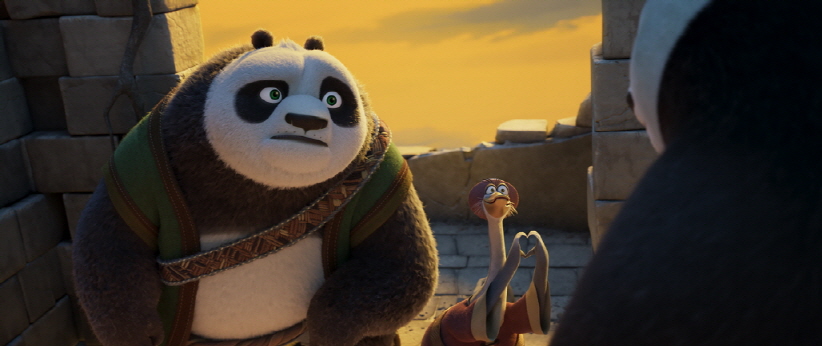
Interestingly, the subplot involved with the impromptu journey of Po’s two very different fathers often steals the show from the main plot. Although this part is virtually dragged by the main plot, it has more effective comic moments in fact, and James Hong and Bryan Cranston, who respectively reprise their familiar roles here, are effortlessly funny as a mismatched duo as compensating for the glaring absence of Po’s usual colleagues to some degree.
In case of several other notable voice cast members, some of them manage to inject some spirit and personality to their broad supporting parts despite being mostly under-utilized. While Ke Huy Quan, who has been more prolific thanks to his terrific Oscar-winning turn in “Everything Everywhere All at Once” (2022), shows more of his comic talent as an old associate of Zhen, Ian McShane and Dustin Hoffman do a bit more than required by their thankless roles, and the special mention goes to Lori Tan Chinn, who is hilarious as the cranky owner of a certain dangerous bar.
In conclusion, “Kung Fu Panda 4” is not a total bore at all, but it is one or two steps below its three predecessors, and you may seriously ask yourself whether another Kung Fu Panda movie is really necessary, though, considering the current box office success of “Kung Fu Panda 4” around the world, we will surely get that within a few years. As far as I observed while watching it at a local movie theater, young audiences surrounding me were entertained enough, but, to be frank with you, I really wanted to recommend them “Robot Dreams” (2023), a recent Oscar-nominated animation film which is currently being shown in South Korean theaters. That film is really something special to be enjoyed by not only young audiences but also all other audiences, you know.


 Seongyong's Private Place