
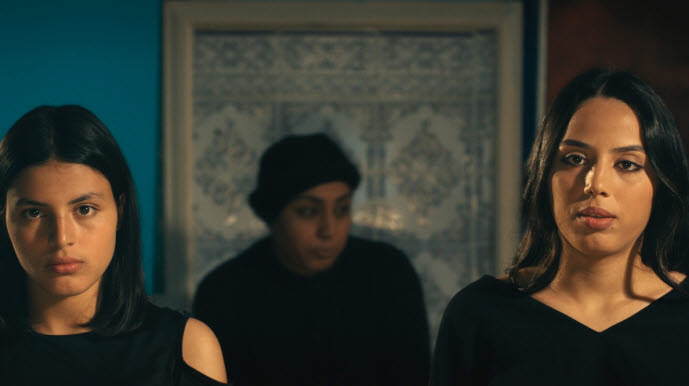
Kaouther Ben Hania’s latest work “The Four Daughters”, which was recently nominated for Best Documentary Oscar (It was also selected as the Tunisian submission to Best International Film Oscar, by the way), presents one painful family story via a plain but striking mix of documentary and fiction. As making the three main real-life figures of the story participate in a series of reenactment scenes, the documentary gradually has them face and reflect more on their harrowing past, and the result is often quite powerful with the aching resonance between fact and fiction.
The central real-life figures of the documentary are a Tunisian woman named Olfa Hamrouni and her four daughters: Ghofrane, Rahma, Eya, and Tayssir. While Eya and Tayssir are going to play their younger selves in front of the camera, Olfa will be often substituted with Tunisian and Egyptian actress Hend Sabri whenever that is deemed necessary, and Ghofrane and Rhama, who are mostly absent in the documentary for a grim and horrific reason to be revealed later, will be played by two young professional performers instead.
After the introduction of Olfa and her four daughters, the documentary playfully presents some amusement generated between Olfa and her two daughters and the performers who are going to play Olfa and her other two daughters. Olfa is willing to show more of herself to Sabri, and Sabri is certainly ready to channel Olfa’s human qualities as much as possible. In case of Eya and Tayssir, they quickly get along well with Nour Karoui and Ichraq Matar, the two young actresses who are going to play their older sisters. In fact, you can clearly sense some emotional bond generated among them as these four young ladies work more fluidly along with each other in front of the camera.
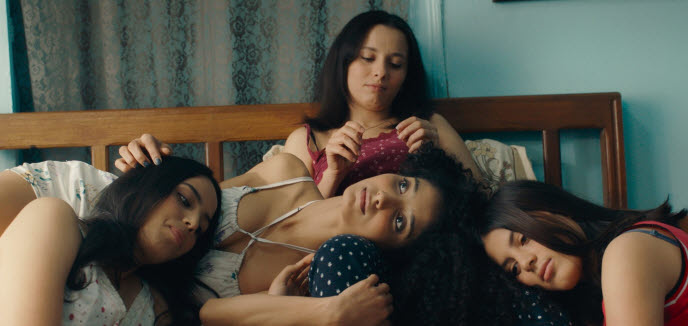
While observing how Olfa and her two daughters collaborate with these professional performers under Ben Hania’s inobtrusive direction, the documentary sometimes simply listens to the personal stories told by Olfa and her two daughters. Even when she was young, Olfa was quite feisty and strong-willed to say the least, but she also eventually had to bend herself to tradition and patriarchy just like many other young women around her age. She got married to a man who did not love that much, but she went through her wedding night in her way, and you may get amused a bit by the following reenactment scene of her wedding night, where Olfa incidentally plays an older sister of hers.
As tolerating her mostly loveless married life during next several years, Olfa managed to give birth to no less than four daughters, who naturally became the sole reason for her to live one day after another. Eya and Tayssir frankly reminisce about how things were often hard and difficult for them and their older sisters mainly due to their father’s frequent abuse as well as their poor economic status, and there is a poignant moment when they do a make-believe play along with the fictional counterparts of their older sisters.
Around the time when Ghofrane and Rhama entered adolescence around the early 2011, Tunisia was shaken up by the beginning of the Arab Spring, and that certainly affected a lot not only them and their younger sisters but also their mother. After seeing the possibility for more change and freedom, Olfa eventually decided to leave her husband, and she subsequently got herself romantically involved with some guy who had just escaped from prison. It looked like she finally found some happiness for herself, but, alas, this dude turned out to be no better than her ex-husband to both her and her daughters.
We watch Eya and Tayssir acting along with an actor playing that scumbag, and the mood becomes so tense between them and him that he comes to quit in the middle of the shooting. As replaying this rather uncomfortable moment in my mind, I am not that sure about whether it was planned in advance or not, but I can tell you at least that you will not easily look away from the intense expression of complicated emotions from both Eya and Tayssir.

After breaking up with that crummy guy, Olfa went to Libya for earning more money for her family, and that was when the distance between her and her daughters began to grow. Especially in case of Rahma and Ghofrane, they became quite wild and rebellious, and they and her mother consequently clashed a lot with each other. Struggling to get things under control as much as she could, Olfa came to abuse her daughters more than once, and that certainly caused another emotional scar upon her daughters.
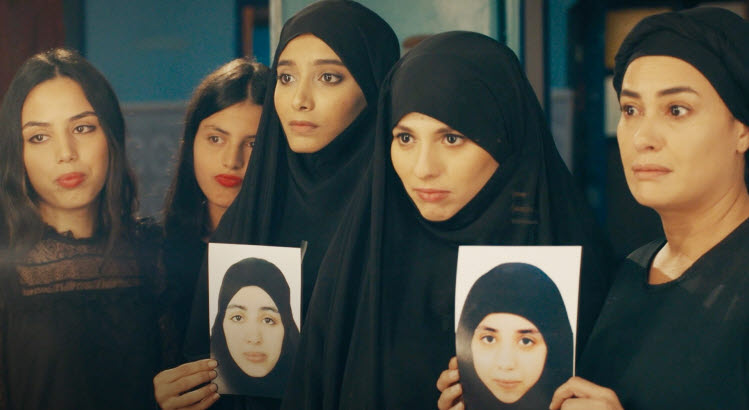
Because of their confused and vulnerable status, Rahma and Ghofrane subsequently let themselves delve into religious fanaticism mainly due to those loud-mouth fanatics in their neighborhood, and the following consequence was pretty dire to say the least. They ran away to Libya for joining the Islamic State, and the only consolation for Olfa was that she managed to prevent the other two daughters from falling into the same fate at least.
As Olfa and her remaining two daughters participate more in the reenactment scenes, they come to process more of their pain and sorrow, but their sad family story is unfortunately still being continued even at present. Rahma and Ghofrane are alive, but they have virtually been lost to their family, and Olfa and her remaining two daughters remain quite hurt by that hard fact of their life.
In conclusion, “The Four Daughters” is compelling for its unconventional presentation of a heartbreaking personal tale, and Ben Hania, who previously directed Oscar-nominated film “The Man Who Sold His Skin” (2020), did a commendable job of handling her main human subjects with enough care and respect. This is certainly one of the more interesting documentaries of last year, and I sincerely recommend you to check it out if you have a chance.


 Seongyong's Private Place