

To be frank with you, I had never heard about US Congresswoman Shirley Chisholm before I watched acclaimed TV miniseries “Mrs. America” a few years ago, which incidentally enlightened me on a lot of interesting American feminist real-life stories besides Chisholm’s. In the episode mainly focusing on Chisholm’s failed US presidential run in 1972, it has some of the most powerful moments in the miniseries, and Uzo Aduba, who deservedly won an Emmy for her performance, is simply devastating as Chisholm is pressured and cornered toward her eventual heartbreaking defeat.
That is why I had some expectation after coming across the trailer of Netflix biopic “Shirley”, which was released on last Friday. Unfortunately, the movie does not show much beyond what I came to learn via that memorable episode of “Mrs. America”, and the result is another by-the-number biopic just like recent Netflix film “Rustin” (2023).
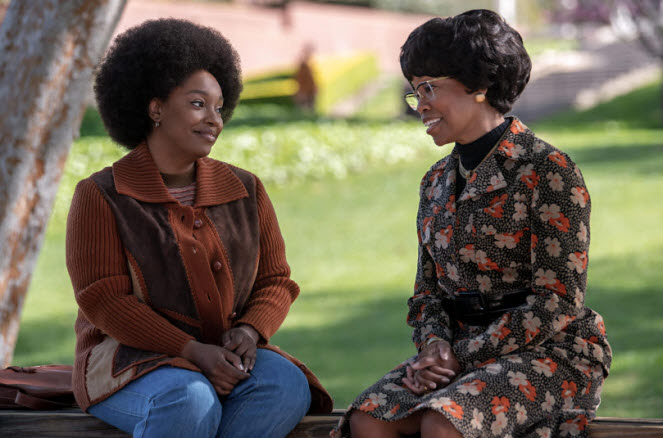
I must say there is not any fault in the lead performance by Regina King, a terrific actress who also produced the film with writer/director John Ridley. She embodies well her character’s unflappable determination and idealism, and she surely has several big scenes where her character shows her indomitable spirit and charisma, but Ridley’s screenplay does not delve that much into her character’s life and personality while often being busy with emphasizing how important Chisholm is in the American political history during the late 20th century.

And she is indeed an important figure, though she was regarded that highly when she entered the US Congress in 1969 as a first-time congresswoman representing her Brooklyn neighborhood of New York City. At that time, she was one of 12 women in the US Congress besides being the sole African American woman in the group, but she was daunted at all by her glaring minority status, and that is quite evident to us when she shows some pluck in front of a jeering racist Southern congressman.
In late 1971, many prominent figures int her party, which is incidentally the Democratic Party, begin to focus on who will eventually be the US presidential candidate competing against President Richard Nixon of the Republican Party, and Chisholm came to consider run for the Democratic Party’s presidential run because she sees some little possibility of actually becoming the nominee – and, perhaps, the president. After all, many people in the American society have been demanding for more change as their society was rocked by a series of sociopolitical happenings during the 1960s, and Chisholm is willing to be a new and fresh representative of changes to come.
Of course, Chisholm and her close associates including her devoted husband do not have much resource from the beginning compared to many other competitors in the party, but, to their surprise, their following modest campaign seems to work a bit better than expected. It actually looks like Chisholm will be able to stay in the competition till the party convention is held in Florida several months later, and Chisholm is certainly willing to go all the way as much as possible.
However, Chisholm and her campaign also face a lot of obstacles popping here and there on their bumpy road to the party convention. Because of her minority political status, many people inside and outside the party are not particularly serious about her campaign, and she is also frequently pressured from inside and outside her campaign. While she is often told that she has to quit for less competition inside the party, she also clashes a lot with her close advisers including her former mentor Wesley McDonald “Mac” Holder (Lance Reddick), and we also see how her married life often gets strained due to the growing distance between her and her husband, who subsequently divorced in 1977.

The movie later tries on some human complexity as Chisholm willingly interacts with a number of various figures ranging from George Wallace to Huey P. Newton, but the result somehow feels flat and uneven without much dramatic impact. In case of a subplot associated with Chisholm’s two family members, the screenplay seems to tries a bit of warts-and-all approach, but this subplot only ends up being rather superficial on the whole.
Anyway, King diligently carries her character and the movie to expected ending, and some of several notable supporting performers around her manage to leave some impression despite their underdeveloped parts. While Terrence Howard casually coasts around the screen as one of the key members of Chisholm’s campaign who would later be her second husband, Lucas Hedges provides some comic relief as an inexperience but smart lad ready to do as much as he can do for Chisholm’s campaign, and André Holland steals the show as usual during his brief appearance in the film. In case of Lance Reddick, who sadly passed away too soon in last year, he brings some intelligence and authority to his rather thankless supporting role, and that reminds me again of what a dependable character actor he was in numerous TV series and movies for many years.
Overall, “Shirley” is surely well-intentioned to say the least, but it fails to make something engaging enough to hold our attention. If it had been made, say, 10 or 15 years ago, I might have been more generous to it, but, folks, the standards of African American biopics have been going up a lot especially after “Selma” (2014), and I really think you should check out “Mrs. America” instead if you have not watched it yet.


 Seongyong's Private Place