
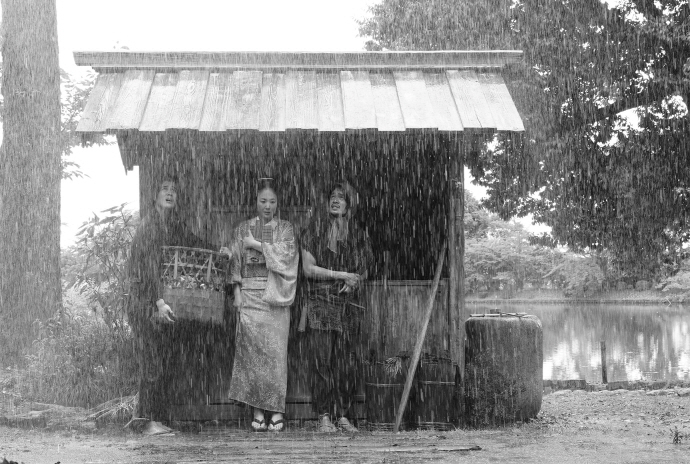
Japanese film “Okiku and the World” may amuse you to some degree if you are not that squeamish about its smelly main story subject. I must warn you that the movie often pays a lot of attention to a dirty but undeniably necessary business involved with human excrement, and you may be relieved a bit because nearly all of these deliberately disgusting moments are presented in black and white film at least.
The story, which is set in Tokyo not long before the Meiji Restoration in the late 19th century, opens with introducing its three main characters one by one. At first, we observe how a young common man named Yasuke (Sôsuke Ikematsu) collects buckets of human excrement from a toilet outside one local temple, and you may cringe more than once as watching how he casually does his job without any hesitation. In fact, he collects heaps of sh*t from many places in Tokyo, and then he sells all of his collected sh*t as the manure to be used in many farms outside the city.
Anyway, Yasuke happens to encounter another lad named Chuji (Kanichiro), who has earned his meager living via collecting used papers. Because his current job has been not going well, Chuji eventually becomes Yasuke’s business partner even though it takes some time for him to get accustomed to a number of occupational hazards including that disgusting smell.
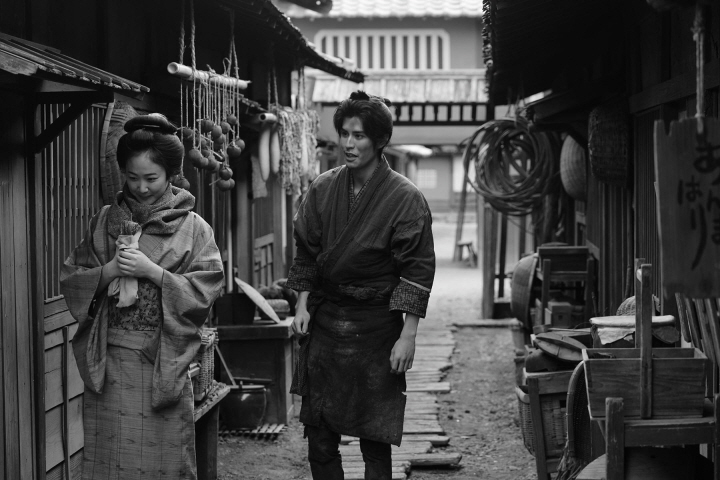
One of Yasuke and Chuji’s main business spots is a sort of community house resided by many different people, who all need Yasuke and Chuji’s service day by day because, well, they all sh*t just like all of us. At one point, their common toilet unfortunately becomes overflowed due to a sudden downpour, and I assure you that what you are going to behold at this point is not so pretty to say the least (I am still shuddering as recollecting that again, to be frank with you).
One of these residents is a young woman named Okiku (Haru Kuroki), who incidentally encountered Chuji and Yasuke during the opening scene when they all try to avoid getting wet due to a sudden raining. Although her father is a rather poor samurai who recently lost his position for some unspecified trouble, Okiku maintains her plucky attitude coupled with some pride, and she has actually earned some money to support herself and her father as teaching writing and reading at the local temple.
However, there soon comes a tragic incident which devastates Okiku a lot. Not only becoming alone by herself but also not being able to speak anymore, Okiku begins to isolate herself within her residence, and that certainly makes many of her neighbors and acquaintances quite concerned about her. In the end, she is persuaded to resume her teaching, though she needs some extra assistance from now on.
Meanwhile, the screenplay by director/writer Sakamoto Junji also focuses on how Yasuke and Chuji continue their sh*t business as usual. We see how they are often avoided by many people due to their occupation, and we also watch how they frequently struggle to get paid enough for their collected human excrement. While Yasuke tries to endure and prevail via his own offbeat sense of humor, Chuji sometimes gets tired of being stuck with loads of sh*t, but there is no other option for both of them, so they must bite the bullet from time to time.
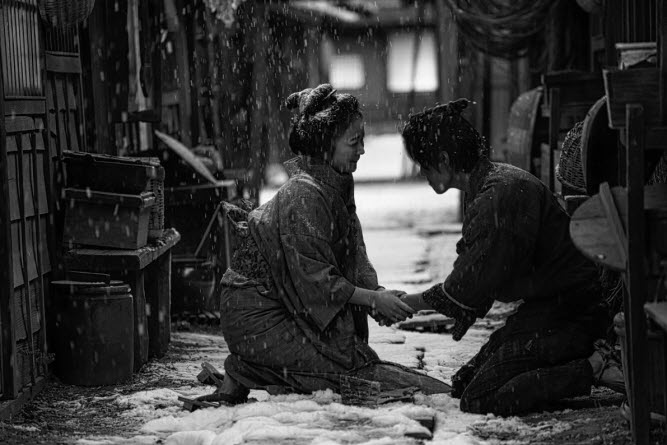
And then there comes an unexpected possibility of romance between Chuji and Okiku. When Chuji visits for a little personal matter between Yasuke and Okiku, Okiku unexpected finds herself attracted to Chuji, who surely often smells but is fairly good-looking at least. While Okiku comes to grow her romantic feelings toward Chuji, it gradually turns out that Chuji is also pining for her, but he understandably does not tell anyone about that mainly because of the apparent class difference between them.
Instead of hurrying its main characters to the expected conclusion, the movie takes more time for letting us appreciate more of its period mood and details. Cinematographer Kasamatsu Norimichi did a splendid job of presenting small and big details in crisp visual quality, and a number of key moments in the film are dramatically accentuated as shifting to color film for a while (By the way, one of these color film moments is involved with one of those toilets in the movie, so you will probably have to watch the film with empty stomach just in case).
The main cast members tune themselves well to the restrained overall tone of the movie. Although Haru Kuroki and Kanichiro do not generate much romantic vibe on the screen, they are effective nonetheless when their characters eventually reveal their mutual feeling to each other later in the story. Sôsuke Ikematsu provides some levity to the story as required, and a number of supporting performers including Renji Ishibashi, Claude Maki, and Kôichi Satô are well-cast on the whole.
In conclusion, “Okiku and the World” may make your stomach very uncomfortable for good reasons, but it somehow generates poetic moments of beauty and poignancy to remember at least. Sure, this is literally sh*tty here and there, but it somehow remains engaging enough even while being drenched with human excrement, and that is certainly something to admire in my inconsequential opinion.


 Seongyong's Private Place