

Netflix film “The Kitchen”, which was released in last week, takes some time for building its shabby dystopian world, and I admire that to some degree. Although it often feels like a warm-up for whatever will come next from its filmmakers, the movie has enough mood and style to distinguish itself from those countless dystopian flicks at least, and you may overlook its several flaws in terms of story and characters.
At the beginning, we observe how things have been quite grim and daunting for Izi (Kane Robinson) and many poor people stuck inside a ghetto area in the middle of London. Some years ago, the government decided to eliminate all the social housing areas for some unspecified reasons, and now this ghetto area, called “the Kitchen”, is the only social housing area remaining in London, but its residents have been quite defiant despite enduring lots of pressures from the government and the police day by day.
In case of Izi, he does not give much damn about the ongoing situation of his neighbors, because he has been eager to move up to some new neighborhood someday. As diligently working at a company providing a cheaper funeral service in which dead people are turned into trees to grow, he has saved a considerable amount of money, and it seems that he will finally be allowed to move to that new neighborhood.

While working as usual on one day, Izi notices the ongoing funeral service of a certain woman he used to know a long time ago. Observing that her funeral service is attended by her adolescent son alone, he feels sorry for this boy, and, what do you know, he soon comes across the boy later when he is about to go back to his current residence in the Kitchen. For a personal reason of his, Benji (Jedaiah Bannerman) wants to go inside the Kitchen, but Izi advises against that as a person who has struggled a lot there for many years since he was very young.
Anyway, Benji eventually goes inside the Kitchen because he has been left alone after his mother’s death, and he soon finds himself getting involved with a local gang led by a dude named Staples (Hope Ikpoku Jr.). Although their first encounter is not exactly pleasant, Staples does not mind taking Benji under his wing, and Benji feels a bit more relaxed as he is being gradually pushed toward crime and violence by Staples and his gangs instead.
Because they often steal the resources for the people of the Kitchen from the outside world, Staples and his gangs are regarded as heroes by many people in the Kitchen, but Izi does not like them that much, and he becomes concerned about Benji when he happens to see Benji hanging around with Staples and his gangs. He willingly lets Benji stay in his current residence in addition to spending more time with him, but, due to his reluctance to become a father figure for him, Benji keeps getting involved with Staples and his gangs.
Now this is surely a familiar slum neighborhood tale, but the screenplay by co-director Daniel Kaluuya, who also directed the film with Kibwe Tavares, and his co-writer Joe Murtagh does not force genre conventions upon its main characters while paying more attention to building its dystopian background around them. As Izi and Benji go here and there in the Kitchen during the middle act of the story, the movie fills the background with enough mood and details to notice, and they and many other characters really feel like living inside this gloomy but interesting dystopian society.
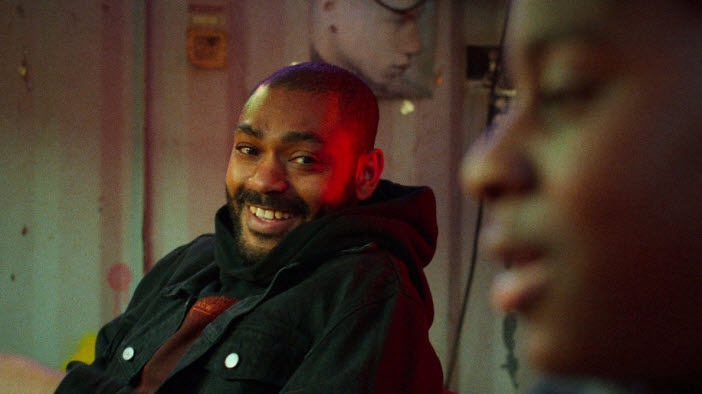
In contrast, the movie also seems to be hesitating in developing its story and characters more. While it is often implied that Izi may be actually Benji’s father, Izi does not admit or deny at all throughout the film, and we are not so sure about his motive behind a certain decision he comes to make when he has to choose between two different options later in the story. In case of Benji, he remains a rather blank figure to the end, and that is the main reason why the last scene between him and Izi feels perfunctory instead of emotionally dramatic.
At least, the movie is supported well by its two good lead actors. Kane Robinson, who has been known mostly for his rapper career, remains as stoic and taciturn as required, but he and his young co-star Jedaiah Bannerman are engaging as their characters tentatively approach to each other along the story. In case of several main cast members in the film, Hope Ikpoku Jr. manages to bring presence and personality to his under-developed supporting character, and Ian Wright provides spirited levity as a local radio DJ not so far from Samuel L. Jackson’s character in Spike Lee’s “Do the Right Thing” (1989).
In conclusion, “The Kitchen” is not entirely satisfying in my inconsequential opinion, but its competent technical aspects make me have some expectation on its filmmakers, who incidentally make a feature film debut here together. I do not know how much they respectively contributed to the final result, but I think Tavares is another interesting young filmmaker to watch, and I am also delighted to see another side of the considerable talent of Kaluuya, a British actor who has been known quite prominent since his unforgettable Oscar-nominated turn in Jordan Peele’s “Get Out” (2017). I still do not like “The Kitchen” enough for recommendation, but I sincerely hope that I will be more entertained by what may come from them in the next time.


 Seongyong's Private Place