

French film “Rise”, which is incidentally another foreign film which belatedly comes to South Korean early in this year, is an amusing and touching story about one young ballet dancer’s struggle for starting over after one big setback in her life and career. While its story and characters may feel clichéd to the core at first, the movie injects an ample amount of spirit, personality, and realism into the story and characters, and the result is one of the most likable films I have ever watched during last several months.
The opening part of the film feels like a humorous send-up of, of course, Darren Aronofsky’s “Black Swan” (2010). As a promising young ballerina, Élise (Marion Barbeau) is surely ready for her big performance to be presented in front of lots of audiences including her family members, but then, alas, she gets struck by two different unfortunate incidents. Right before coming onto the stage, she happens to discover that her boyfriend, who is also her co-star, is cheating on her behind his back, and she is certainly shocked and devastated. She manages to perform mostly well on the stage as a professional, but then she gets injured in one of her anckles in the middle of the finale, and she is all the more depressed to be notified later that her burgeoning career must be suspended during next several months for the following recovery and rehabilitation.
Now facing a long period of considerable void in her life and career, Élise natuarally feels conflicted and confused. Yes, she may be back on the stage later if things go well during next several months, but it still hurts her to see her many years of passion and dedication being ruined by her unexpected injury. While she is often consoled by not only her family but also a generous physical therapist who is clearly carrying a torch for her, she still does not know what to do next for her during next several months, and she also comes to wonder whether she should pursue a different life and career instead.

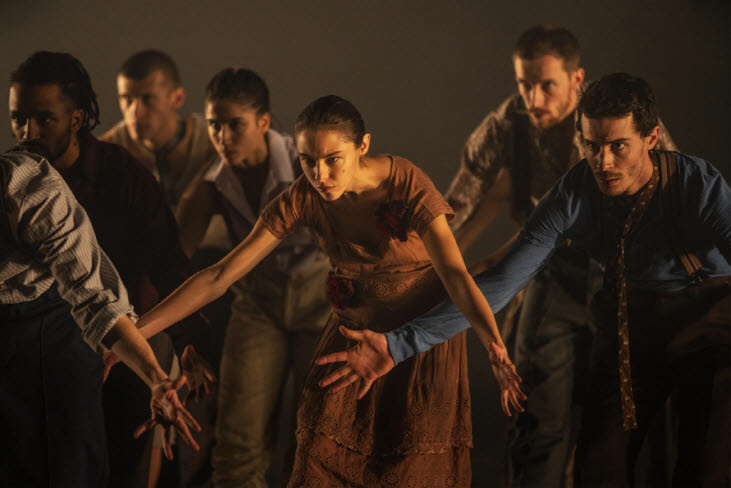
And that is how Élise becomes interested in contemporary dance, which looks and feels relatively less formal and rigorous than ballet. At one point, she and her close friends watch how free and joyous the members of a company led by Hofesh Shechter are in their dynamic dance movements, and she also finds herself attracted to one of these modern dancers.
However, the screenplay by director Cédric Klapisch, who previously made “Back to Burgundy” (2017), and his co-writer Santiago Amigorena does not hurry itself at all as Élise leisurely spends more time on determining on how to start over. At one point later in the film, she meets a friend who was once a promising ballerina just like her before eventually quitting, and she comes to see that she really does not have to hang onto her current career. When her friend suggests that Élise should accompany her and her chef boyfriend during their brief stay at a rural house for artists, Élise does not hesitate to accept her friend’s suggestion, and she feels much more relaxed than before as working along with them for a while.
Coincidentally, Shechter and his company members subsequently arrive at the house for their workshop week, and it does not take much time for Élise to pay more attention to what Shechter and his company members are doing day by day. She is still concerned about her ankle injury despite being recovered a lot, but she cannot help but drawn to the bouncing spirit felt from their practice session, and, what do you know, she eventually participates in their practice session while also getting closer to that certain member of the company.

Steadily sticking to its leisurely tone, the movie is often energized by music and dance as expected, and it certainly helps that many of its main cast members are actually professional dancers in real life. While Marion Barbeau, a newcomer who incidentally makes a movie debut here in this film, is a professional dancer and ballerina in fact, Hofesh Shechter has really been famous for being the founder and artistic director of the Hofesh Shechter Company as shown in the movie (He was also Tony-nominated for his choreography in Bartlett Sher’s 2016 Broadway revival of “Fiddler on the Roof”, by the way), and his several company members are virtually playing themselves on the screen. Whenever these performers are together for another dance, the mood and spirit are spontaneous to say the least, and the movie often gets elevated by that even when the camera looks at them from the distance.
Meanwhile, the movie also pays some attention to several supporting characters in the story, who brings extra personality to the story in one way or another. We get amused a bit from time to time as observing the tumultuous but ultimately loving relationship between Élise’s friend and her chef boyfriend, and Muriel Robin and Pio Marmaï constantly steal the show whenever their characters pull or push each other on the screen. As Élise’s caring physical therapist, François Civil has a very funny scene when his character comes to realize that it is already too late for him to express his romantic feeling toward Élise, and Denis Podalydès and Muriel Robin are also well-cast in their respective supporting parts.
In conclusion, “Rise” is quite spirited and charming as effortlessly dancing between drama and comedy, and it certainly does not disappoint us when its young heroine is finally on the road to new opportunities for her life and career on the horizon. Regardless of whatever will happen next, she will go on anyway, and you will definitely cheer for that.


 Seongyong's Private Place