
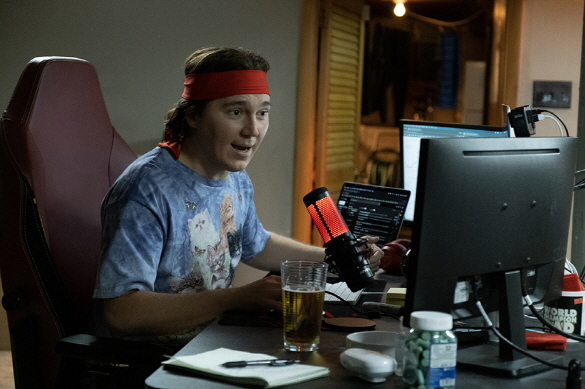
“Dumb Money” tries to present the absurd aspects of the GameStop short squeeze incident in 2021, but it somehow fails to intrigue and engage me enough despite some entertaining moments. Sure, its main subject is certainly an interesting example showing how flawed the financial system of Wall Street is, but the movie often tries too hard as busily cramming numerous stuffs into its rather shorting running time (105 minutes), and now I am wondering whether it can have more depth and insight if it is made a few more years later.
As many of you remember, the GameStop short squeeze incident was a dramatic case of David vs. Goliath. Mainly via YouTube and Reddit, a small-time stock market analyst named Keith Gill (Paul Dano) presented his prediction on the stock price of a video game retailer company named GameStop, and, what do you know, this supposedly inconsequential prediction of his ultimately led to a catastrophe for several hedge fund companies of Wall Street. These companies actually bet a lot on the decrease of GameStop stock price, but then Gill and his numerous online followers banded together for raising the stock price a lot more than before, and this eventually resulted in an unprecedented happening to remember.
Like Adam McKay’s “The Big Short” (2015), the screenplay by Laurent Schuker Blum and Rebecca Angelo, which is based on “The Antisocial Network” by Ben Mezrich (Yes, he is the one who wrote that book which was adapted into David Fincher’s “The Social Network” (2010)), juggles a bunch of different characters besides Gill. As Gill sticks to his prediction on GameStop stock price, many of those people watching his YouTube clips certainly become willing to buy some GameStop stock just in case, and we see how some of them are financially desperate in one way or another. There is a single mother nurse who really needs any chance for more money as soon as possible, and then there is a college lesbian couple who has been burdened by their college tuition debt, and then there is also a young GameStop employee who simply wants to walk away from his menial job someday.
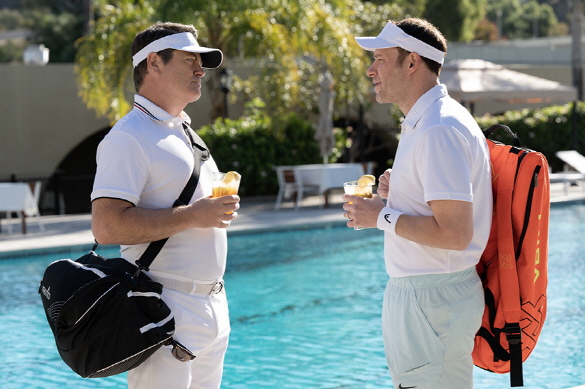
As these and many other people begin to buy more GameStop stocks day by day during next several months, this sudden unexpected trend surely draws the attention of several major figures in Wall Street. At first, Gabe Plotkin (Seth Rogen) and his several associates including Steve Cohen (Vincent D’Onofrio) think this trend will eventually be over sooner or later, but then, as already shown at the beginning of the film, they are all thrown into sheer panic as facing the grim possibility of a big financial disaster to strike them all.
While these Wall Street dudes try to stop Gill and many small-time investors as much as possible, the movie generates some tension as Gill and several other characters are pressured more and more along the story. Watching their stock price going up much more than they ever imagined, they are all surely excited about their unexpected luck, but they all know that the stock price may stop rising at any point – if any of them steps back in their growing battle against Wall Street.
Director Craig Gillespie, who previously directed “I, Tonya” (2017) and “Cruella” (2021), and his crew members including Oscar-winning editor Kirk Baxter keep things rolling here and there as occasionally throwing heaps of information bits onto the screen, but the result only feels like scratching the surface instead of delving deeper into its main subject. As observing how the movie fumbles more than once in its attempts to present and explain the main subject, I often felt like not totally understanding everything in the film, and I came to appreciate more of how “The Big Short” was not only informative but also entertaining even to audiences not so familiar with the financial system of Wall Street (Full Disclosure: I am one of such people).
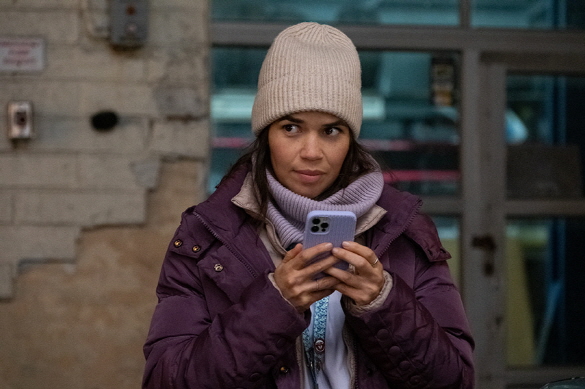
Another reason for the failure of “Dumb Money” is the lack of strong characters to hold or support everything together in the film. While Gill is supposed to be the center of the film, he is not that interesting compared to many of colorful main figures in “The Big Short”, which are one of the main reasons for why it works as an effective comedy. In case of a bunch of supporting characters in the story, they are no more than flat archetypes, and we come to observe them from the distance without much care or attention.
Anyway, the main cast members of the movie try as much as possible with their respective parts. Paul Dano is no stranger to looking nerdy and earnest, and he certainly does not disappoint us when his character has to deliver a public statement later in the story, though Shailene Woodley does not have much to do in contrast as Gill’s ever-supportive wife. On the opposite, Seth Rogen, who recently worked along with Dano in Steven Spielberg’s “The Fabelmans” (2022), is an effective counterpart in his low-key comic performance, and Vincent D’Onofrio, Sebastian Stan, and Nick Offerman are also well-cast, but I must point out that many other notable cast members including Anthony Ramos, Dane DeHaan, Olivia Thirlby, Pete Davidson, Clancy Brown, Kate Burton, and America Ferrera are sadly wasted due to their bland supporting characters.
On the whole, “Dumb Money” does not reach at all to the level of excellence achieved by “The Social Network” or “The Big Short”. To be frank with you, not so entertained during my viewing, my mind somehow could not help but think of American film critic Gene Siskel’s advice on stock investment to his close friend/colleague Roger Ebert, and I think I will stick to that advice for the rest of my life: “You can never outsmart the market, if that’s what you’re trying to do. Find something you love, for reasons you understand, that not everyone agrees with you about, and put your money in it.”



 Seongyong's Private Place