

Ken Loach’s latest film “The Old Oak”, which is supposedly his last movie, is another bittersweet British working-class drama you can expect from him. While it is a bit preachy and sentimental at times, its quiet but big heart is surely in the right place in addition to being supported well by the strong performances from its two lead performers, and the overall result is the commendable last chapter for Loach’s long and illustrious career.
At the beginning, the movie quickly establishes how things get tense in a little town of Northern England. There was a time when the town was a prominent mining community, but now it has been going down without much hope and possibility for many years, and then a bunch of Syrian refugees come to stay in the town at least for a while. While many people including TJ Ballantyne (Dave Turner) are willing to help the refugees, some other people are not so pleased about that, and the opening scene shows one of these mean people viciously harassing one of the refugees.
That harassed refugee in question is a young Syrian woman named Yara (Ebla Mari), who fled to England along with her mother and siblings not long after her father was arrested and then imprisoned in Syria. Her precious camera happens to be broken during that harassment incident, and she needs to get it repaired as soon as possible. TJ, who becomes more sympathetic to her, gladly helps her a bit, and that is the beginning of their little friendship. As getting to know her and her family and fellow refugees more, he is reminded more that they do need more help, and he willingly helps them along with several other town people day by day.
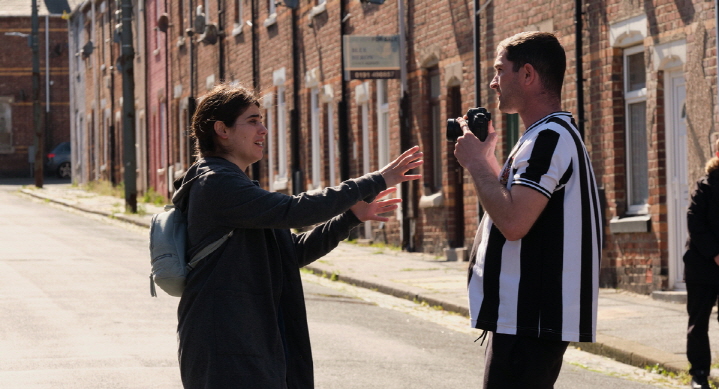
Of course, the tension rises more in the town because of the hate and prejudice against Yara and other refugees. TJ has been struggling to run his little local pub for years, so he often depends a lot on his remaining customers who frequently come to his pub, but some of his regular customers do not hesitate to show their resentment and bigotry against the refugees. Mainly because 1) he does not want any more trouble and 2) he understands well where these disagreeable people’s hate and prejudice come from, TJ does not respond much to their rude and detestable behaviors at first, but then they continue to annoy and exasperate him more and more as he keeps trying his best for both his pub and the refugees.
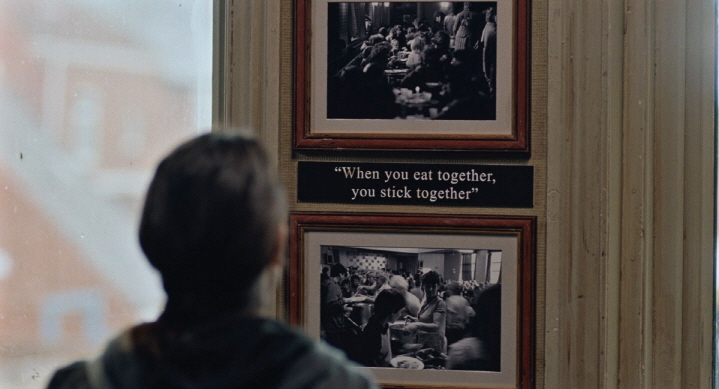
Meanwhile, we get to know more about TJ’s melancholic life of solitude. His wife left him along with their son some years ago because he often cared more about others instead of them, and he was more devastated when his dear father, who shot many of old photographs kept in a big room of his pub, died a few years ago. As a man who managed to avoid the worst thanks to a little accidental happening, he naturally empathizes with the refugees’ grim situation to some degree, and he becomes more determined to help and support them even after he is struck by another loss later in the story.
What follows next is a series of little heartwarming moments as TJ, Yara, and several others work together for turning that big room of his pub into a new public place for not only the town people but also the refugees. They somehow acquire enough money and help from here and there for their little project, and, what do you know, that abandoned empty place becomes a precious spot of generosity and solidarity once it is opened for everyone in the town.

Not so surprisingly, we also come to sense troubles more from some of TJ’s regular customers, who still do not want to see their last public space in the town being filled with, well, outsiders. What eventually happens next will not surprise you much, but it is really saddening and infuriating to see how hate and prejudice cause more misery and unhappiness, and you may not mind at all when Loach and his frequent screenplay writer Paul Laverty express their feelings and thoughts directly to us via a certain big moment of speech around the last act of the story. This is surely a bit too blatant, but, considering how much our world has been damaged by hate and prejudice during last several years, I will not deny that the message feels quite important nonetheless.
As usual, Loach draws good natural performances from his main cast, most of whom are relatively unknown performers or non-professional ones. While Dave Turner ably anchors the movie with his low-key acting, Ebla Mari brings warmth and spirit into her character, and she has her own lovely little moment when she gets a chance to look around the interior of an old cathedral outside the town. I must point out that the following scene between her and Turner feels like Loach and Laverty lecturing more on us, but Mari handles this scene with enough sincerity at least, and Turner dutifully supports her as before.
In conclusion, “The Old Oak” is relatively less impressive than Loach’s recent films “I, Daniel Blake” (2017) and “Sorry We Missed You” (2019), but it still works enough to engage and then touch us besides being a quintessential Ken Loach film. Considering that he has steadily advanced as making one interesting film after another for more than 50 years since his first feature film “Poor Cow” (1967), it is really a shame that this great British filmmaker will supposedly be retired after “The Old Oak”, but he gives us one last movie to be appreciated and admired at least, and that is surely a good thing for us for now.


 Seongyong's Private Place
The guy in the picture who breaks Yara’s camera is wearing a Newcastle United football shirt. I wondered how he might be feeling now about his team being owned by the Saudi Public Investment Fund.
SC: Amusing…
Pingback: 10 movies of 2024– and more: Part 2 | Seongyong's Private Place