
I must confess that it took some time for me to appreciate more of that immense talent of Albert Brooks. When I was just a young South Korean moviegoer a long time ago, he seemed to me like a merely good American comedian who had sometimes drawn my attention via a series of solid movie performances including his stellar (and sweaty) Oscar-nominated turn in James L. Brooks’ “Broadcast News” (1987), but I gradually came to admire his long and illustrious career as getting to know more about his old and new achievements during next several years.
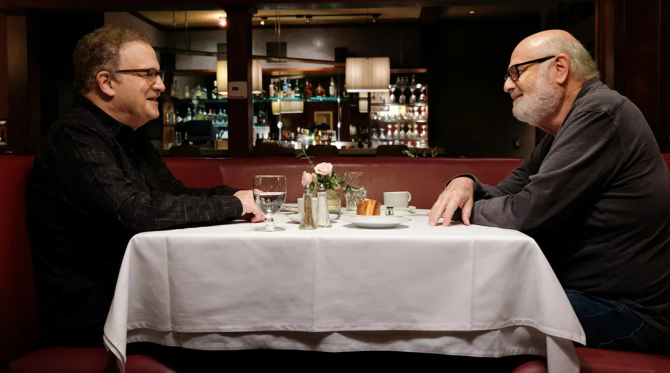
In HBO documentary film “Albert Brooks: Defending My life”, Brooks surely has lots of things to tell as casually talking with his longtime friend Rob Reiner, who also serves as the director/co-producer of the documentary. As a matter of fact, Brooks and Reiner were already close to each other when they were studying at the same high school in Beverly Hills, California along with the kids of many different Hollywood celebrities ranging from Groucho Mark to Lee J. Cobb, and they were no exception at all in case of their family background. As many of you know, Reiner is the son of legendary comedy writer Carl Reiner, and Brooks is the son of Harry Parke, a radio comedian star who was also known as “Parkyakarkus”.
Probably because of his real surname which I will not reveal here for not spoiling a good laugh for you, Brooks was always ready to go for laughs even when he was just a teenager, and his comic talent even impressed Reiner’s father a lot as both he and Reiner fondly remember. Eventually, he went all the way for comedy just like his father when he subsequently entered adulthood, and a number of archival footage clips from his early career show us how much he was willing to go for more laughs in his own distinctive comic methods. While often quite silly and outrageous, his comic tactics were always accompanied with wit and intelligence behind all those absurdities of his, and that surely makes many of his comedy sketches not only richer but also timeless.

As he drew more attention as a young promising comedian to watch, Brooks started to appear in a number of major TV shows including NBC’s The Tonight Show Starring Johnny Carson, where he never disappointed his audiences at all whenever he appeared as a special guest. Believe or not, he seldom tested or practiced most of those comic sketches of his in advance, and that certainly tells us a lot about how unhesitant he was for taking risks for spontaneously comic moments to tickle his audiences.
Just like many other comedians, Brooks certainly had his own anxiety and security behind his comic persona. As the son of a famous comedian whose death was absurdly legendary to say the least, he definitely had to try a lot for proving his own talent to others, and he also had a rather strained relationship with her mother, which is incidentally incorporated into his little comedy film “Mother” (1996). While quite frank about the emotional distance between him and his mother, Brooks knows how to tell his personal story with some sharp sense of humor, and I was particularly tickled by an anecdote involved with his mother’s simple wish about her funeral.
The second half of the documentary mainly revolves around Brooks’ movie career, and that is where it will become more interesting for anyone familiar with his movies. After making his first feature film “Real Life” (1979), Brooks impressed critics and audiences more with “Lost in America” (1985) and “Defending Your Life” (1991). In case of the latter, Brooks plays a guy who comes to reflect a lot on his whole life after he suddenly dies and then is transferred to a state of afterlife, and I strongly suggest you that you should check out this little gem which is also one of the most hilarious and intelligent movies about life and humanity.

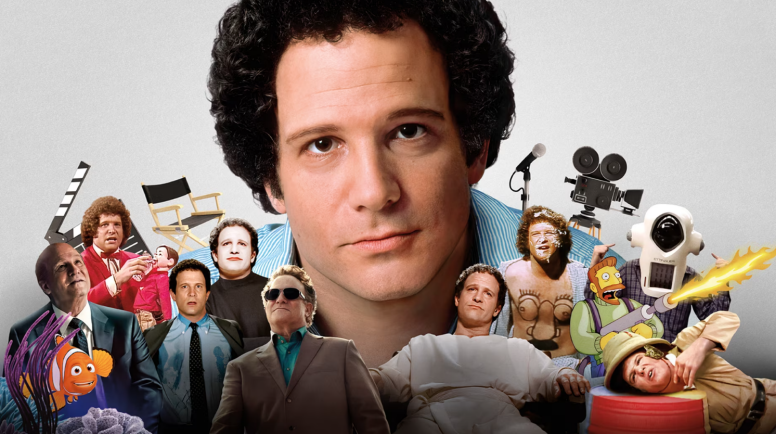
After “Mother”, “The Muse” (1999), and “Looking for Comedy in the Muslim World” (2005), Brooks became less prominent as a filmmaker, but he steadily worked as a versatile character actor to be appreciated. While he continued to show his usual comic talent here and there as shown from his funny guest performance in HBO comedy series “Curb Your Enthusiasm”, he also demonstrated a more serious side of his acting talent in Nicholas Winding Refn’s “Drive” (2011), and it is really a shame that he was not Oscar-nominated again for his chillingly against-the-type villain performance despite receiving the enthusiastic recognition from several major film critics associations including the National Society of Film Critics.
While it is constantly fun and amusing to see the frequently comic interactions between Brooks and Reiner, Reiner also assembles a bunch of various interviewees ranging from David Letterman and Conan O’Brien to James L. Brooks and, surprise, Steven Spielberg, who actually often hanged around with Brooks when they were starting their respective careers during the early 1970s. All of these interviewees in the documentary have each own interesting story to tell about Brooks, and that surely makes the documentary all the more engaging.
On the whole, “Albert Brooks: Defending My Life” is a splendid documentary which will show a lot about Brooks’s life and career, and you will come to admire his undeniable talent more like I did after watching this entertaining documentary. He is indeed one of the best comedians of our time, and we should cherish his singular talent as long as we can.


 Seongyong's Private Place