

Documentary film “Little Richard: I Am Everything” looks around the life and career of Little Richard, who has been regarded as the ground-breaking pioneer of American Rock and Roll music. As looking beyond his legendary flamboyance, the documentary illuminates an energetic but conflicted man who had a fair share of ups and downs as struggling with his sexual identity in addition to being often underappreciated throughout his lifetime, and you will surely come to appreciate more of his significant artistic contribution to the American pop music of the 20th century.
Little Richard was born to a poor African American family in Georgia, 1932. Even when he was very young, Richard, who was Richard Wane Penniman during that period, often demonstrated his considerable musical talent, and he surely helped his minister father a lot at not only his church but also his little illegal business spot, though his father sternly disapproved of how he often looked feminine and flamboyant.
In the end, Richard eventually left his family home for working along with a various number of traveling black musician groups, and he became more comfortable with his sexual identity as he and many other black queer musicians were accepted more inside their free-wheeling artistic community. As a matter of fact, Richard even willingly performed as a drag queen at times, and that was certainly an interesting part of his early career period.

Meanwhile, Richard came to draw more attention as a young and talented musician to watch, and then there came an accidental breakthrough which boosted his career much more than he and others ever imagined. In 1955, he recorded “Tutti Frutti” with his own free style, and, what do you know, this became an immense hit not only inside but also outside black community. As a result, his name and music were widely spread around the whole country, and he soon found himself receiving the feverish adoration of thousands of black girls as well as white girls.
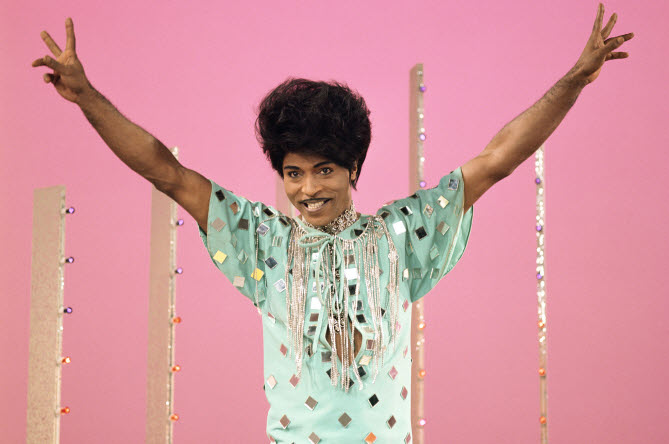
Ironically, Richard was allowed to be pretty and flamboyant on the stage during that time mainly because of his race and sexual identity. While intensely exuding sexuality in front of his audiences all the time, he was mostly regarded as a non-threatening oddball to white people, and that was how he could freely ride on his big success during the 1950s. When he eventually found his music and style being appropriated by major white musicians such as Pat Boone or, yes, Elvis Presley, he intentionally dialed up his performance for more intensity, and the result was pretty astounding to say the least.
However, behind all the exaggerating flamboyance of his, Richard was frequently conflicted about his sexual identity. He subsequently presented himself as a born-again Christian, and he also tried on married life as marrying Ernestine Harvin in 1959. Nevertheless, his sexual confusion, mainly fueled by his Christian upbringing, always followed him throughout his life, and the documentary details on how he often swung back and forth between his Christian background and sexual identity during next several decades. As one interviewee in the documentary points out, it is really ironic that he could not liberate himself that much even though his music has liberated so many LGBTQ+ people out there.
Anyway, Richard’s music continued to influence numerous different musicians ranging from the Beatles to David Bowie, whose flamboyantly androgynous appearance certainly owes a lot to Richard’s. When he made a comeback in London in the early 1960s, Richard actually met the Beatles when they were just newcomers who still had to prove themselves more, and he surely impressed and inspired these British lads a lot as showing the way toward their eventual success.

During the 1980s, Richard became less prominent than before, but he often reminded others that he would not just go away at all. Due to a very unfortunate accident, he missed the opportunity to attend a very special ceremony for him and several other giants of American Rock and Roll music, and he surely felt hurt about that, but he kept going like a trouper. In the end, he came to receive some overdue recognition in the 1990s, and there came a touching moment when he eventually received the American Music Award of Merit in 1997.
Around the time before his death in 2020, Richard got swung back to his Christian background as being aware of his imminent mortality, but several interviewees in the documentary including Billy Porter and John Waters still appreciate Richard’s considerable contribution to their LGBTQ+ community. He might never be totally comfortable with being himself, but he inspired and motivated other queer people a lot instead, and that deserves to be regarded as one of his significant legacies.
Overall, “Little Richard: I Am Everything”, directed by Lisa Cortés, presents its human subject with enough care and respect, and I enjoyed some nice visual touches for vividly conveying to us how Richard often electrified stages and audiences during his prime period. While it could show more, the documentary is still fairly engaging in addition to giving us a good overview on Richard’s life and career, and it is certainly worthwhile to watch if you are not so familiar with his music.


 Seongyong's Private Place