
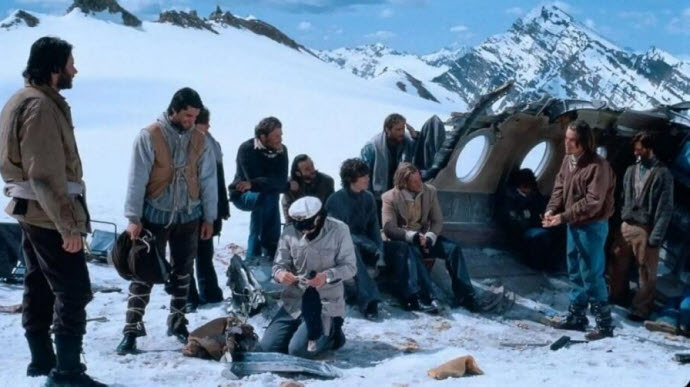
What would you do under a situation as grim and extreme as whatever the survivors of the Andes Flight Disaster experienced in 1972? This is surely a hard and difficult question, and Netflix film “Society of the Snow”, which was released on last Friday, throws its thought-provoking main question with full respect and no compromise. While never overlooking a certain disturbing choice made by these survivors during that gloomy period of survival, the movie goes for something nearly impossible, and it accomplishes its daunting goal mostly well with enough mood and intensity to hold our attention during its rather long running time (144 minutes).
The opening part of the film shows how everything seemed fine and well to the passengers of Uruguayan Air Force Flight 571 on October 13th, 1972. Along with a bunch of families members, friends, and supporters of theirs, the team members of an Uruguayan rugby team were supposed to have a good time once they arrived in Santiago, Chile, and the passengers were not concerned that much when their airplane was about to pass the Andes, because they were already told about how risky their flight could be due to the frequent turbulence over those high mountains of the Andes.
Unfortunately, mainly because of the inexperienced its co-pilot, the airplane crashed onto a wide and remote field in the middle of the Andes, and the movie jolts us with a terrifying sequence which vividly presents the crash course of the airplane on the screen. It is quite evident that the movie uses lots of special effects here, but the overall result is pretty intense and scary to say the least, and we come to brace ourselves more because we are already well aware of what will happen next to the survivors, who gradually come to face how hopeless and despairing their situation is in many aspects.

The screenplay by director/co-producer J.A. Bayona, who is mainly known for his Oscar-nominated film “The Impossible” (2012), and his co-writers Bernat Vilaplana, Jaime Marques, and Nicolás Casariego, which is based on the nonfiction book of the same name by Pablo Vierci, slowly and steadily rolls its characters’ increasingly desperate circumstance. Although some of the initial survivors died due to injury and extreme cold weather, the survivors kept hoping for the best while trying to survive day by day in addition to searching for any chance for getting rescued. As they stuck together under a guy who became their de factor leader, there seemed to be some possibility for rescue, and they managed to acquire a radio which would tell them what was going on outside, but, alas, they later became quite despaired when a radio news told them that the following search would be suspended for a while.
In the meantime, they kept getting hungrier in addition feeling colder, and something quite unthinkable inevitably came to their mind. The movie handles the characters’ ghastly inner conflict over their impossible situation with enough thoughtfulness and restraint, and it thankfully does not delve too deep into their following act of cannibalism on those dead people while never looking away from their horror and shame about that. They surely felt disgusted and conflicted at first, but, once they set their own moral lines for their exceptional circumstance, they soon got more accustomed to that in the name of surviving a few more days at least.
Nevertheless, the situation remained as grim as before, and Bayona and his crew members including cinematographer Pedro Luque did a commendable job of filling the screen with the overwhelming sense of isolation and despair. Although the film was mostly shot in Spain, its background details look pretty convincing enough on the whole, and the main cast members of the films, most of whom are newcomers from Argentine and Uruguay, really look like living through the extreme conditions surrounding their characters – especially when their characters are suddenly attacked by a couple of avalanches in the middle of the story.

In the end, the remaining survivors decided to try more when the weather on the Andes got milder a few months later, and two of them eventually succeeded to rescue not only themselves but also other survivors after enduring an arduous journey across the Andes. Even at that narrative point, the movie restrains itself from any cheap sentimentalism, and the score by Michael Giacchino sticks to its low-key attitude as before. They survived, and they were certainly glad and relieved for that, but, as reflected by the bittersweet reflective tone of the last scene of the film, they had to live with the cost for their survival while sharing the real understanding on their extreme experience only with each other.
As many of you know, the story of the survivors of the Andes Flight Disaster has been the main subject of a bunch of movies and documentaries before “Society of the Snow”. The most famous one is Frank Marshall’s 1993 film “Alive”, and there was also René Cardona, Jr.’s Mexican exploitation flick “Survive!” (1976) before that. I still remember Gonzalo Arijón’s excellent documentary film “Stranded” (2007), and it reminded me that the Andes Flight Disaster is more suitable for documentary than movie for several good reasons.
While it may not be better than “Stranded”, “Society of the Snow”, which was selected as the Spanish submission to Best International Film Oscar in last year (it was recently included in the shortlist, by the way), is more compelling than “Alive” at least for its vivid and effective docudrama approach. Yes, it is indeed a tough stuff to watch, but the movie surely tries its best for handling its tricky story materials, and I admire its considerable achievement even though I cannot possibly say that I was, well, entertained.


 Seongyong's Private Place
Pingback: My Prediction on the 96th Academy Awards | Seongyong's Private Place
Pingback: 10 movies of 2024– and more: Part 2 | Seongyong's Private Place