

Emerald Fennell’s second feature film “Saltburn”, which is currently available on Amazon Prime, is as disturbing and vicious as its very title suggests. Following one young man’s insidious journey into the isolated world of wealth, ennui, and decadence, the movie often wields its nasty wit upon its story and characters, and we observe this with morbid fascination from the distance.
The story, which is initially set in 2006, begins with how its hero Oliver Quick (Barry Keoghan) happens to befriend a rich upper-class boy named Felix Catton (Jacob Elordi) during their final year at the Oxford campus. As a nobody who has been depending on a scholarship, Oliver has been eager and desperate to get any popular friend, but Felix and his rich buddies seem to be out of his reach while Oliver only finds himself stuck with some nerdy lad who is as unpopular as him.
Anyway, Oliver later comes to draw the attention of Felix via one small lucky incident, and it does not take much time for Oliver to draw more attention from Felix, who becomes more curious about Oliver during their subsequent encounter. As Oliver eagerly presents more of himself to Felix, Felix gladly lets Oliver get along with him and his inner circle members including his American cousin Farleigh Start (Archie Madekwe), who understandably regards Oliver with subtle hostility and contempt because he has already seen through what is going on between Oliver and Felix.
Not long after their final year at the Oxford Campus is over, Felix suggests that Oliver should stay some time at his family manor, and Oliver has no problem with that, but he soon comes to see how awkward he will be among Felix and his family members. Right from when he arrives their family manor, Oliver is coldly handled and served by their stern butler (Paul Rhys is very good while implying a lot via his mostly unflappable attitude and appearance, by the way), and he feels all the more uncomfortable as having the following formal dinner along with Felix and his family members.

Felix’s family is certainly your average snobbish rich British people. While Felix’s father, Sir James (Richard E. Grant), is pretty haughty to say the least, Felix’s mother, Lady Elspeth (Rosamund Pike), is quite a self-absorbed woman living in her own world who occasionally shows some superficial care to others around her, and Felix’s younger sister, Venetia (Alison Oliver), is apparently tired of being stuck with her family although, just like his family, she does not know how she can possibly live outside their cozy isolated world.
And there is Farleigh, who has to depend on the family’s generosity as long as possible just like Oliver. He does not hesitate to point out how fragile and facile Oliver’s status is in the Catton manor, and we come to sense more of tension him and Oliver as bright hot summer days languidly pass by around them and others in the manor.
Meanwhile, the situation becomes weirder and darker as Oliver gradually comes to show his true colors to us along the story, and Fennell’s story consequently becomes a deranged cross between Evelyn Waugh’s “Brideshead Revisited” and Patricia Highsmith’s “Talented Mr. Ripley”. As Oliver gets himself deeper into the daily life of the Cattons, he begins to manipulate many of them in one way or another, and he even seems to be emotionally attracted toward some of them including Felix. At one point, we get a truly perverted (and disgusting) moment showing whatever he is feeling toward Felix, and that is just the beginning of a parade of moments filled with sexual perversion and debauchery.

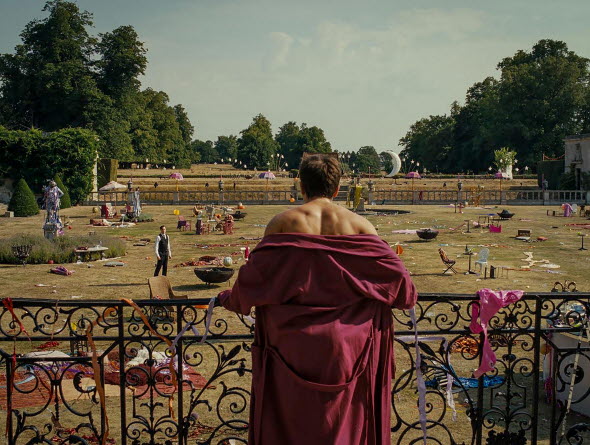
Even around that narrative point, the movie sticks to its cold and distant attitude without giving us anyone to care about, but it steadily holds our attention thanks to Fennell’s competent handling of humor and morbidity. The result feels a little overlong and sprawling at times in my consequential opinion, and her screenplay stumbles more than once during its third act, but Fennell and her crew members including cinematographer Linus Sandgren, who won an Oscar for Damien Chazelle’s “The La-La Land” (2016), diligently serve us striking visual moments to remember. We find ourselves more immersed into its main background just like its increasingly unnerving hero, and we become more disturbed as discerning more of how he is as horrible as those rich people surrounding him.
The performances in the film are the main reason why the movie is worthwhile to watch. Barry Keoghan, who has been always good at playing odd or disturbing characters as shown from his recent Oscar-nominated supporting turn in Martin McDonagh’s “The Banshees of Inisherin” (2022), boldly goes all the way for showing more of his own distinctive presence and talent, and he is also supported well by several good performers surrounding him. While Jacob Elordi, Alison Oliver, and Archie Madekwe hurl themselves into their youthful but ultimately superficial supporting characters, Richard E. Grant and Rosamund Pike savor every snobbish moment of theirs in the film, and Carey Mulligan, who previously collaborated with Fennell in “Promising Young Woman” (2020), effortlessly steals the show during her brief appearance.
On the whole, “Saltburn” is Fennell’s another interesting work after her first feature film “Promising Young Woman”, which incidentally garnered her a Best Screenplay Oscar. To be frank with you, I do not think “Saltburn” is better than “Promising Young Woman”, but both of them show Fennell as a distinctive filmmaker to watch, and I am already waiting for whatever will come next from her.


 Seongyong's Private Place