
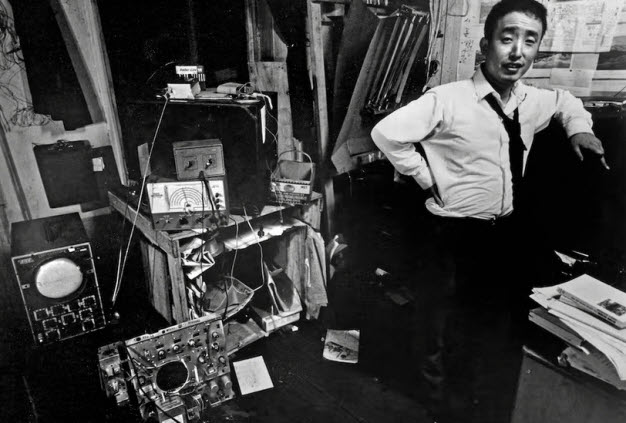
I remember an old local TV commercial featuring Nam June Paik and one of his artworks. Although I was just a little boy when I came across it in the early 1990s, what was shown from that local TV commercial impressed me a lot for the striking appearance of that artwork of his, and that is the main reason why I was often fascinated as observing what is interestingly presented in documentary film “Nam June Paik: Moon Is the Oldest TV”. Although I knew a bit about his artistic career, the documentary shows a lot more than I knew, and I certainly had a fair share of enlightenment during my viewing.
The early part of the documentary focuses on how much Paik struggled during the early years of his artistic career. Born to a very affluent family in South Korea, young Paik was expected to follow his rich businessman father’s footsteps someday, but he defiantly chose to pursue his growing interest in art instead, and he eventually left South Korea for studying in Munich, Germany in 1956. While studying music and philosophy there, he had some difficult times as trying to find his own artistic style, and the excerpts of his old writings, narrated by co-executive producer Steven Yeun, give us more details on that hard time of his.
And then there came an unexpected moment of inspiration when he went to see a little concert by famous American avant-garde composer John Cage on one day. As beholding how freely daring Cage was in breaking many rules and conventions, Paik became quite inspired to do his own things without any hesitation, and he soon came to draw considerable attention as he valiantly threw himself into a series of acts of performance art including destroying a piano on the stage. I must confess that I still do not totally get the meaning of this performance art of his, but I can tell you at least that it did leave some indelible impression on me for his youthful boldness.
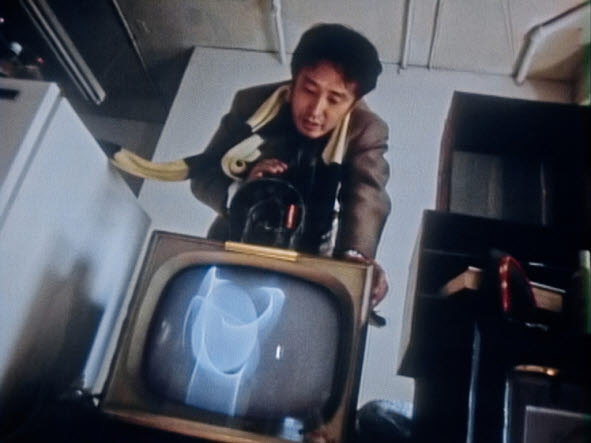
While pushing himself further, Paik later got interested in the artistic possibility in TV, and he began some early artistic experiments with a bunch of TVs before eventually moving to New York City for more artistic exploration in 1964. As he created a number of artworks made from TVs and other electronic stuffs, he surely drew a lot of attention from his fellow artists in the city as well as local critics and curators, but his artworks were mostly not appreciated much on the whole. As a matter of fact, many of his artistic outputs including the one associated with the very title of the documentary were not received that well by many major critics, and we get some nasty amusement from several scathing reviews on his artistic outputs during that period.
Not so surprisingly, Paik found himself struggling more in one way or another during next several years, and we hear a bit about how he and his Japanese spouse managed to live day by day without any stable source of income. He often had to depend on the generosity of his friends and supporters, and there is an amusing letter on how he could take care of his daily meal with only 10 dollars during next few weeks.
Nevertheless, Paik did not give up at all, especially after being encouraged and supported more by Cage, who had always been a close friend/colleague of his since they met each other after that little concert in Munich. He tried harder and harder for acquiring any kind of grant, and there is a rich irony in how one of his prominent detractors during that time came to help him in the end.
Once he got the grant at last, Paik went on full throttle mode, and that eventually led to his first major experiment with video art in public. Again, the reviews on this artistic experiment of his were mostly negative to his disappointment, but Paik became more confident about his artistic vision, and the documentary makes a strong point on how Paik’s artistic experiment came to influence a number of famous music videos during the 1980s such as the one for Talking Heads’ “Once in Lifetime”.
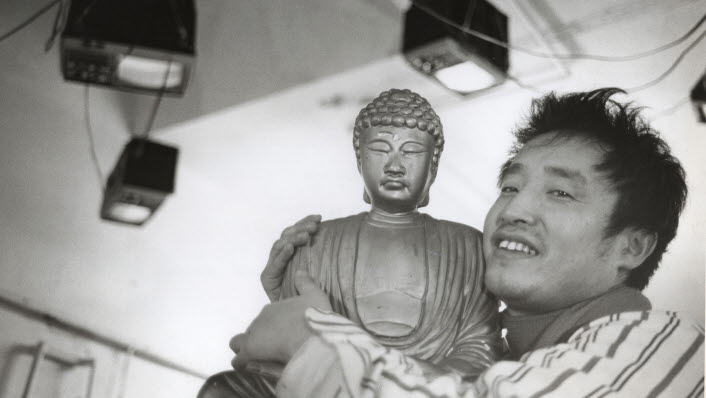
In the early 1970s, there came a purely coincidental breakthrough for Paik. Not long after having his 41st birthday in 1973, he happened to buy a Buddha statue just for amusement, and, what do you know, this led to the creation of “TV Buddha”, one of the most famous and successful works in his career. Thanks to its big critical success, he rapidly rose as the leading pioneer of video art, and that was followed by a number of major projects including the global satellite broadcast of “Good Morning, Mr. Orwell” in 1984. Although this project was technically pretty disastrous from the beginning to the end, it further solidified Paik’s prominence in public, and now he was welcomed everywhere including South Korea, though he was reluctant to visit his home country for understandable reasons.
Around the 1990s, Paik became less active due to his declining health, but he kept going as a dedicated artist, and he also saw how communication technology advanced as much as he envisioned in his artworks. As a matter of fact, he already imagined how our world would feel much smaller via what he called “Electronic Superhighway” at that time – and how much we would often feel lost and confused during our current digital era. If he were still alive now, he would not be surprised that much by what is happening on the Internet everyday.
While it does not delve that much into Paik as a human being, “Nam June Paik: Moon Is the Oldest TV”, directed by Amanda Kim, gives us an engaging presentation on Paik as an innovative artist, and it did a commendable job of mixing heaps of informative archival materials with a bunch of various interview clips. The technology behind many of his artworks may look quite dated at present, but his artistic ideas remain fresh as before, and the documentary will probably make you more interested in exploring his fascinating artworks out there.


 Seongyong's Private Place