

Pedro Almodóvar’s short film “Strange Way of Life”, which is incidentally his second English-language work after his previous short film “The Human Voice” (2020), is a little gay western as colorful and melodramatic as you can expect from its genre and Almodóvar. Although the story and characters are rather thin in my humble opinion, it is clear that Almodóvar has a small and simple fun along with his two leading actors, and that is mostly enough for me at least for now.
The story premise is pretty familiar except that the homoerotic subtext of many western films is fully unclothed here. The two heroes of the film, Jake (Ethan Hawke) and Silva (Pedro Pascal), were actually lovers when they were young and wild many years ago, but things have changed a lot since they came to part their ways not long after those two months of their passionate romance. While both of them do not work as hired guns anymore, Jake is now working as the sheriff of some small desert town, and Silva works as a plain worker of some horse ranch located somewhere far from Jake’s town.
During the opening scene, we see Silva silently arriving at the town while a singer performs a rather melancholic song on the main street, and the mood becomes less moody when he subsequently meets Jake. Despite all those years of separation, both of them still cannot help but feel love and attraction as they talk with each other, though they do not dare to show their hidden feelings in front of others outside. Once they have a dinner together at Jake’s house, the mood between them becomes a bit more relaxed between them, and it does not take much time for them to be driven by that old passion palpitating inside their hearts.

However, there is another reason for why Silva comes to Jake besides his deep desire and affection toward Jake. As shown from an earlier scene between Jake and one of those town people, somebody was killed in the town, and the victim was none other than the wife of Jake’s older brother. Because he promised to his old brother that he would take care of his older brother’s wife after his older brother’s death, Jake is quite determined to find and arrest who was responsible for her death, and the prime suspect turns out to be Silva’s estranged rogue son. Knowing that his son is in a big trouble now, Silva is going to ask Jake to let his son get away from the town, but that makes Jake all the more determined to stick to his code of honor, and the situation consequently becomes much more tense between them than before.
While this is surely an interesting narrative setup which could be expanded into a feature film along with more story and character development, Almodóvar keeps everything in his story simple and succinct. We get a brief flashback scene which shows a bit of Jake and Silva’s past romance, and we observe how both Jake and Silva are still haunted by the old memories their good old romantic time as they go each own way for dealing with their impending issue. Although they are going to clash with each other in one way or another, they still care much about each other, and that is the main reason why the following climax works on the emotional level.
While the overall result is less flamboyant compared to many of his works, the film often shows Almodóvar’s distinctive artistic touches. He occasionally uses bright colors in the production design and costumes of the film, and that surely brings some style and personality to your average dry western atmosphere. In addition, the score by his longtime collaborator Alberto Iglesias, which sometimes evokes the more tender sensibility of Ennio Morricone’s western scores, subtly and constantly underlines the emotional undercurrents below the screen, and it is definitely another highlight to be added to many fruitful collaborations between him and Almodóvar.
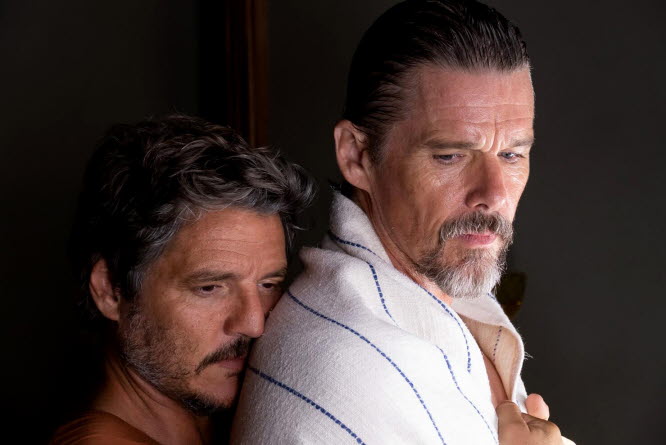
Above all, the movie is anchored well by the strong presence of two charismatic actors. Ethan Hawke, who has been one of the most interesting American actors to watch for more than 30 years, effectively embodies his character’s growing emotional conflicts along the story, and his low-key performance is complemented well by the more expressive acting by Pedro Pascal, a wonderful actor who has shown more of his talent during last several years since his crucial supporting part in the fourth season of HBO drama series “Game of Thrones”. Right from their first scene, we can instantly sense a long history between their characters, and Hawke and Pascal never miss a beat as their characters tentatively revolve around each other before eventually arriving at the inevitable point where they have to confront their matters of heart again.
In the end, the movie comes to us as a mild test run on its genre by Almodóvar, who was incidentally offered to direct “Brokeback Mountain” (2005). Considering how unadorned and restrained that classic queer western drama is, he was wise to decide that it was not exactly a right stuff for him, and “Strange Way or Life” may give you a glimpse on how he would have made “Brokeback Mountain”.
On the whole, “Strange Way of Life” is less impressive and interesting compared to “The Human Voice” or Almodóvar’s recent acclaimed works such as “Pain and Glory” (2019) or “Parallel Mothers” (2021), but it is still worthwhile to watch as another distinctive work of his. It is not very good, but it interested and engaged me to some degree at least, so I will not grumble for a while.


 Seongyong's Private Place